
Unbiased headlines. Facts, not spin.
Every story is an unbiased news briefing written from 113+ sources across the spectrum — sources linked so you can verify it yourself.
 politics
Major Story (7/10)
Event date: September 25, 2026
politics
Major Story (7/10)
Event date: September 25, 2026
Education Department Cut Nearly Half Its Civil Rights Staff. Disabled Students Are Waiting Longer for Answers
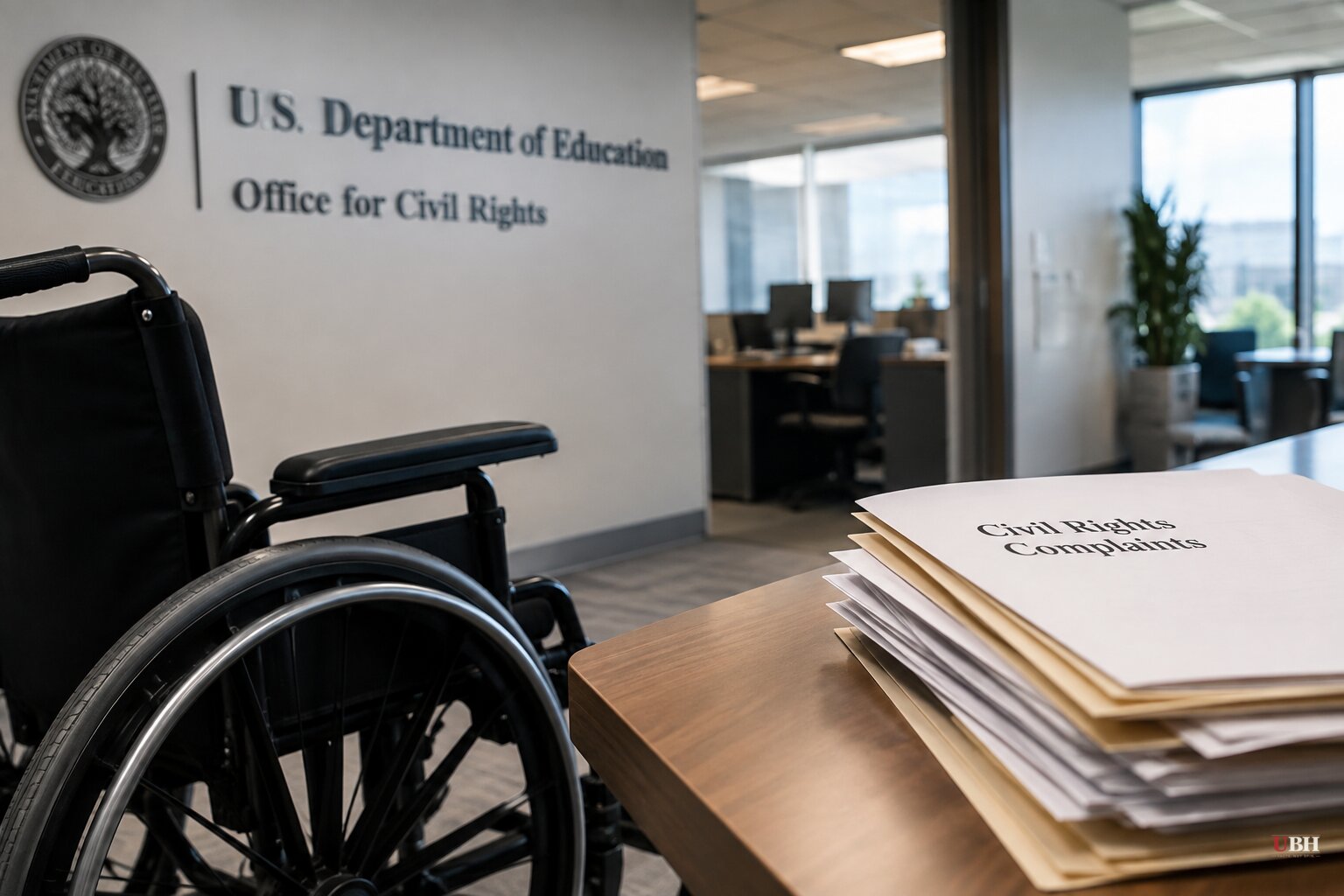
Liz Piñón's daughter Felicita weighed one pound at birth. She was later diagnosed with cerebral palsy, uses a power wheelchair, and testified at the Texas Capitol against a school voucher bill in 2025. In 2024, when Felicita wanted to join the cheerleading team at her Crowley, Texas, middle school, her mother says the school wouldn't make accommodations she believed federal disability law required. She filed a complaint with the Education Department's Office for Civil Rights, according to reporting by The Conversation's David Edward DeMatthews, republished by PBS and other outlets.
The complaint was rejected in July 2024, months before President Trump took office. The Office for Civil Rights, known as OCR, was already dismissing large numbers of complaints before any budget cuts hit. Piñón told DeMatthews that families used to at least get confirmation their complaint was received and being reviewed. Now, she says, that follow-up often doesn't happen even after a case is closed.
The Numbers Behind the Cuts
In March 2025, the Education Department cut nearly half its workforce, including an estimated 299 of OCR's 575 positions, according to figures compiled by Ground News. Seven of OCR's twelve regional branches were permanently closed, including offices in Atlanta, Boston, Cleveland, Chicago, Dallas, Philadelphia, and San Francisco.
The Government Accountability Office found that about 90% of disability complaints the Education Department labeled "resolved" were actually dismissed without any investigation. That statistic predates the layoffs in some cases and postdates them in others, but disability advocates say the trend has accelerated since the restructuring.
DeMatthews, a University of Texas professor who previously worked as a teacher and administrator in Baltimore and Washington, D.C., has spoken with parents, advocates, and school officials who worry the cuts leave nobody to catch cases when states and districts fall short on special education law. Disability rights under Section 504 and the Individuals with Disabilities Education Act are statutory obligations, not a discretionary equity program. Fewer investigators means longer waits and, in practice, fewer complaints ever getting a real look.
A Separate Fight Over Desegregation Orders
At the Justice Department, a parallel rollback is underway. The Civil Rights Division, led by Assistant Attorney General Harmeet Dhillon, has moved to dismiss desegregation cases that in some instances have sat on federal court dockets for more than 60 years. The department announced it had closed more than 50 such cases since Trump took office, according to the Daily Signal, with dismissals already granted in Tuscumbia, Alabama; St. Clair County, Alabama; Tarrant, Alabama; Rankin County, Mississippi; and Dyersburg, Tennessee.
About 150 school districts, mostly in the South, remained under active desegregation orders when Trump took office. Dhillon says continuing federal oversight of districts that achieved "unitary status" decades ago no longer reflects reality on the ground. A DOJ official told the Daily Signal that compliance typically costs districts a few thousand dollars a year in statistical reporting and court motions, but that a handful of districts, including Huntsville and Jefferson County, Alabama, have spent hundreds of thousands to millions of dollars in legal fees and facility changes tied to the orders.
Taxpayers in those districts have concerns about paying legal bills for court oversight of schools their grandparents attended under segregation. Whether every one of those 150 districts has actually achieved the integration the courts were watching for is the harder question, and the Justice Department's case-by-case review process doesn't make that determination public in a way outsiders can independently verify.
Disparate Impact Goes Away Too
The Education Department also rescinded a regulation this summer that let schools measure potential discrimination by comparing outcomes across racial groups, such as which students land in advanced classes, according to reporting by the Associated Press carried on Breitbart. The department followed with a letter telling schools it's illegal to factor race into discipline policy even when one racial group is suspended or expelled more often than others.
Education Department spokesperson Sabin Sidney said the Obama and Biden administrations "weaponized disparate impact by effectively coercing schools to discipline students differently based on race in order to engineer equitable disciplinary outcomes across racial groups," adding that the practice "led to unsafe classrooms and undermined student learning." The administration's defense lines up with a straightforward colorblind-law position: judge policies by intent and equal application, not by whether the numbers come out even.
Rep. Bobby Scott, D-Va., took the opposite view, telling the AP that returning enforcement to the states amounts to "returning to how it was before 1954," when school segregation was legal. Disparate impact theory has always been contested precisely because it doesn't require proof of intentional discrimination, only a statistical gap, which is exactly why the administration says it was ripe for abuse and exactly why civil rights groups say it caught discrimination that colorblind rules would otherwise miss.
What's Still Unresolved
A separate legal development landed this past week. On September 24, 2026, a federal judge ruled in Texas v. Kennedy to strike down the community integration provisions of a 2024 Section 504 rule from Health and Human Services, applying nationwide, according to a statement from the American Association of People with Disabilities' Defend Community Integration Coalition. The coalition called the ruling a rollback of federal commitment to keeping disabled people out of institutions and urged renewed advocacy; the ruling's full legal reasoning wasn't detailed in available reporting.
When a district denies a wheelchair-bound student a spot on the cheerleading squad, who investigates now that seven regional OCR offices are gone and 90% of disability complaints get closed without a look? The Education Department hasn't announced plans to reopen the shuttered offices or restaff OCR to pre-2025 levels, and no congressional action to do so has passed as of this writing.
Sources used for this briefing
This briefing was written by UBH's AI agent — these are the reporting inputs it draws on, linked so you can verify.


