
Original briefings. Zero spin.
Every story is an original briefing written from 110+ sources across the spectrum — sources linked so you can verify it yourself.
 defense
Notable (6/10)
Event date: September 8, 2026
defense
Notable (6/10)
Event date: September 8, 2026
NASA Hands 71 Artemis Nations a Common Data Standard While China and Russia Build a Separate Moon Network
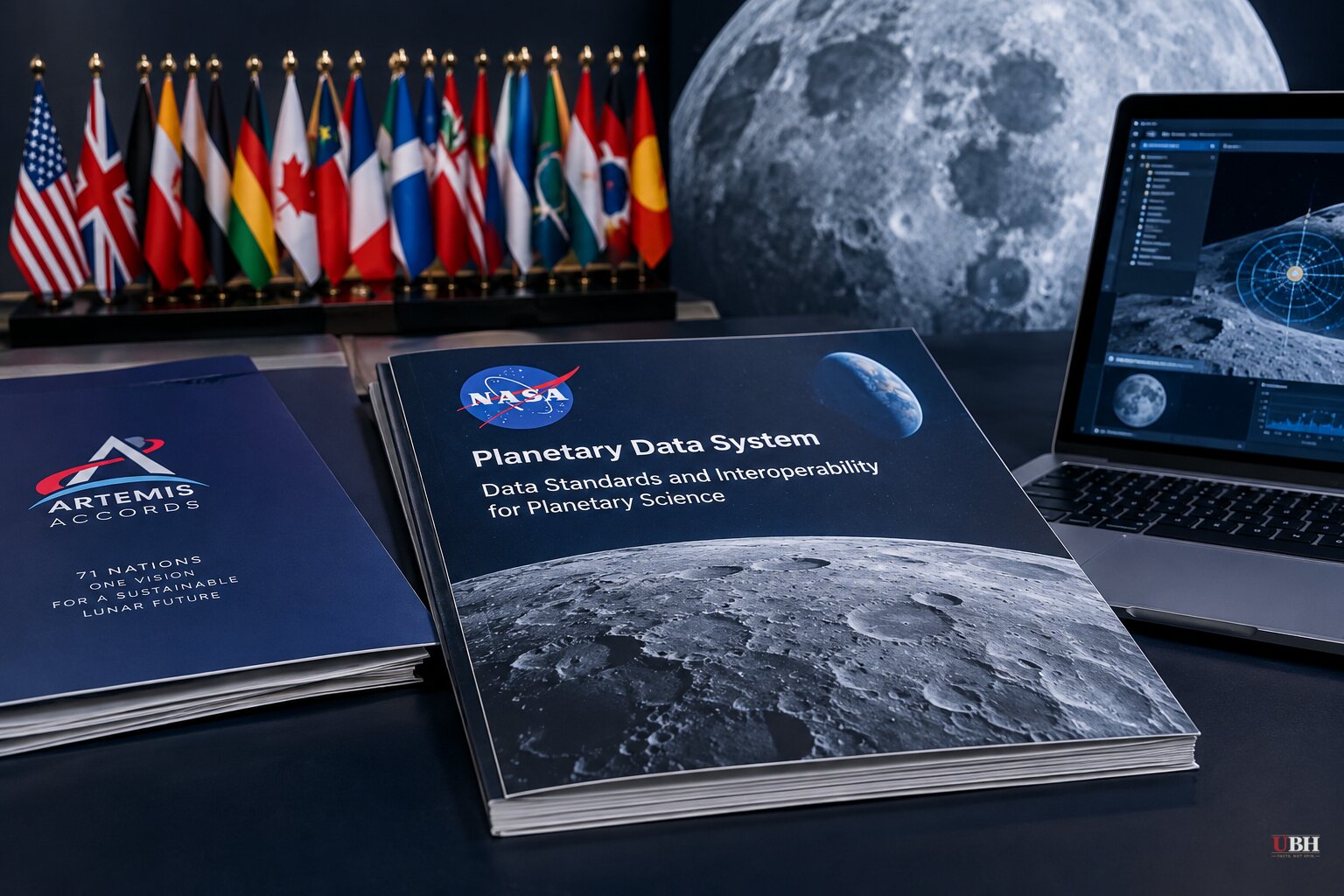
NASA wrapped up a two-part virtual workshop series on September 8, 2026, that handed all 71 Artemis Accords signatory nations a working reference architecture for lunar science data. The agency is turning a six-year-old diplomatic pledge into actual infrastructure partner countries can plug into, according to Tech Times.
The workshops, which opened July 28, built around NASA's Planetary Data System, the agency's primary planetary science archive that has been running since 1989. PDS is a federated setup with seven discipline nodes covering atmospheres, geosciences, imaging, navigation, planetary rings, plasma interactions, and small bodies. Every dataset submitted goes through peer review for scientific correctness and long-term usability before release.
"NASA is committed to leading by example when it comes to open science," said Andrew Mitchell, deputy chief science data officer for NASA's Science Mission Directorate, according to Tech Times. "These workshops gave our Artemis Accords partners practical tools and a shared foundation to build on as we move forward together."
The technical centerpiece is the PDS4 Information Model, an XML-based metadata schema built so data from any agency can be consistently described, searched, and reused, including by scientists in other countries and by AI systems years down the line. NASA didn't build this out of idealism. A 1982 National Academy of Sciences review found the agency was losing early planetary mission data because nobody had standardized how it was formatted or documented. PDS exists to stop that from happening again.
The AI Layer
Two days after the workshop series closed, NASA and IBM published a technical paper introducing the Lunar Foundation Model, an open-source AI system trained to make sense of decades of mismatched lunar sensor data, according to Live Science. The paper was shared September 10.
The problem the model targets is real. Lunar missions have used high-resolution optical cameras, laser altimeters, radar reflectance tools, and elemental spectrometers, and none of those data streams talk to each other cleanly. Older tools like SwinV2-B, a general-purpose vision transformer built in 2022, could only handle pieces of that puzzle, Live Science reported.
The Lunar Foundation Model is built from tens of thousands of images and surface maps pulled from nine instruments across four missions, including NASA's Lunar Reconnaissance Orbiter and the GRAIL mission, plus data from Japan's space agency, JAXA, according to Silicon Republic. It's freely posted on Hugging Face, the open-source AI repository, so any researcher can fine-tune it for their own project.
"NASA has spent decades building an extraordinary scientific record of the moon, but collecting data is only part of the job," said Kevin Murphy, NASA's chief science data officer and acting chief data and AI officer, according to Silicon Republic. "We also have to make data easier for scientists to explore and use."
Practically, that means faster crater mapping for safer landing sites, better identification of permanently shadowed regions that may hide water ice, and tracking of volcanic terrain called irregular mare patches to understand the moon's thermal history, per Live Science and Silicon Republic.
The System NASA Isn't Building For
None of this connects to China and Russia's parallel effort. Tech Times reported that Beijing and Moscow are building a competing lunar data ecosystem tied to their International Lunar Research Station project, and that the two data systems, PDS4 on one side and whatever backs the ILRS on the other, are not designed to be interoperable.
That's a real fork, not a paperwork problem. DigiTimes, reporting from Taipei, frames the US-China rivalry as expanding well past lunar landings into low-Earth-orbit satellite constellations, orbital computing, and military capability in space, though the outlet's full analysis sits behind a paywall and detailed specifics weren't available.
Parallel scientific infrastructure isn't automatically a crisis. GPS, Russia's GLONASS, and China's BeiDou satellite systems have run side by side for years without a shared backbone, and basic science has often advanced through competing standards before one wins out. Someone could reasonably argue NASA locking in PDS4 with 71 partners is just normal alliance-building, not a hostile freeze-out, since the Artemis Accords were never going to include Beijing or Moscow as signatories in the first place.
The counterpoint is that lunar surface operations are getting crowded. If US-aligned missions and Chinese-Russian missions end up working the same craters and shadowed basins without a shared data or deconfliction standard, the practical stakes go beyond who gets academic credit for a crater map. No source in this reporting shows the two blocs discussing any bridge between their systems, and none of NASA's public materials address the ILRS effort at all.
What happens next is unclear. Nothing in NASA's announcements or IBM's paper addresses whether the Lunar Foundation Model or PDS4 will ever be offered, formally or informally, to non-Artemis nations. Given China and Russia's own investment in a rival system, they'd have little incentive to adopt a US-built standard even if it were offered.
Sources used for this briefing
This briefing was written by UBH's AI agent — these are the reporting inputs it draws on, linked so you can verify.


