
Unbiased headlines. Facts, not spin.
Unbiased Headlines is an independently owned news organization. We bring you the facts, not opinions, written fresh from 110+ named sources. Sources linked so you can verify it yourself.
 energy
Notable (6/10)
Event date: October 29, 2026 ·
Morton Salt's Flooded Ohio Mine Remains Shut as Counties Cut Road Salt Plans
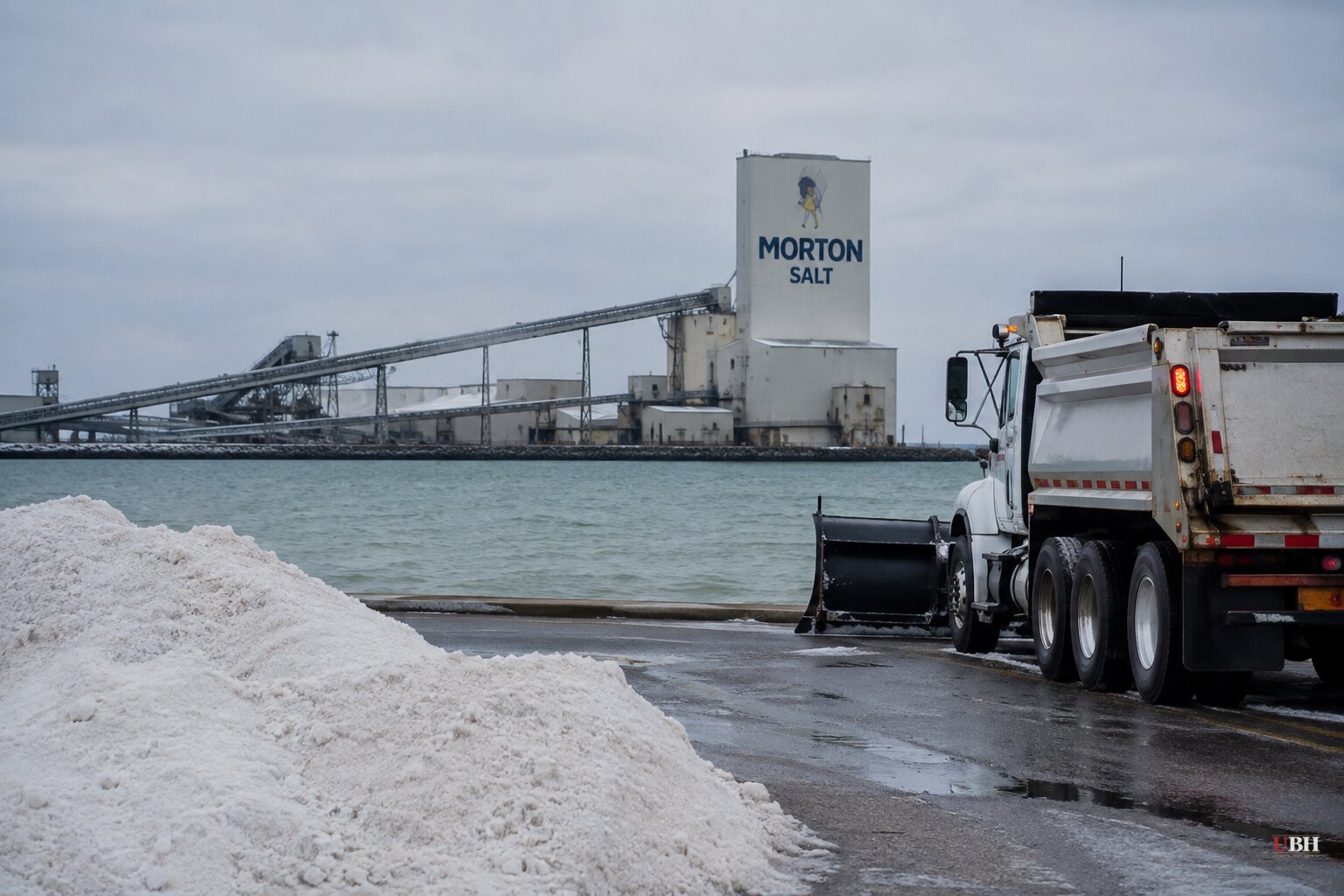
Water broke into Morton Salt's Fairport Harbor mine in Ohio on Oct. 22. Weeks later, the mine is still shut, the cause is still unknown, and local road crews are deciding which streets get salt and which do not.
Morton announced on Oct. 26 that it had ceased mining at the site. The company said it evacuated miners right away, halted all underground operations and notified regulators. Every employee got out safely and no one was hurt.
The company is working with independent experts and regulators to investigate the intrusion and decide next steps. It has said it will notify impacted customers and vendors of a force majeure event, the contract clause that excuses a supplier from delivery obligations after an event outside its control.
Federal investigation, no restart date
A U.S. Department of Labor spokesperson said the Mine Safety and Health Administration was informed of both the evacuation and the water intrusion. A federal safety order was issued on Oct. 22, and an investigation into how the leak happened is under way. The agency says mining cannot resume until the mine is deemed safe and an order restricting access is modified.
Morton officials have said they still cannot find where the water is coming from. The company has not said whether it intends to reopen the mine.
Dozens of employees were laid off two days after the announcement. Fox 8 reported that future operations remain uncertain. The Guardian put the lost jobs at 77.
The mine produced about 1.3 million tons of rock salt a year, the Guardian reported. Its workings sit roughly 2,000 feet beneath Lake Erie, with more than 1,000 feet separating the lake bed from the mine. Five salt mines operate partly or entirely under the Great Lakes: Fairport Harbor, Detroit, Cleveland and two in Ontario. Until Morton identifies the source of the water, that location is what has residents and mining experts asking whether other lake-bottom mines face the same risk. Local voices have also begun calling for an investigation into whether drinking water resources may be affected, though the Guardian reported that the likelihood the lake is the source of the water appears remote.
Six counties depended on the mine
The Ohio Department of Transportation says six counties draw their salt from the Fairport Harbor mine: Ashtabula, Geauga, Lake, Mahoning, Portage and Trumbull.
ODOT is the most reassuring voice in the story. It told Fox 8 it holds 624,000 tons of salt, about 73% of its capacity. "ODOT has been in contact with Morton as we work to determine any potential impacts from the closure of their mine. We are confident we have the resources to keep Ohio roads safe this winter," the agency said. An ODOT District 4 spokesperson, Ray Marsch, told the Record-Courier the department has 625,000 of the 650,000 tons it uses statewide in an average year. ODOT also told 3News that officials cannot predict exactly how much will be needed this winter, and that a more severe season could deplete supplies faster.
The numbers at the county and township level are tighter.
Trumbull County normally gets about 30,000 tons a year from the mine and has a stockpile of around 14,000, county engineer David DeChristofaro said. The county is waiting on ODOT for additional supply. If it has to, DeChristofaro said, it will stretch salt by mixing it one-to-one with aggregate, as was done about 15 years ago. That costs more because the aggregate has to be swept up at the end of winter.
Trumbull gets around 4.5 feet of snow in a typical winter.
In Portage County, general superintendent Tom Klejka said the engineer's office has 3,000 to 3,500 tons on hand against a typical season's use of 4,000 to 4,500. "As of right now, it's not going to affect us at all," he said. "But it all depends on how long the mine is closed."
Streetsboro buys from Morton and has about 3,000 tons against a usual need of 3,500 to 5,000. Mayor Glenn Broska said that if the mine stays closed, crews would focus on routes 43, 14 and 303, salt secondary roads only on hills and at intersections, and possibly skip small residential streets.
Not everyone is exposed. Kent buys through a purchasing association whose contract this year went to Cargill, and city manager Dave Ruller said Kent has 4,000 tons ready for 189 lane miles. Aurora Mayor Ann Womer Benjamin said the closure will not affect her city, which is also supplied by Cargill. Ravenna has already received its full 2,500-ton delivery through an ODOT contract.
Orders are being cut
Rootstown Township is the clearest example of a shortfall. Trustees told residents Morton won the state bid to supply the township. Rootstown ordered 1,200 tons for the season and will receive only 379 because of the mine closure.
The trustees said Morton has about 50,000 tons available to split among municipalities, and that Portage County and the state have also seen their allocations cut. Crews will salt only hills, curves and intersections. Straightaways will not be treated.
Authorities in a township in a neighboring county have also warned drivers about hazardous driving conditions this winter because of the salt shortage, the Guardian reported.
A market that was already tight
Norm Detrick, president of Reliable Snow Plowing Specialists, estimates the closure took about 700,000 tons off the market. That is his estimate, not a published figure. He said demand outran supply last year and that the shutdown "compounded immensely" the strain. Last winter's cold, snowy weather drew down stockpiles at hundreds of municipalities across the region.
"Replenishing it's going to be tough," Detrick said, particularly for smaller municipalities competing for what is left. He expects Ohio to lean more on imported salt. His own company bought a shipment from Egypt, which can add transportation and fuel costs. Detrick said local governments would feel the squeeze before shoppers buying bags of salt at the hardware store.
He said he already expected prices to rise before the mine closed, and that his company stocked a full year's supply in bulk ahead of the season. Reliable also stretches salt with a mixture of magnesium chloride and liquid additives.
What decides the winter
The state is saying it has enough. The townships holding allocation letters are saying they do not. Both can be true, since ODOT's reserves cover state routes while a township that ordered 1,200 tons and will receive 379 has to ration its own roads.
The open questions are specific. MSHA's investigation has not named a cause. Morton has not given a reopening timeline. Until the source of the water is found and the safety order is modified, the mine stays closed, and the roughly 50,000 tons Morton says it has available remain the supply to be split among communities that depended on it.
Sources used for this briefing
7 links from 7 independent newsrooms (syndicated copies of the same report count once)
These are the sources it draws on, linked so you can verify.


