
Unbiased headlines. Facts, not spin.
Unbiased Headlines is an independently owned news organization. We bring you the facts, not opinions, written fresh from 110+ named sources. Sources linked so you can verify it yourself.
 economy
Major Story (7/10)
Moody's Keeps France at Aa3 With Negative Outlook After 10-Year Yield Hits 5.14%
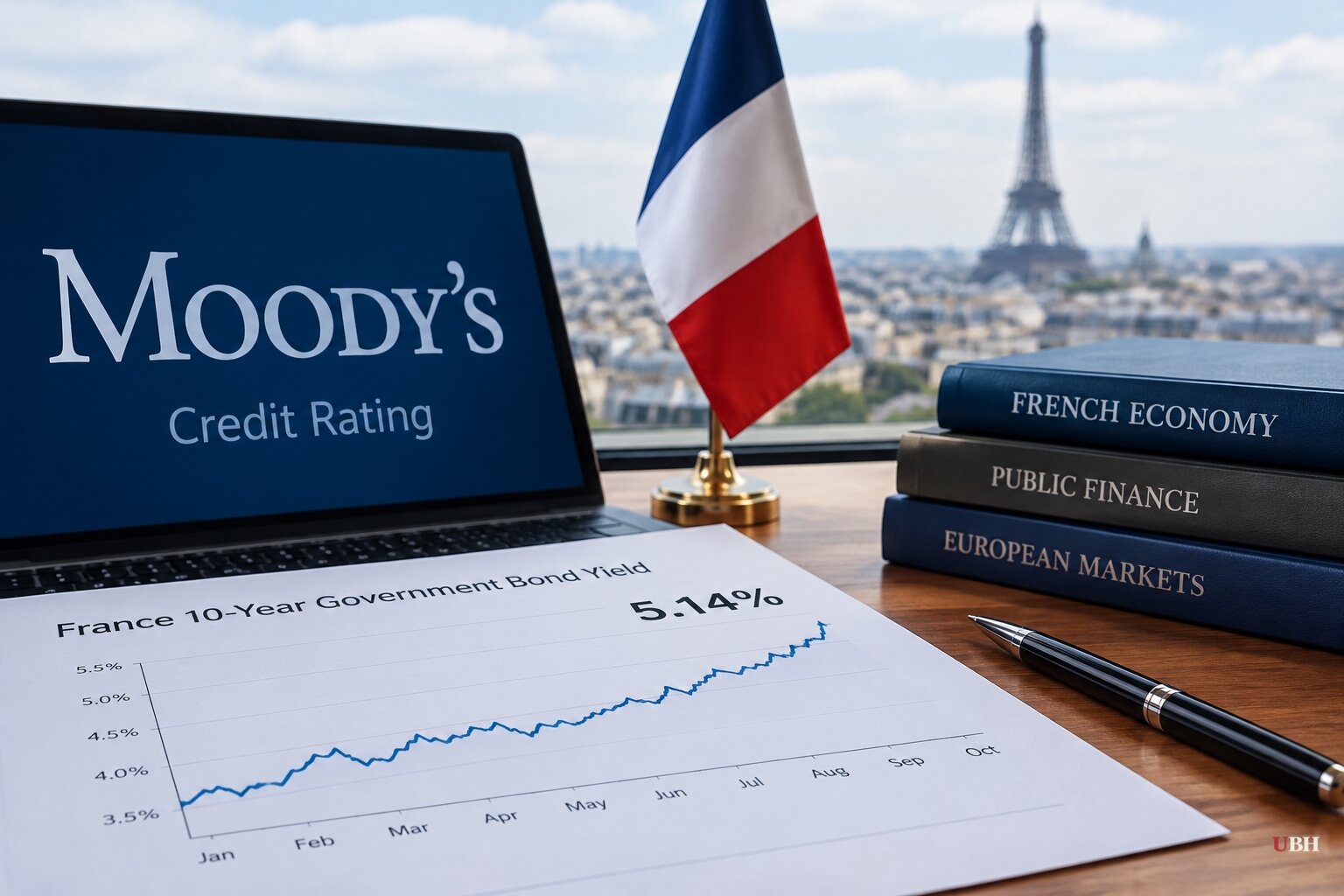
Since the weekend riots pushed French borrowing costs to a 24-year high this week, the open question has been whether the rating agencies would act. On Friday, Oct. 23, Moody's did not. It kept France at Aa3 and left the outlook negative.
Moody's said it had concluded a periodic review. The negative outlook has been in place since last October. Bond markets had been pricing in a downgrade, which would have put Moody's level with S&P and Fitch. Both of those cut France in 2025.
What Moody's said
The agency's own wording is conditional. "The Aa3 rating assumes that a deficit-reducing budget for 2027 will be adopted, while financing costs and social tensions will abate somewhat in the next few months," Moody's said in its statement.
It also said the "negative outlook reflects the increased risk that the fragmentation of France's political landscape will continue to impair the functioning of the country's legislative institutions."
Moody's warned that political instability, "also visible in the current social tensions," could weaken France's key credit metrics faster than it currently expects. It said it could return the outlook to stable if institutions manage to narrow the deficit.
The French finance ministry read the decision as a vote of confidence. It said the unchanged rating reflected the "credibility of the budget the government has put forward in the 2027 finance bill, which is designed to keep our public finances on the path to recovery."
The numbers behind the decision
France's benchmark 10-year yield hit 5.14% on Thursday, its highest since July 2002. The risk premium over German bunds reached its widest in 15 years the same day. French yields have risen more than those of any other developed economy this month, and French borrowing costs now exceed those of lower-rated Italy.
The deficit is projected at 5.4% of GDP this year, against an EU limit of 3%. The 2027 budget targets 5%. In the past month the finance ministry warned that debt would reach 121.7% of GDP in 2027. More than $1 trillion of French debt matures by 2030, according to CNBC's tally.
Moody's is still one notch above S&P and Fitch. Last month Scope Ratings downgraded France, and Morningstar DBRS moved its outlook to negative.
A budget that has to pass a hostile parliament
The Aa3 depends on a budget the government has not yet secured. Opposition parties could reject the bill and topple the government in a no-confidence vote. In the lower house, deputies have scrapped some key savings measures while adding spending elsewhere. Opposition parties show little appetite for compromise before the presidential election.
That election is set for April 18 with a runoff on May 2. Polls suggest the far right could win.
The street is a second pressure point. More than 500,000 people marched last weekend against declining public services and the cost of living. Protests over underfunded schools had already turned violent, and the cost-of-living demonstrations descended into riots and looting. The government has refused to release more school funding or raise the minimum wage. Further protests are planned for Saturday, Oct. 24.
The political fight over the cause
French Prime Minister's office and the U.S. president describe the unrest differently. The prime minister has blamed "ultra-left radical groups." At a Wichita, Kansas, rally on Monday, President Donald Trump blamed migrants, jihadists and communists, and said he had told Macron years ago, "Close your border or you will lose France." He told supporters, "If you want to see what is at stake in this election, just look at what's happening in France."
The protests themselves have been tied to school funding, living costs and public services. Those were the grievances stated by the marchers and the issues behind the school protests that preceded the riots. Fox News analyst Brit Hume called the later violence "not a student protest" but "an absolute orgy of destruction." He also criticized Macron for traveling to the Middle East while "your country's on fire."
What investors are watching
Analysts say the reprieve does not remove the risk. "You want to wait and see how the narrative evolves over the next six months into the election. That's going to have a more meaningful impact on the spread," said Rushabh Amin, a portfolio manager at Allspring Global Investments.
Mike Bell, head of market strategy at RBC BlueBay Asset Management, pointed to a bigger threat. If Moody's, S&P and Fitch all cut France to BBB, just above junk status, investors with rating limits could be forced to sell. "That's where it could really start to get more ugly," he said.
Moody's has said the government's ability to overcome parliamentary fragmentation will be the key factor in its next move. That puts the 2027 finance bill vote, and any no-confidence motion that follows it, ahead of the April election as the next test of the Aa3.
Sources used for this briefing
7 links from 6 independent newsrooms (syndicated copies of the same report count once)
These are the sources it draws on, linked so you can verify.


