
Unbiased headlines. Facts, not spin.
Unbiased Headlines is an independently owned news organization. We bring you the facts, not opinions, written fresh from 110+ named sources. Sources linked so you can verify it yourself.
 economy
Notable (6/10)
EU Ministers Back More Talks With Beijing as Plastics Safeguard Probe Nears
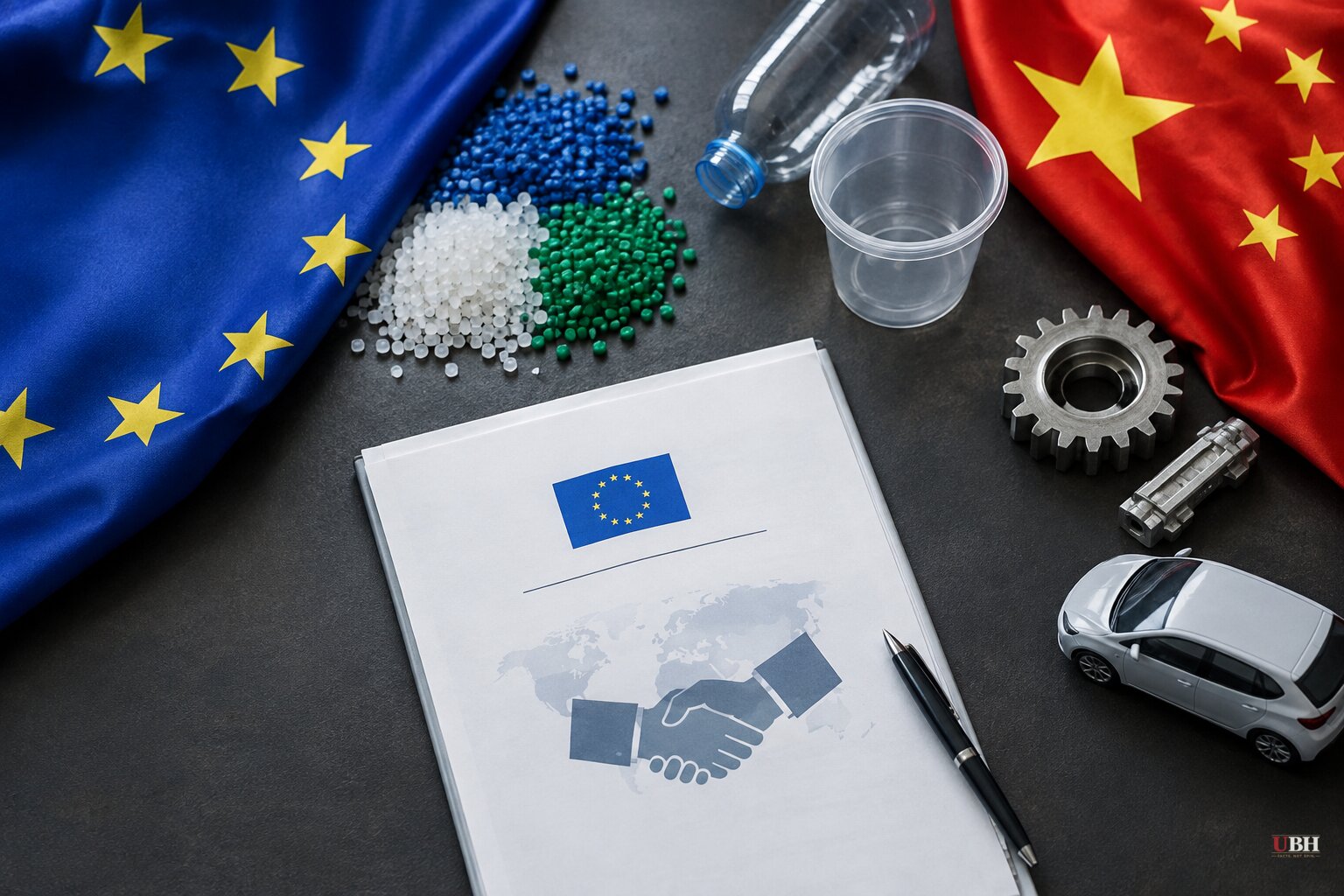
European Union trade ministers meeting in Dublin on Friday, Oct. 23, said the bloc should keep talking to Beijing and push to expand a deal that cuts Chinese hybrid-vehicle imports to other sectors.
The backdrop is a deficit the EU itself calls unsustainable. The bloc's goods trade deficit with China exceeded €370 billion ($414 billion) in 2025. It is on course to go well past €400 billion this year, or more than €1 billion a day. European Commission President Ursula von der Leyen has called the imbalance "unsustainable."
What the hybrid deal delivered
Earlier this month, Trade Commissioner Maros Sefcovic agreed with Beijing that the EU would cut hybrid-vehicle imports from China by more than half. The aim is to support Europe's struggling carmakers.
China also agreed to cut import tariffs on €4 billion of EU exports, including car parts and olive oil, and to ease the issuing of export licences for rare earths. Sefcovic and Chinese Commerce Minister Wang Wentao are due to meet again in March, when further steps could be announced.
Sefcovic has acknowledged the hybrid agreement is only a first step. Ireland's foreign minister, Helen McEntee, told a news conference all EU members want the Commission to continue the dialogue. "There's a very clear desire for us to move beyond that (hybrid cars) and to look at other areas, chemicals, machinery," she said, adding agrifood to the list.
Lithuanian Foreign Minister Kestutis Budrys said pharmaceuticals could be included as well.
Why ministers think talks can work now
Greek Deputy Foreign Minister Haris Theoharis said the EU had talked with China for years without results, but that the talks were now yielding something. "We should be continuing to engage in this process, and of course keep all the options open," he said.
France's junior trade minister, Nicolas Forissier, tied the change to European unity. Dialogue is possible, he said, because the EU is now speaking as one. Chinese authorities, in his words, "understand when you are clear, when you speak frankly, when you are firm on your positions."
Beijing rejects the premise that it is the problem. China has said in the past that it is not the root cause of the EU's difficulties but a partner in solving them.
The dispute is partly about who absorbs the goods. China needs foreign buyers for state-subsidised products its own shoppers cannot take up. The EU is torn between welcoming cheap imports to ease living costs and keeping them out to rebuild its own factories.
European industry groups say the export surge, dubbed "China Shock 2.0," is already closing factories and costing jobs. The most cited example is the 100,000 positions set to go at Volkswagen.
Chinese customs data show the pressure is not letting up. China's surplus reached $938.1 billion in the first nine months of 2026, and September exports rose 36.3% from a year earlier, according to the figures as cited in a commentary by Wang He in The Epoch Times.
Plastics likely first in line
Sefcovic said an investigation into safeguards for plastics appears to be the next trade-defence case. "Currently, I think the plastics sector is the closest," he told reporters. "We are looking into whether all the requirements to launch an investigation are in place."
He appeared to be referring to a request for measures against imports of PET, the plastic widely used in packaging. Lawyers told Reuters earlier this month that the request had been submitted.
Safeguards set import quotas, with tariffs typically applying above the quota. The EU has used them only for steel products and ferro-alloys so far. Pending or possible cases include PET, chemical composites, other chemicals and machinery.
McEntee said that while dialogue is the priority, the Commission could use existing trade defence tools itself to resolve some imbalances. Ministers did not go into short-term measures the EU could take alongside the talks.
The existing toolbox has limits
The EU already runs a heavy docket of anti-dumping and anti-subsidy cases. Of 25 new investigations underway against all countries, 22 target China alone or with others. They cover tyres, some steel products and a wide range of chemicals. The Commission is opening around 30 China investigations a year, up from a historical average of about 12.
The highest-profile case ended in 2024 with additional tariffs of up to 35.3% on Chinese electric vehicles.
Critics of the approach cite a backlog of complaints. They also say the cases are so narrow that Chinese producers can shift to similar products, or goods one step up or down the value chain.
What comes next
France and Germany have proposed a rapid-action instrument, dubbed a "kill switch," to respond to countries that harm the bloc by restricting access to the EU single market. The Commission has agreed to propose it, but the timing is unclear.
In December, the Commission plans to propose a diversification instrument to limit reliance on single sources for critical supplies. It will come with a solidarity package for EU members or sectors hit by foreign trade measures.
It is unclear whether Beijing will accept sector-by-sector cuts beyond hybrids. The March Sefcovic-Wang meeting is the next scheduled test.
Sources used for this briefing
6 links from 6 independent newsrooms (syndicated copies of the same report count once)
These are the sources it draws on, linked so you can verify.


