
Unbiased headlines. Facts, not spin.
Unbiased Headlines is an independently owned news organization. We bring you the facts, not opinions, written fresh from 110+ named sources. Sources linked so you can verify it yourself.
 economy
Notable (6/10)
Energy Department designates helium a critical material, opening more federal financing for producers
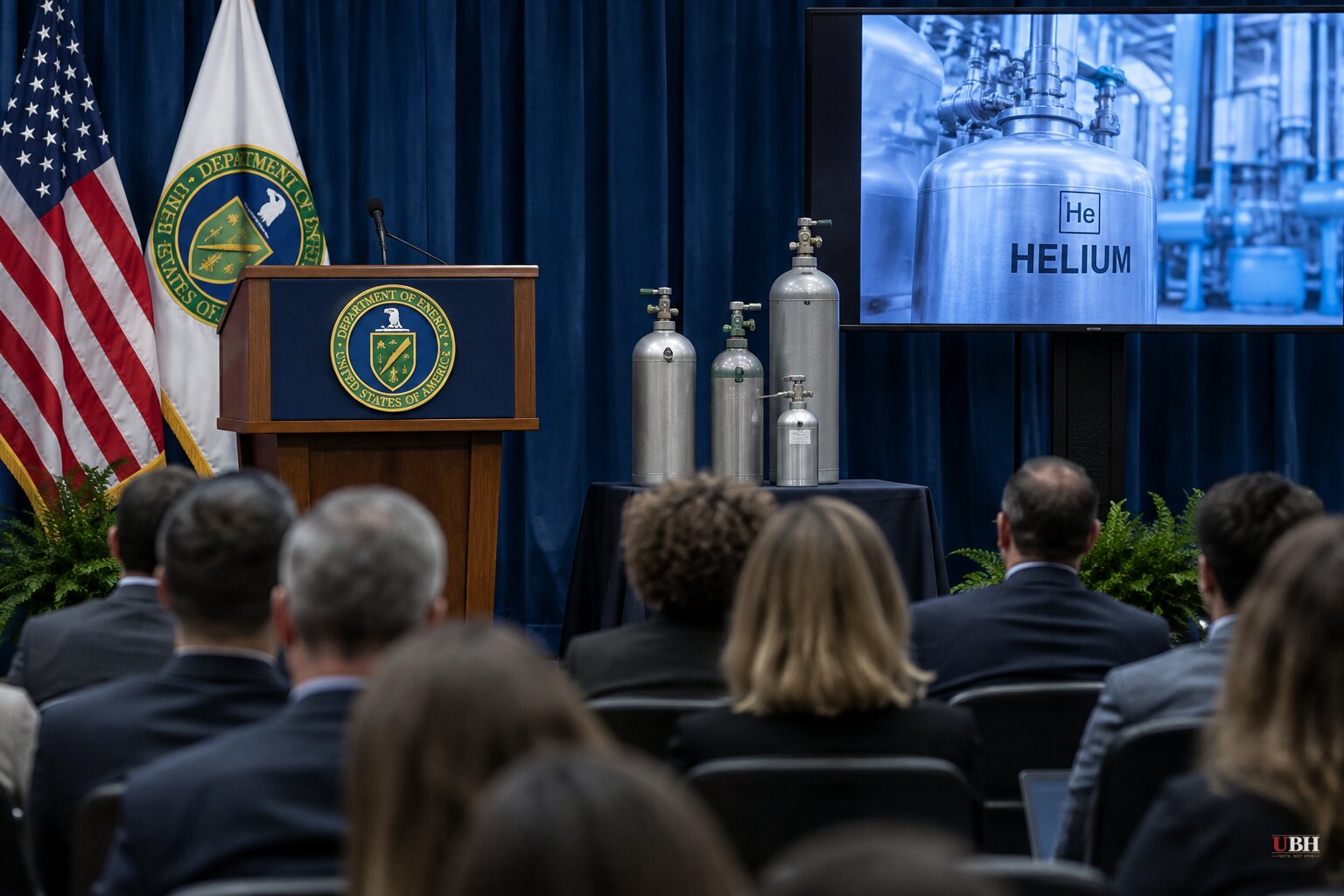
The Energy Department designated helium a critical material today, Oct. 23, under the Energy Act of 2020. Secretary Chris Wright signed off on the move. A Federal Register notice accompanies it.
The practical effect: more federal financing becomes available to helium producers, and the government will monitor the gas more closely. Helium is the 20th material on the department's list. Metallurgical coal, used in steelmaking, was the last addition, in 2025. Fluorine is the only other gas on the list.
What the designation requires
To make the list, a non-fuel mineral element or substance must serve an essential function in energy technologies and face a high risk of supply disruption. DOE says helium meets both tests.
The department's notice calls helium "non-substitutable for multiple critical energy functions, including: semiconductor manufacturing, leak testing natural gas infrastructure, and quantum computing." It also points to medical and scientific uses, and notes that demand is growing.
Assistant Secretary Audrey Robertson, who oversees the Office of Critical Minerals and Energy Innovation, said helium has the lowest boiling point of any gas and does not burn. She called it a possible "single point of failure" for American technology. "It's not necessarily for our birthday parties," Robertson said in an interview. "It's really towards the future of American competitiveness and energy security, which we believe is national security."
Wright framed it as industrial policy. "President Trump is bringing back America's manufacturing industry, and that means making sure we have the materials needed to build things in America again," he said in a statement.
Where the supply squeeze comes from
The U.S. is the world's largest producer of helium and of natural gas, which is where helium comes from as a byproduct. Qatar and Russia are the other top producers.
Qatar is the problem. Iran's closure of the Strait of Hormuz in February trapped about one-third of the global helium supply in the Persian Gulf. In March, Iranian strikes hit Ras Laffan, the Qatari facility that produces helium. Exports have been severely curtailed since.
Russia imposed temporary export controls on helium in April to protect its domestic supply. China imposed a temporary export ban on the gas in July. China is not a major helium producer, but it has served as a transit hub for Russian supplies headed to Europe, according to a July Financial Times report. The EU banned direct imports of Russian helium in 2024, though some supply reportedly kept reaching European markets through China.
The designation came five days after CBS's 60 Minutes aired a segment on the helium market and the Hormuz closure. The segment, titled "Up in the Air," ran Oct. 18. DOE's stated reasons are supply-chain risk and helium's role in semiconductors, not the broadcast.
Semiconductors drive demand
Chipmaking is at the center of DOE's case. David Isaacs, a vice president at the Semiconductor Industry Association, noted that helium plays an essential role in the industry's cooling, photolithography and leak detection.
Richard Brook, president of Garrison Ventures and a helium industry veteran who appeared in the 60 Minutes segment, says semiconductors are the fastest-growing consumer of the gas. He ties that to the buildout of AI infrastructure, including advanced processors and high-bandwidth memory. The same company statement notes helium's use in MRI machines, research and rocket pressurization.
The domestic bottleneck
DOE's own announcement concedes the limits of the move. The department says the U.S. has significant domestic deposits of helium-rich natural gas. It also says global demand is growing faster than production, and that "limited refining capacity and lengthy permitting timelines continue to constrain U.S. production."
That is the gap between a label and a molecule. A federal designation can make financing available. It does not by itself build a refinery or shorten a permit review.
DOE has not announced a dollar figure for the financing, or named which programs or producers would receive it. The designation also does nothing about the Gulf supply sitting behind a closed strait. Europe, meanwhile, is dealing with its own shortfall after the Russian and Chinese restrictions.
It remains unclear whether the financing and monitoring translate into new U.S. output fast enough to matter while Qatari exports remain curtailed. DOE has pointed to refining capacity and permitting as the obstacles. Its Federal Register notice is the next place to look for how the department plans to apply the designation.
Sources used for this briefing
8 links from 8 independent newsrooms (syndicated copies of the same report count once)
These are the sources it draws on, linked so you can verify.


