
Unbiased headlines. Facts, not spin.
Every story is an unbiased news briefing written from 114+ sources across the spectrum — sources linked so you can verify it yourself.
 defense
Breaking / Critical (9/10)
October 9, 2026 at 08:26 PM
defense
Breaking / Critical (9/10)
October 9, 2026 at 08:26 PM
Military Source Says Houthis Mined Bab al-Mandab as Iran Names LPG Tanker It Struck in Hormuz
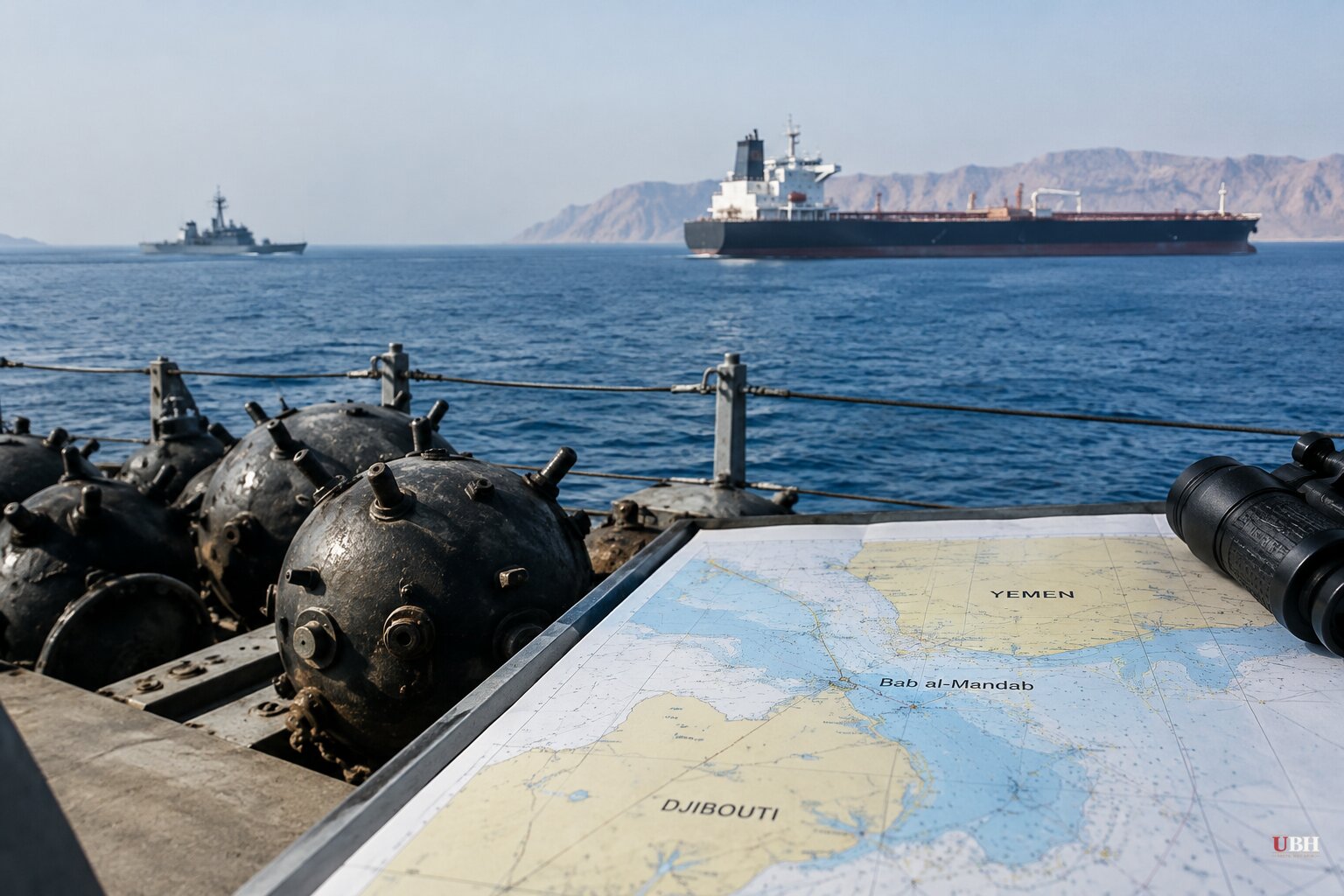
Since the U.S. and Israel began striking Iran on Feb. 28, the war has centered on the Strait of Hormuz. As of Friday, Oct. 9, a second chokepoint, Bab al-Mandab at the mouth of the Red Sea, is drawing attention.
Mines reported at Bab al-Mandab
A military source told Saudi-funded Al Arabiya that Houthi militias have planted a large quantity of mines in the Bab al-Mandab area. The source said Saudi-backed engineering teams are clearing mines and improvised explosive devices there.
A separate report from Ajel News, citing a military source, adds that the Houthis placed concrete blocks on roads. A Yemeni military source said Friday that government forces have taken control of the strait and Mayyun Island.
Both accounts rest on unnamed military sources, and no shipping authority or government has publicly confirmed the extent of the mining. The Houthis have so far signaled that the strait is open to normal transit. They have said only Saudi and Israeli-linked vessels would be attacked.
The mining could be local to the coast, where Saudi-backed fighters are pushing against Houthi positions. The reports do not say shipping lanes are mined.
The Red Sea is also seeing violence on land. Several explosions were heard in Riyadh on Thursday, including a large blast at King Khalid International Airport. A witness said flights were halted and passengers evacuated. The Houthis claimed a ballistic missile attack on the airport but provided no evidence. Saudi authorities had not immediately commented.
The vessels hit near Hormuz
In a statement carried by Iranian state media, the Islamic Revolutionary Guard Corps Navy said it struck a "giant LPG carrier" named NV Sunshine, owned by a company it called NatWit. The IRGC said the ship was attempting to transit an "illegal route" south of the strait. It said the strike caused a fire in the engine room and propulsion system and forced the vessel to stop.
The statement did not specify the weapon used. No independent confirmation of the damage has come from a shipping authority, a flag state or the owner.
A separate incident was reported by the UK Maritime Trade Operations agency. A vessel was hit by an unknown projectile about 13 nautical miles west of Al Jazeera Al Hamra, UAE, at roughly 10:00 UTC Friday. The strike started a fire that was later extinguished. UKMTO said the crew status and damage were unknown.
The British security firm Vanguard identified the ship as the Panama-flagged crude tanker GEM NO.2. Nobody has claimed responsibility, and the sources do not establish a link to the NV Sunshine strike.
This follows a British military statement earlier this week that several projectiles struck a tanker off Qatar, causing multiple casualties. Shipping data show at least 12 attacks on oil, LNG and LPG tankers around Hormuz between Sept. 28 and Oct. 5.
Iran's stated position
The IRGC says its forces have "taken control of the administration of the strait." It put responsibility for rising maritime tension on the U.S. military.
Ali Mohammadi, the IRGC Navy's political deputy, told the Fars news agency that the Navy has run nightly operations since the war began. He said it keeps "complete and absolute surveillance" of the waterway and can "impose its will" on vessels it says violate its rules. Vessels crossing outside Iran's designated routes will be "punished," the IRGC warned.
Tehran has also warned regional states that alternative oil-export routes, including shipping lanes closer to the Omani side, would be treated as hostile, according to officials cited by Reuters.
Washington's position is the opposite. It is pushing for commercial traffic to resume and the U.S. Navy is escorting some tankers. Before the war, roughly a fifth of global oil and LNG shipments moved through Hormuz.
Diplomacy and sanctions
President Trump said the U.S. will not attack Iran before the Nov. 3 midterm elections. He described "productive discussions" with Tehran, but he has continued to suggest escalation remains possible after the vote.
The nuclear file remains a sticking point. Mohammad Eslami, head of Iran's Atomic Energy Organisation, said Iran will not give up uranium enrichment or hand over its uranium. He called enrichment an "inseparable part" of the nuclear process. That came after U.S. demands for a "meaningful" reduction in enrichment capacity.
Foreign Minister Abbas Araqchi said Tehran could respond within days to a U.S. reply to its proposal for reopening the Strait of Hormuz.
The Treasury Department sanctioned 17 tankers and other entities it accuses of moving Iranian oil and petrochemicals through a shadow network. It said the aim is to cut revenue funding the war, missile development and cyberattacks.
What to watch
Araqchi's promised response to the U.S. reply is the next concrete diplomatic marker. The other open question is whether the Bab al-Mandab mining is confirmed by a shipping authority or coalition command, and whether it reaches the transit lanes or stays confined to the Yemeni coast.
Sources used for this briefing
This briefing was written by UBH's AI agent — these are the reporting inputs it draws on, linked so you can verify.


