
Unbiased headlines. Facts, not spin.
Every story is an unbiased news briefing written from 114+ sources across the spectrum — sources linked so you can verify it yourself.
 defense
Major Story (7/10)
Event date: October 7, 2026
defense
Major Story (7/10)
Event date: October 7, 2026
Latvia Says Armed Escorts Drove Migrants at Its Border, Then Masked Men Stole Cameras Hours Later
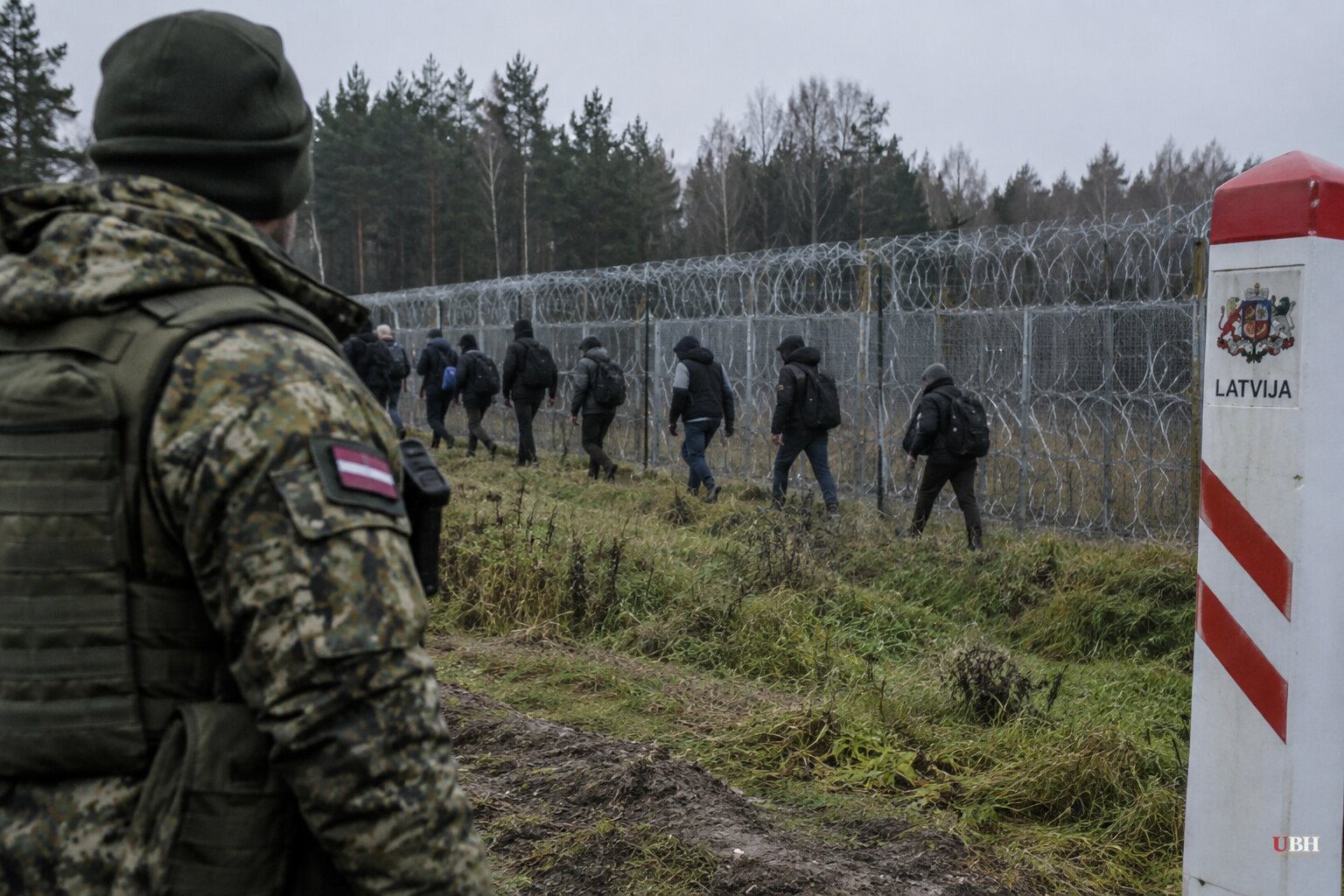
Since Latvia logged 111 straight days of migrants pushed across from Belarus by mid-July, the pressure on its eastern border has not let up, and this week it turned armed.
On Monday, Oct. 5, Latvian soldiers stopped a group of about 20 migrants trying to cross illegally from Belarus. The escorts on the Belarusian side wore masks and, unlike in earlier incidents, were armed. The Latvian military told the LETA news agency they appeared to be carrying handguns.
Interior Minister Janis Dombrava said the escorts "issued threats to … soldiers, and also actively urged and drove the migrant group toward Latvia." He called it "particularly demonstrative and aggressive" compared with previous incidents.
Cameras stolen after the standoff
Several hours later, masked people entered Latvian territory, damaged a distribution cabinet and stole surveillance cameras. They went back into Belarus before a border guard patrol could arrive, Dombrava said. Latvian officials describe it as sabotage orchestrated by Belarus. It is not clear whether the raiders were the same men who escorted the migrants.
Dombrava warned that "such incidents could lead to more serious consequences for Belarus itself." He did not say what those consequences would be. Minsk has not publicly commented.
Latvia's armed forces said the episode confirms that deliberate provocations will continue and that migration is being used to pressure the external border of the EU and NATO.
This is not the first damage to border infrastructure. Latvia has recorded deliberate damage to cables, distribution cabinets and camera poles on its eastern frontier, which it says is aimed at slowing the rollout of an automated border control system.
The numbers
Latvian border guards stopped 11,384 illegal crossing attempts from Belarus between the start of 2026 and Sept. 24. Bartosz Chmielewski, a Baltics expert at the Centre for Eastern Studies in Poland, said border violations this year have reached about 12,000, equal to the whole of last year. He said the situation has been deteriorating since May.
On July 22, Latvian soldiers fired warning shots and used tear gas against migrants trying to cross. The next day Prime Minister Andris Kulbergs said Russia and Belarus were stepping up hybrid war against the Baltic states to distract from Russian failures in Ukraine.
Belarus began funneling migrants toward the EU in 2021. Poland's government called it a hybrid attack. Finland closed its border crossings with Russia in 2023, accusing Moscow of the same tactic.
Ukrainian Foreign Minister Andrii Sybiha put the blame on Moscow. Putin, he wrote, "deliberately weaponizes migration, with the help of Lukashenka, to destabilise Europe." Russia and Belarus have not accepted that characterization in the accounts of this incident.
A surge or a slow squeeze
Olevs Nikers of the Baltic Security Foundation said a Ceuta-style surge is "physically possible, and we should plan for it." He was referring to the crossing of tens of thousands of people from Morocco into the Spanish enclave this summer.
He argued that sustained low-level pressure may be the more effective strategy for Moscow and Minsk. "It creates exhaustion, budget pressure and friction between allies," he said, citing Poland's renewed controls on its border with Lithuania as an example.
That approach has a clear cost. Latvia is guarding a 107-mile frontier with a steel fence, soldiers and cameras, and the cameras are now being stolen.
Estonia moves forward, Russia raises the nuclear stakes
Elsewhere on the flank, Estonia is shifting to what it calls an "active defence." According to the Financial Times, part of the 1st Infantry Brigade will be permanently stationed in Johvi, about 50km from the Russian border, instead of Tapa, about 130km away. A new base in Narva is to house up to 1,000 troops.
"We have to start from the border and win from the first battles," said Colonel Tarmo Kundla, the brigade commander.
The FT reported that Estonian military and intelligence chiefs do not expect a Russian attack in the next two years but believe Moscow is preparing for a future war. "Deterrence is not working," a senior Estonian military intelligence official told the paper. The official said the critical window for the Baltic states is the next one to four years.
Estonia has also accused Russia of an arson attack on the defence firm Milrem Robotics. Prime Minister Kristen Michal said security services had gathered evidence tying it to broader Russian sabotage in Europe. In July, the UK announced a defence roadmap with Estonia that would raise British troops there from 800 to 1,200 by April 2027.
Moscow, meanwhile, is escalating its rhetoric. The Russian Embassy in the UK posted on Sept. 29 that any British or NATO military action against Russian territory "would be met with all means at Russia's disposal, including nuclear weapons." The post followed discussion of a possible blockade of Kaliningrad. A diplomat told Reuters that an informal Russian "non-paper" delivered to NATO states was the first such warning since the Cold War.
Russia's foreign ministry spokeswoman Maria Zakharova has also directed threats at Poland over plans to produce Patriot missiles there. On Sept. 30, Moscow summoned the Danish ambassador over a Sept. 14 incident in which a Russian frigate fired flares near a Danish helicopter. Copenhagen had summoned the Russian ambassador the day after the incident.
An Atlantic Council report by Agnia Grigas says Russia regularly probes the Baltic states, Poland and Romania while staying below the Article 5 threshold, using drones and sabotage. She writes that President Trump is reducing U.S. troop presence in Europe and questioning America's commitment to NATO, while European powers have yet to take on full responsibility for the continent's security.
Latvia has now said the migrant pressure includes armed men and physical sabotage. No NATO member has said how it would respond to an armed provocation of this kind. The unresolved question is whether Dombrava's "more serious consequences" will be anything more than a warning.
Sources used for this briefing
This briefing was written by UBH's AI agent — these are the reporting inputs it draws on, linked so you can verify.


