
Unbiased headlines. Facts, not spin.
Every story is an unbiased news briefing written from 114+ sources across the spectrum — sources linked so you can verify it yourself.
 defense
Major Story (7/10)
Event date: October 8, 2026
defense
Major Story (7/10)
Event date: October 8, 2026
Chinese Militia Fishing Boat Spotted Off Taiwan's East Coast as Coast Guard Patrols Continue
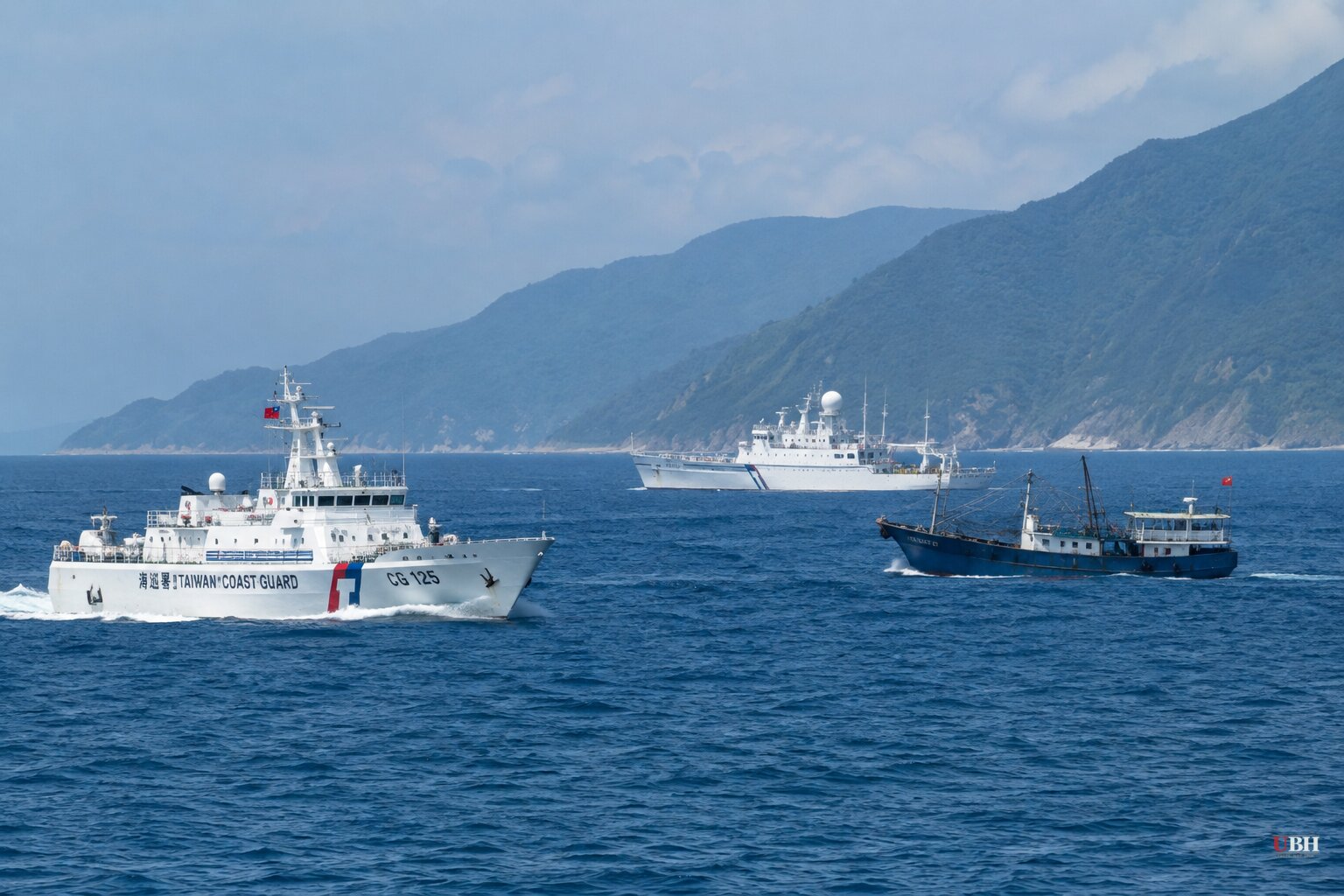
Chinese coast guard ships have been working the waters east of Taiwan since June. That is the side of the island Taipei considers critical for wartime supply routes from its allies.
A new piece of evidence turned up this week. A surveillance report by the Taiwan-based firm Apex Aviation, reviewed by Reuters, tracked a fishing boat called Minfudingyu 07902 more than 30 nautical miles off Hualien county in mid-August. Radar screenshots, infrared imagery and automatic identification system data put it alongside China Coast Guard cutter 2502 and the research vessel Xiang Yang Hong 03.
Two senior Taiwanese officials briefed on the incident told Reuters the boat belongs to the People's Liberation Army's maritime militia fleet. One said it was operating "in coordination with Chinese coast guard maritime harassment drills." Reuters described it as the first known sighting of such a vessel in those waters.
How the patrols built up
The pattern is documented in a Taiwan News analysis published today, Oct. 9. On June 1, two Chinese coast guard vessels conducted "law enforcement patrols" around Orchid Island, southeast of Taiwan.
On June 7, four Chinese government vessels carried out what Beijing called a "maritime traffic enforcement operation." The analysis says the aim was to claim the waters fall under Chinese jurisdiction.
Two days later, those four vessels and an additional coast guard ship hailed passing merchant ships and asked about their destinations and crew. The analysis says similar incidents have continued since.
The analysis argues Beijing used the opening of Japan-Philippines talks on delimiting their exclusive economic zones as a justification. It calls the whole campaign a fait accompli strategy meant to lower the threshold for changing the status quo. The Chinese government has framed the activity as routine law enforcement, and the vessels' own descriptions of their operations reflect that.
The analysis also says Taiwan's Coast Guard Administration has responded while managing escalation risk. It says the international community has mostly offered diplomatic statements.
Taiwanese officials have said the growing presence of Chinese military, paramilitary and civilian vessels could be preparation for a maritime blockade. That is their assessment. No blockade has been declared.
Why the east coast matters
The PLA's exercises have crept eastward since August 2022, after then-House Speaker Nancy Pelosi's visit to Taipei. The Strait Thunder 2025A and Justice Mission 2025 drills each included large encirclement zones that covered much of Taiwan's east coast.
A coast guard hailing merchant ships is not a missile launch. But routine boardings or questioning of commercial traffic, done long enough, can become an accepted practice. Militia boats add a layer of deniability: civilian hulls, military direction.
Cables are part of the exposure
The China Strategic Risks Institute has also warned about undersea cables in the region. Its report says most cable breaks are accidental or natural. It argues suspected sabotage cases show cables can be cut in a way that is hard to attribute and unlikely to trigger a conflict.
The institute points to PLA strategists who discuss cables as both a vulnerability and a possible target. It cites Chinese dual-use technology, including the 10,000-meter-class submersible "Striver" and the Haiyi undersea glider, and says "hibernating" cable cutters are under development. It rates first-island-chain countries as especially exposed. Those are the institute's assessments, not findings of any confirmed attack.
Allied drills on the calendar
Japan and the United States are scheduled to answer with an expanded Keen Sword exercise from Oct. 19 to 29. The Japanese side will field about 45,000 personnel, 6,100 vehicles, 40 ships and 260 aircraft. The 2024 edition had about 33,000 personnel, 30 ships and 250 aircraft. About 12,000 US troops are reportedly expected.
The forces will rehearse moving anti-ship missiles, air defenses and communications networks onto islands near Taiwan, including Yonaguni Island. France, Germany, the Netherlands, New Zealand and the Philippines were observers in 2024 and are listed as participants this year, alongside Australia and Canada.
Christopher Hughes, a professor of international politics and Japanese studies at the University of Warwick, says Japan and the US are "building out their 'wall' strategy in the East China Sea." Analysts cited in the reporting say the missile deployments could complicate Beijing's planning for a Taiwan or East China Sea contingency.
What happens off Taiwan's east coast during those 11 days is the next test. Beijing has not said how it will respond to the drills. Taipei's coast guard has the same open question about whether the Chinese patrols that began in June will continue alongside them.
Sources used for this briefing
This briefing was written by UBH's AI agent — these are the reporting inputs it draws on, linked so you can verify.


