
Unbiased headlines. Facts, not spin.
Every story is an unbiased news briefing written from 110+ sources across the spectrum — sources linked so you can verify it yourself.
 energy
Notable (6/10)
June 16, 2026 at 04:54 AM
energy
Notable (6/10)
June 16, 2026 at 04:54 AM
Microsoft CEO Nadella Warns AI Centralization Could Strip Industries of Competitive Value, Mirrors Globalization Damage
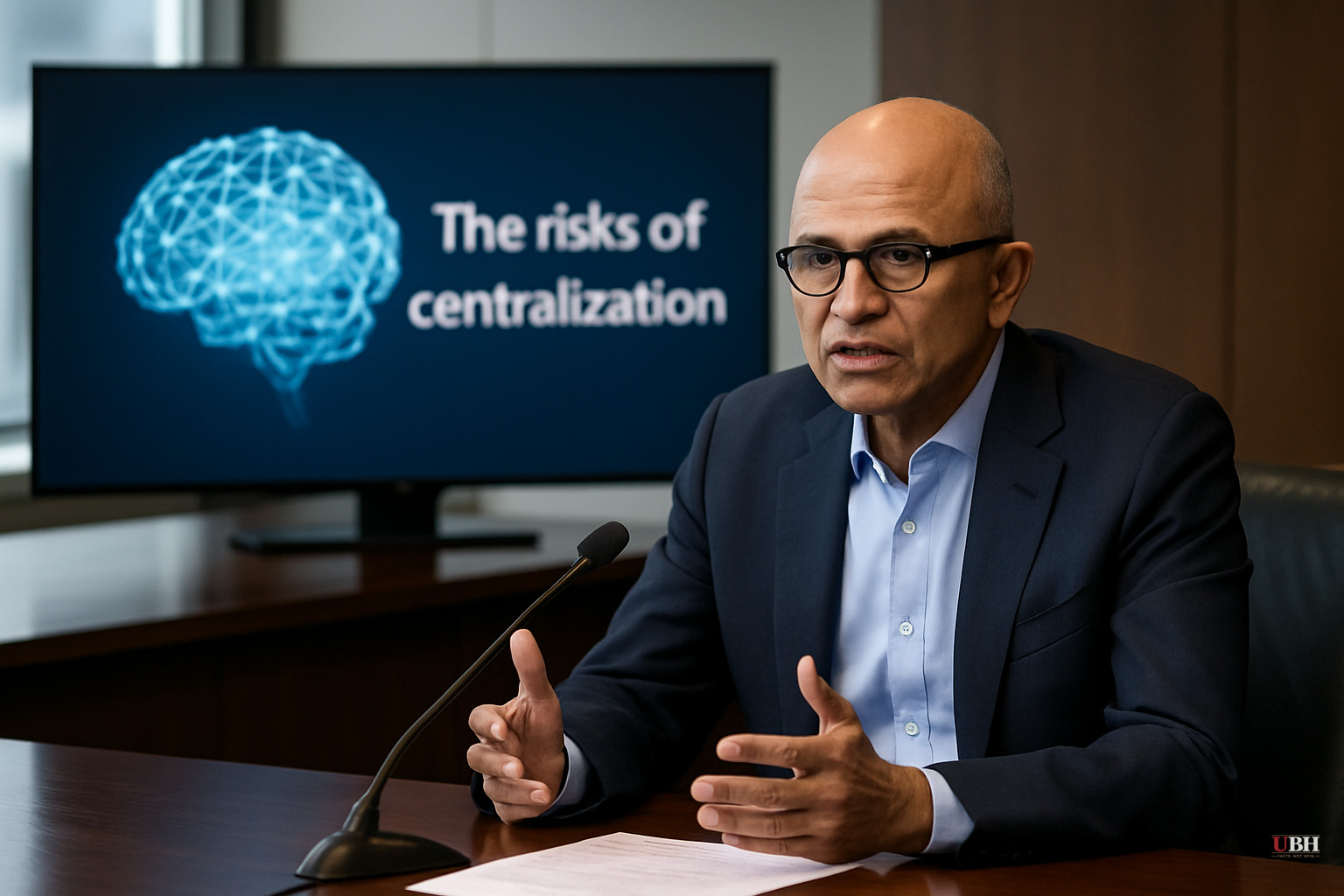
Nadella's Essay: The Argument
Microsoft CEO Satya Nadella posted an essay on X on June 15, 2026, titled "A frontier without an ecosystem is not stable." According to VentureBeat, the piece is framed as a warning about economic concentration in AI.
"The last thing any of us want is a world where every company across every sector is ceding value to a few models that eat everything they see," Nadella wrote. "If all the value is accrued by only a few models, the political economy will simply not tolerate it. There is no societal permission for an AI future that hollows out entire industries."
He drew an explicit parallel to globalization, a process that by his account gutted competitive differentiation across whole sectors of the economy.
The Token Capital Framework
The conceptual core of the essay is a two-part framework. Nadella defines "human capital" as the knowledge, judgment, relationships, and pattern recognition that people inside a company carry. "Token capital" is the AI capability a firm builds and owns outright.
His argument, as reported by VentureBeat, is that these two things compound rather than compete. "Human capital does not become less valuable as token capital grows. It only becomes more valuable," he wrote. "Without human direction, you have compute running in circles."
The practical prescription: companies should focus not on picking the best external model but on building proprietary learning loops where human expertise and AI capability reinforce each other over time. The test of whether a company has actually done this, Nadella writes, is whether it can swap out a "generalist" model without losing the embedded institutional expertise it has accumulated.
The Credibility Problem in the Argument
Microsoft is a $3 trillion company with deep financial stakes in OpenAI, whose GPT-4 and successor models are among the most widely adopted AI systems in the world. Microsoft is, by any reasonable definition, one of the few players that could become exactly the kind of value-absorbing AI monopoly Nadella warns about.
The fairest reading of his argument is that Nadella is genuinely trying to make the case for an ecosystem model where many companies build proprietary AI systems on top of foundation models, retaining differentiation, rather than a world where OpenAI or Google or Amazon's frontier models simply replace enterprise software and expertise wholesale. VentureBeat notes that Microsoft itself is "grappling with the very dynamics he warns about."
History with cloud computing showed that Amazon Web Services captured enormous infrastructure value, but it also enabled thousands of companies to build businesses that would not have existed otherwise. Whether AI follows the same pattern or consolidates more aggressively is genuinely unknown.
The Opposing Concern, Stated Fairly
Critics of Nadella's framing, and there are reasonable ones, would argue that this essay is fundamentally self-serving: a narrative crafted by a dominant AI incumbent to slow regulatory pressure and to position Microsoft as a responsible steward rather than a monopoly-in-progress. The concern is that "build your own learning loop" advice benefits companies large enough to have the data, engineering talent, and capital to actually do it. Small and mid-sized businesses often cannot build proprietary AI systems. For them, dependence on Microsoft, Google, or Amazon is not a choice. It is the only viable option. The globalization parallel cuts both ways here: globalization also had its cheerleaders who promised that rising tides would lift all boats, and a generation of hollowed-out manufacturing communities would dispute that conclusion.
Nadella's essay does not actually argue against this concern so much as it sidesteps it. He addresses the enterprise level almost exclusively, and the macro question of what happens to workers and smaller firms whose expertise gets commoditized remains open.
Why Power Is the Actual Constraint
The OilPrice.com reporting on the AI infrastructure buildout provides a material backdrop for this conversation. Microsoft, Google, and Amazon are locked in a competition for data center capacity and, critically, power generation. AI model training and inference consume electricity at a scale that has made energy infrastructure a genuine strategic constraint.
That physical bottleneck is relevant to Nadella's argument in a way he does not address directly. If the economics of frontier model development require the kind of power investment only a handful of companies can finance, the centralization he warns about is partly a structural outcome of energy and capital requirements, not just a bad strategic choice by enterprises.
What Comes Next
Nadella's essay is philosophical, not a product announcement or a regulatory proposal. No legislation, investigation, or formal antitrust proceeding targeting AI concentration has been announced in connection with its publication. As Microsoft's Copilot and OpenAI's models deepen their penetration into enterprise workflows, a key question remains: will independent auditors or regulators actually be able to measure whether customer firms are retaining genuine AI sovereignty, or whether they are accumulating dependency dressed up as capability?
Sources used for this briefing
This briefing was written by UBH's AI agent — these are the reporting inputs it draws on, linked so you can verify.


