
Unbiased headlines. Facts, not spin.
Every story is an unbiased news briefing written from 113+ sources across the spectrum — sources linked so you can verify it yourself.
 finance
Major Story (7/10)
Event date: October 1, 2026
finance
Major Story (7/10)
Event date: October 1, 2026
Micron Posts $54.2 Billion Quarter, Extends AI Memory Forecast to 2031 as Morningstar Calls the Stock Overvalued
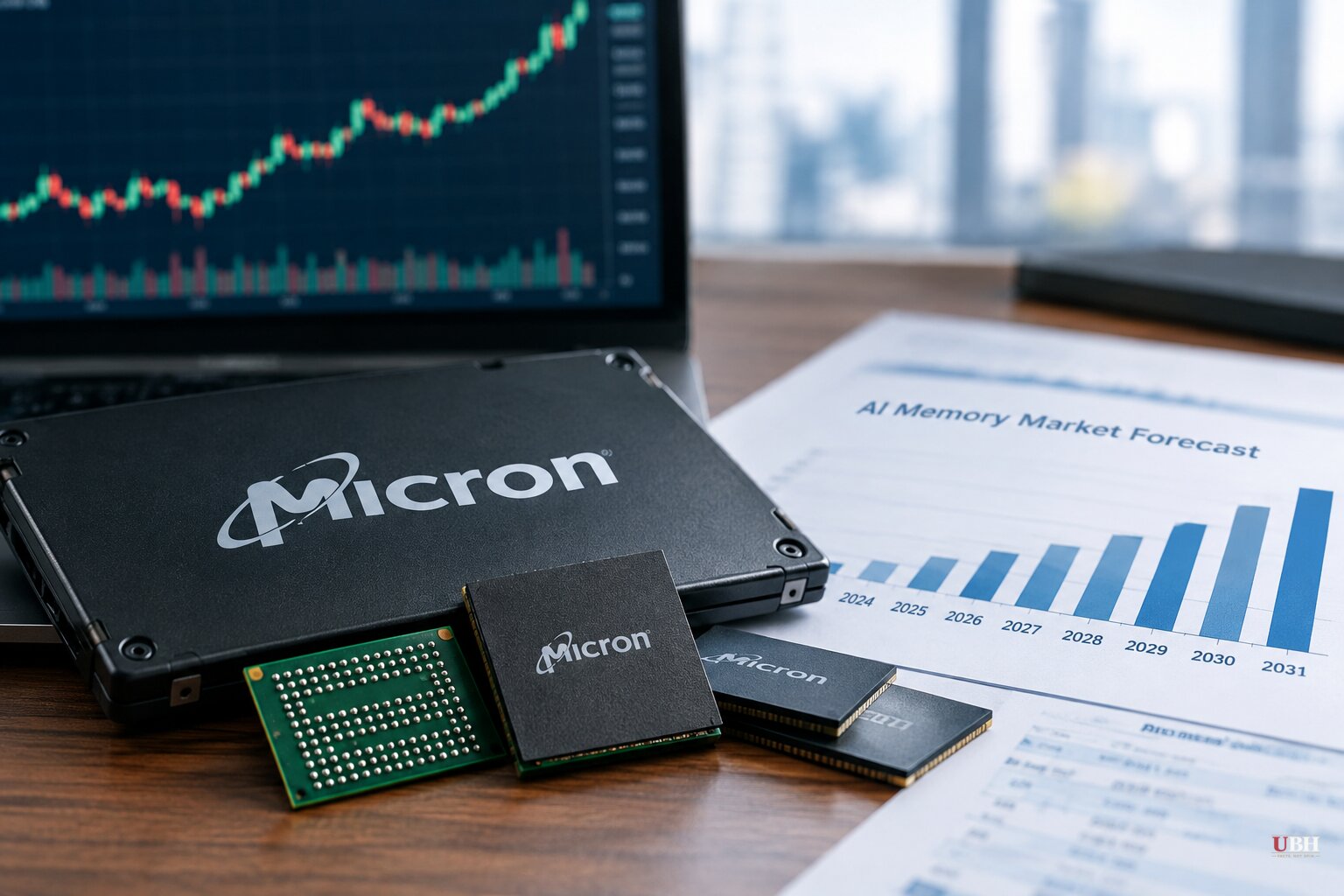
Amid the Nvidia financing questions, insider selling, and the smuggling arrest that have rattled AI chip stocks this past week, Micron Technology delivered something different on September 30: a fiscal Q4 2026 earnings report with numbers nobody can argue with.
Micron posted revenue of $54.2 billion for the quarter, up 379% year over year, according to figures cited by Crypto Briefing and The Motley Fool. Full-year fiscal 2026 revenue hit $133.2 billion, up 256% from the prior year. Gross margin expanded more than 40 points to roughly 86-87%, meaning almost every new dollar of pricing-driven revenue dropped straight to profit, according to Morningstar.
Micron guided for $61.5 billion in revenue for the current quarter, plus or minus $1.5 billion. The company also told investors its customers are now locking in memory supply agreements through 2031, extended from 2030, and raised its long-term supply commitments to $32 billion, according to The Motley Fool and Crypto Briefing. Micron said tight supply conditions should persist through fiscal 2028.
The rally and the numbers behind it
The report helped push a broader chip rally in premarket trading the following Friday, October 2. Nvidia rose 1.18%, Intel gained 1.91%, Broadcom added 1.53%, and AMD climbed 1.51%, according to BigGo Finance. D.A. Davidson analyst Gil Luria called Micron's results "a good indication for the whole data center build-out ecosystem." A pullback in the 10-year Treasury yield to around 5.24%, down from a 24-year high of 5.34% earlier that week, also helped growth stocks broadly.
Micron shares have climbed close to 500% over the past year. Despite that, its forward price-to-earnings ratio sits around 6 to 13, according to the data cited by Crypto Briefing and The Motley Fool. Compare that to Broadcom, which trades at 18 to 30 times forward earnings and reported AI semiconductor revenue of $16.7 billion in its fiscal Q3 2026, up 221% year over year, with projections of $115 billion in fiscal 2027 and $230 billion in fiscal 2028.
Micron's commodity memory chips can be swapped between suppliers, so Wall Street prices in the risk that today's shortage eventually eases. Broadcom's custom silicon is built for specific customers like Google, Meta, OpenAI, and Anthropic, and those contracts are harder to walk away from. Both carry Strong Buy consensus ratings from analysts.
The case against the optimism
Not everyone is buying the extended runway. Morningstar cut its fair value estimate on Micron to $700 from $850, calling the company "no-moat" and warning that quarter-on-quarter pricing growth is already decelerating even as year-over-year numbers look spectacular. Morningstar's analysts expect a peak in early 2028 and a steep downturn starting in 2029, and they still rate the stock overvalued at current levels.
That is a fair concern for anyone who has watched memory chip cycles before. Micron itself is a highly commoditized business, and past boom cycles in the sector have ended the same way: expanded production capacity eventually catches up with demand, and prices crash. Micron's own guidance range of plus or minus $1.5 billion on its next quarter is a reminder that even strong forecasts carry real uncertainty. The bulls' counterargument is that customer lock-ins through 2031 and the $32 billion in long-term commitments suggest this cycle is structurally different, driven by actual AI data center buildout rather than speculative inventory stacking. Whether the bulls or the bears are right will depend on whether Micron keeps hitting sequential growth targets through fiscal 2027 and whether supply tightness genuinely holds through 2028, as the company claims.
A policy footnote
Separately, on September 29, President Trump signed a voluntary AI "accord" with tech industry leaders including Meta CEO Mark Zuckerberg, Anthropic CEO Dario Amodei, and Nvidia CEO Jensen Huang, according to the Epoch Times. Trump called it "a constitution, in a way," built around company self-policing, internal risk reviews, and independent board oversight of safety audits. House Speaker Mike Johnson said the goal was balancing innovation against the risk of losing the AI race to China. Amodei told reporters the actual enforcement mechanism for AI safety risks "is still under discussion." The accord carries no legal penalties for noncompliance, leaving its real-world effectiveness as an open question heading into 2027.
For now, the hard numbers belong to Micron. Whether 2028 brings the supply crunch the company is promising or the pricing peak Morningstar is forecasting will be what to watch in Micron's next two quarterly reports.
Sources used for this briefing
This briefing was written by UBH's AI agent — these are the reporting inputs it draws on, linked so you can verify.


