
Unbiased headlines. Facts, not spin.
Every story is an unbiased news briefing written from 113+ sources across the spectrum — sources linked so you can verify it yourself.
 finance
Major Story (7/10)
October 4, 2026 at 08:16 AM
finance
Major Story (7/10)
October 4, 2026 at 08:16 AM
Hong Kong's AI Deal Boom Hits Record $47.5 Billion in Third Quarter
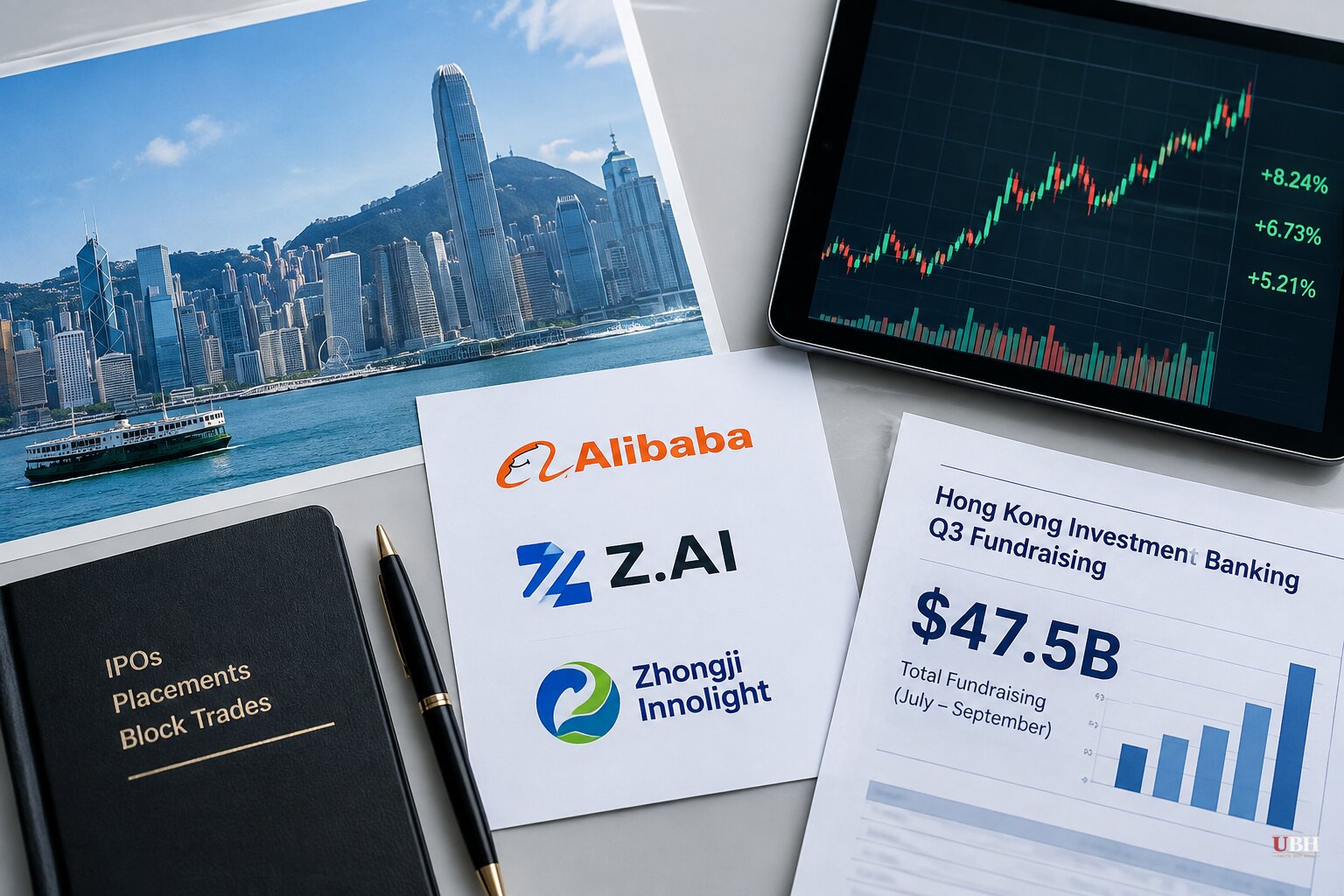
Hong Kong's equity market just had its best third quarter on record, and nobody in the city's banking towers got a summer vacation to show for it.
Initial public offerings, share placements and block trades in Hong Kong raised $47.5 billion between July and September, the biggest haul ever for that three-month stretch, according to data compiled by Bloomberg. That pushes Hong Kong's 2026 fundraising total above $92 billion, closing in on the all-time annual record of $112.5 billion set in 2021.
Separately, LSEG Data & Analytics figures reported by the South China Morning Post show Hong Kong IPOs alone, 112 companies on the main board plus two on the Growth Enterprise Market, raised $48.4 billion in the first nine months of 2026. That's the highest nine-month IPO total since records began in 1980, and the busiest deal count since 2018.
Who's Actually Cashing In
Artificial intelligence is doing the heavy lifting. Alibaba Group Holding's $10.2 billion follow-on offering was the single biggest Hong Kong transaction of the quarter, according to Bloomberg. Zhongji Innolight, an optical-networking equipment maker, raised almost $8 billion in Hong Kong's largest listing in nearly seven years.
AI model developer Z.AI has pulled in $9.6 billion so far in 2026 across its IPO, follow-on placements and convertible bonds, Bloomberg reported. Rival MiniMax Group, which raised roughly $619 million in its own IPO according to Crypto Briefing, returned to the market again in July alongside chipmakers Shanghai Iluvatar CoreX Semiconductor and Shanghai Biren Technology, all tapping investors again right after their IPO lockups expired.
Zhipu AI raised $4 billion in a single July placement, part of a $5.8 billion AI financing week that Bloomberg found largely bypassed traditional Wall Street banks. If Chinese AI issuers keep routing deals around the big US investment banks, that's a fee pool shifting east, not just a one-quarter blip.
James Wang, head of Asia ex-Japan equity capital markets at Goldman Sachs, told Bloomberg the pattern is becoming the norm, not the exception. "Before, they did it once and it would be quiet for one to two years. Now they do it and three months later they come back," Wang said. "This will continue for a couple of years because of AI. I don't see that pace slowing down."
It's Bigger Than Hong Kong
Zoom out to all of Asia-Pacific and the numbers get wilder. Share sales across the region topped $120 billion in the third quarter, the strongest such period in six years, according to Business Times Singapore and Moneycontrol.
Reuters data via The Express Tribune shows Asia-Pacific companies raised $327.1 billion in equity and convertible bond deals through the first nine months of 2026, up 53% from a year earlier. That puts the region on track to challenge its full 2021 record of $557.6 billion, though it would take a record $230.6 billion in the fourth quarter alone to get there.
South Korea's SK Hynix raised $26.5 billion in a Nasdaq share sale, the single largest Asia-Pacific deal of the quarter, bigger even than Alibaba's Hong Kong raise. Mainland China's CXMT, a memory chipmaker, pulled in 66.6 billion yuan, about $9.9 billion, in the country's second-biggest IPO ever.
India had its best quarter on record too, raising $26 billion since July according to Business Times Singapore, including a $3.2 billion government sell-down in Life Insurance Corporation and the $2.4 billion IPO of the National Stock Exchange of India, the country's second-biggest IPO ever. That happened even as the Nifty 50 index slumped almost 9.5% from its August peak. The divergence between deal volume and stock performance points to a real split in market conditions.
The Catch
Not everyone thinks this keeps going at the same pace. Bloomberg's own reporting notes rising bond yields and poor post-listing stock performance are making both issuers and investors more cautious. Kenneth Chow, Asia-Pacific head of ECM origination and products at Citigroup, told Reuters "we're seeing some signs" of investor caution after the heavy supply of recent deals, though he said the market remains open if pricing terms are more reasonable than a few months ago.
A market flooded with repeat issuers tapping investors every few months, on top of a regional stock index already down sharply in India, is exactly the kind of setup that can turn into overhang when sentiment shifts. The counterargument, from Goldman's Wang, is that AI capital spending is a multi-year cycle, not a one-off spike, so repeat issuance is rational rather than a warning sign.
What's Left
Deloitte China expects three to four more Hong Kong mega-listings of at least HK$10 billion, about $1.3 billion, each before year-end. The known pipeline includes Australian AI infrastructure firm Firmus, Singapore data center operator DayOne, and Chinese chipmaker Yangtze Memory Technologies, each potentially raising around $5 billion, plus Reliance Jio Platforms' approved Mumbai IPO that could raise about $3.8 billion, per Reuters.
All of this is happening while Beijing keeps tightening its grip on Hong Kong politically. The Epoch Times has tracked a parallel timeline this year of national security convictions against media figures like Jimmy Lai, the forced disbandment of Hong Kong's Democratic Party, and arrests tied to a deadly high-rise fire that killed over 150 people. The money is flowing into Hong Kong's exchange at record pace even as the city's political freedoms keep shrinking. Two trends running in opposite directions. None of the financial coverage connects them, but they matter to anyone deciding whether to trust Hong Kong markets long-term.
The open question is whether the fourth quarter holds. Hong Kong needs roughly $20 billion more to beat its 2021 annual record, and Asia-Pacific needs $230.6 billion regionwide. Whether rising yields and investor fatigue cap that run, or whether AI issuers keep proving Wang right, will show up in the numbers by year-end.
Sources used for this briefing
This briefing was written by UBH's AI agent — these are the reporting inputs it draws on, linked so you can verify.


