
Unbiased headlines. Facts, not spin.
Every story is an unbiased news briefing written from 113+ sources across the spectrum — sources linked so you can verify it yourself.
 finance
Notable (6/10)
Event date: September 30, 2026
finance
Notable (6/10)
Event date: September 30, 2026
Oura, SB Energy and Holtec Pull Back as Wall Street's Fall IPO Pipeline Stalls Out
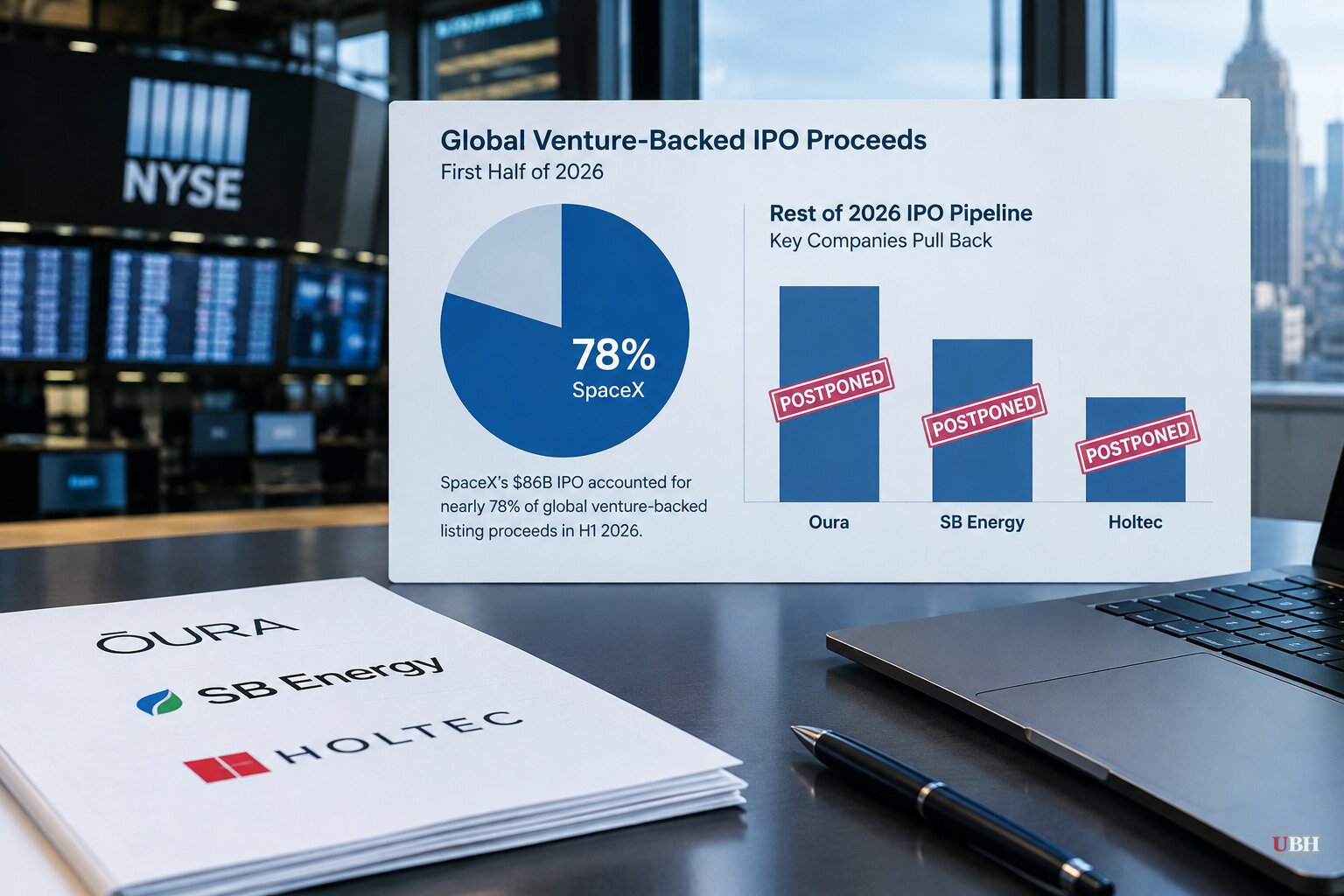
Since SpaceX's record $86 billion debut in June accounted for nearly 78% of the $110.8 billion venture-backed companies raised globally through IPOs in the first half of 2026, according to Crunchbase News, Wall Street expected the rest of the year would bring more of the same. Those expectations are now fading.
Smart-ring maker Oura postponed its IPO on Wednesday, September 30, citing "uncertainty in the IPO market," according to LiveMint. The company had been aiming to raise up to $2.2 billion at a roughly $15.6 billion valuation, but people familiar with the matter told LiveMint that potential investors balked at the price and questioned whether Oura's revenue growth could hold up as consumers feel the squeeze from higher prices and interest rates.
Oura wasn't alone. SoftBank-backed data-center company SB Energy delayed its IPO date after pushback on valuation, people close to the deal told LiveMint. Nuclear-reactor company Holtec withdrew its filing earlier this month, citing unfavorable market conditions. Nvidia-backed cloud startup NScale was expected to launch its investor roadshow as soon as this past week, but LiveMint reported that timing may now shift. Dunkin' owner Inspire Brands, which had eyed a late-2026 or early-2027 listing, is now unlikely to go public this year unless publicly traded restaurant rivals start trading better, according to people familiar with the matter cited by LiveMint.
The two biggest names in the pipeline are moving in opposite directions on timing. Anthropic is weighing a November listing after originally targeting earlier in the fall, the Wall Street Journal reported, as cited by LiveMint. OpenAI, which filed for an IPO within days of Anthropic back in the spring, has pushed its own offering to at least next year, saying it wants more safety-related work done across the industry first. OpenAI is instead talking to investors about raising additional money privately. Advisers told LiveMint that OpenAI's delay actually takes pressure off Anthropic, potentially giving it a fundraising advantage if it beats its rival to market.
A Weak Debut Underscores the Mood
One IPO did go forward. Data-center infrastructure company Accelevation priced its offering below its marketed range, selling shares at $18 after being marketed at $20 to $24, and raised $540 million, according to Bloomberg reporting cited on Yahoo Finance.
Renaissance Capital's Matt Kennedy told Reuters, as quoted on Yahoo Finance by hosts Julie Hyman, Pras Subramanian and Jake Conley, that "AI infrastructure is the dominant theme of the 2026 IPO market, but there's no question that market conditions have worsened. Not long ago, IPO investors would line up for almost any AI infrastructure play. That's no longer the case." The Yahoo Finance panel also flagged that roughly two-thirds of Accelevation's shares came from private equity firm Olympus Partners selling down its stake rather than the company issuing new shares to raise capital, a structure Pras Subramanian noted echoed concerns raised about Oura's offering.
The Macro Backdrop Investors Are Weighing
The IPO retreat is playing out against a stock market that, on the surface, looks fine. The Nasdaq composite hit an all-time high near 27,300 in September and the S&P 500 topped 7,800 for the first time, according to the Epoch Times. But Mahoney Asset Management's Ken Mahoney told the Epoch Times that "the indexes can hide what's happening underneath," warning that narrow leadership from a handful of mega-cap names has papered over broader market stress.
That stress is tangible. West Texas Intermediate crude surged more than 30 percent in the third quarter, trading between $70 and $105 a barrel, the Epoch Times reported. Diesel hit a record $6.51 a gallon. The Federal Reserve's benchmark rate now sits between 3.75 percent and 4 percent, and annual core PCE inflation held at 3 percent in August. For a company trying to convince public investors its growth story justifies a rich multiple, that's a tougher pitch than it was a year ago.
Crunchbase's Mark Williams argues the window isn't closed, just narrower. Williams writes that companies with public-company-quality reporting, clean governance and a credible path to profitability can still get deals done. Those that can't demonstrate it are the ones getting shelved. Datasite data cited by Williams shows capital-raising project kickoffs, an early indicator that can precede public filings by six to nine months, rose 32 percent globally in the first half of 2026, suggesting more companies are quietly preparing even as headline listings stall.
The open question is whether Anthropic actually files for its reported November window, whether NScale's roadshow slips further, and whether Inspire Brands waits out 2026 entirely. None of those outcomes is locked in yet.
Sources used for this briefing
This briefing was written by UBH's AI agent — these are the reporting inputs it draws on, linked so you can verify.


