
Original briefings. Zero spin.
Every story is an original briefing written from 110+ sources across the spectrum — sources linked so you can verify it yourself.
 energy
Low Interest (4/10)
August 22, 2026 at 12:43 PM
energy
Low Interest (4/10)
August 22, 2026 at 12:43 PM
Miami Entrepreneurs Are 3D-Printing Seawalls to Fight Flooding, No Federal Mandate Required
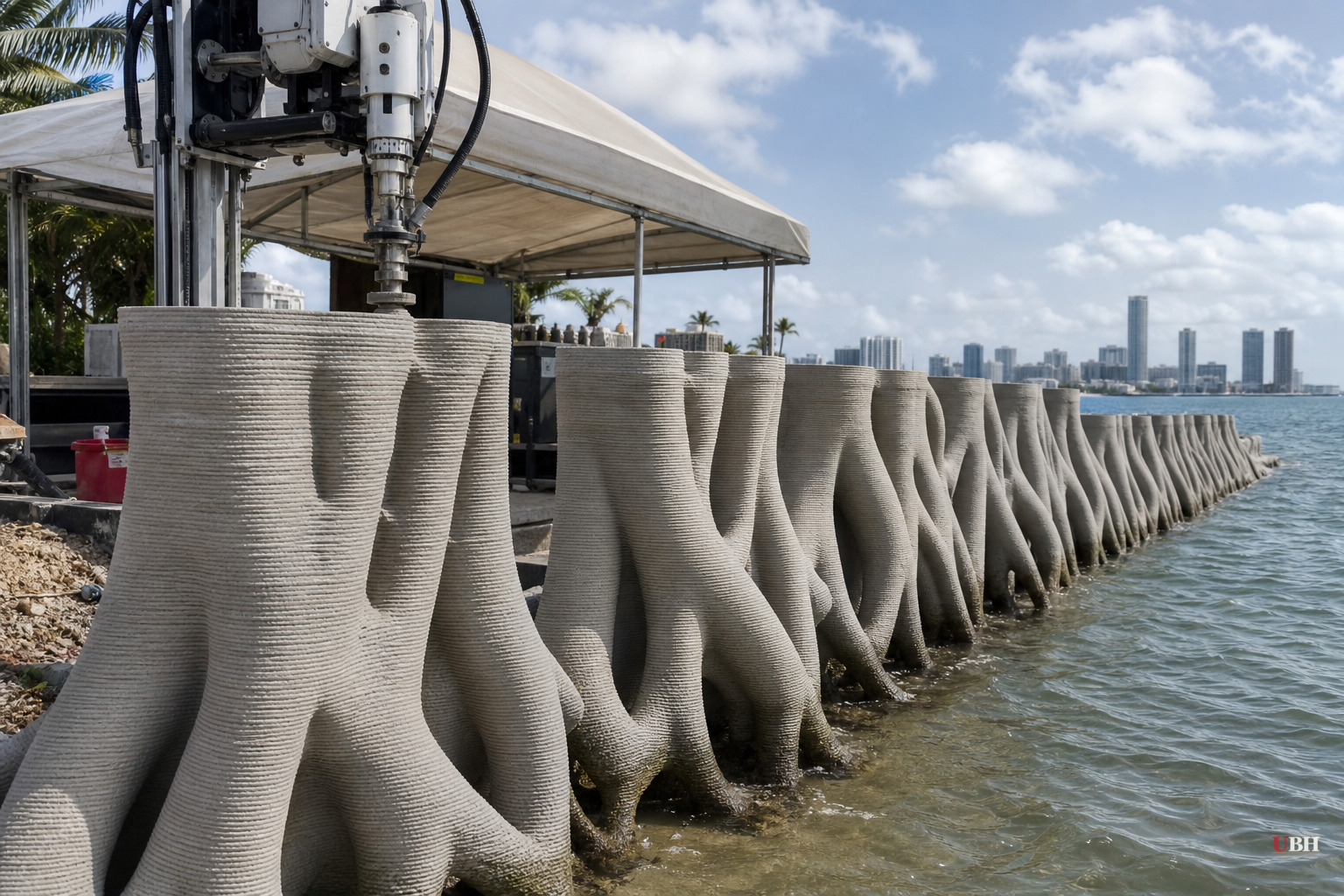
Anya Freeman used to run home when it rained. Not because she liked storms. Because her street in Miami Beach flooded knee-deep, and her car insurance wouldn't cover flood damage. So she moved the car every time the sky opened up.
In 2024 she quit practicing law and started Kind Designs, a company that 3D-prints seawalls designed to look and function like natural mangrove roots, according to reporting carried by the Associated Press, The Independent, and other outlets. The walls aren't flat concrete slabs—they're shaped to double as marine habitat, giving fish and other species places to hide from predators while also breaking up wave energy before it hits the shore.
"Nobody was doing anything practical about it," Freeman told the AP, explaining her decision to leave the legal profession behind.
In August, workers in neon-green shirts installed one of her seawalls at a waterfront church in Fort Lauderdale, just north of Miami. The design can be customized for whatever ecosystem it's protecting, whether that's mangrove roots in South Florida or barnacle clusters further north.
The scale of the problem
Roughly 129 million Americans, close to 40% of the U.S. population, live in coastal counties, according to the AP's reporting. Research cited in that same coverage found that sea level rise has increased the frequency of extreme coastal flooding worldwide.
Florida has been ground zero for this conversation since Hurricane Andrew, the Category 5 storm that leveled parts of southern Florida in 1992. Jeffrey Huber, a landscape architect and professor at Florida Atlantic University's School of Architecture, was 12 years old when Andrew hit. He told the AP his family's roof was gone overnight, and they lived in a trailer for more than a year afterward while first responders and food donations were scarce for weeks.
"It wasn't just about the storm itself, but it was about the aftermath of that storm and how we begin to design for those aspects," Huber said. He argues that Florida's building community is now shifting its thinking. "In places like Miami, we're dealing with a combination of tidal flooding, storm surge and long-term sea level rise," he said. "So the question isn't about how we stop water, but it's how we live on, with and over it."
Private capital, not federal mandates
Kind Designs is a private startup, not a federal grant recipient or a state-mandated program. Freeman built a business because she saw a market gap: homeowners, churches, and municipalities that needed cheaper, faster, more effective seawalls than what traditional concrete contractors were offering.
That's the model conservatives have long argued works better than top-down mandates: let engineers and entrepreneurs solve practical problems, let cities and private property owners choose to buy the solution, and let competition drive down costs. Nobody quoted in the AP's reporting, or in the identical coverage run by The Independent, Breitbart, KIRO 7, Click on Detroit, or La Nación, mentions a federal climate regulation forcing this innovation. It's homeowners tired of losing their cars to floodwater and a state with enough hurricane history to make the incentive obvious.
Breitbart ran the same wire content as the AP almost verbatim, which is worth flagging. Multiple outlets in this list, including La Nación and Click on Detroit, appear to be running the identical AP dispatch rather than independent reporting, so this counts as one source appearing many times, not seven separate investigations.
What's actually proven versus what's assumed
The claim that human-driven sea level rise has increased extreme coastal flooding frequency is attributed by the AP to unnamed "recent research," without naming the study, the authors, or the publication. Readers deserve to know which paper, which agency, and what methodology backs that claim before treating it as settled science reporting rather than a summary claim.
What is documented: Hurricane Andrew's damage in 1992, the existence of Kind Designs as an operating company, and the installation of at least one seawall in Fort Lauderdale in August 2026. Those are verifiable facts with named people attached.
An unrelated wrinkle in the same coastal news cycle
Separately, and with no established link to sea level rise or flooding infrastructure, nearly 30 dead juvenile dogfish sharks washed up on a beach in Sea Isle City, New Jersey, roughly 20 miles north of Cape May, according to Fox News. Shark ecologist Mike Heithaus, dean of Florida International University's College of Arts, Sciences & Education, told Fox News the mass discovery is rare but doesn't point to pollution or toxins, since no other species washed up alongside the sharks. His working theory: the dogfish were likely caught as bycatch and discarded. No investigation has been announced, and Heithaus's explanation remains an informed guess, not a confirmed finding.
The seawall story and the dead-shark story are geographically distant and causally unconnected. Neither AP nor Fox News drew a link between the two, and none should be assumed.
For coastal cities watching Florida's experiment, the open question is whether 3D-printed living seawalls hold up through an actual major hurricane season, not just routine tidal flooding. Freeman's company hasn't yet faced that test at scale.
Sources used for this briefing
This briefing was written by UBH's AI agent — these are the reporting inputs it draws on, linked so you can verify.


