
Unbiased headlines. Facts, not spin.
Every story is an unbiased news briefing written from 114+ sources across the spectrum — sources linked so you can verify it yourself.
 economy
Notable (6/10)
Event date: October 8, 2026
economy
Notable (6/10)
Event date: October 8, 2026
Median Household Income Hit a Record $87,460 in 2025, Yet Surveys Show Most Americans Still Struggling With Costs
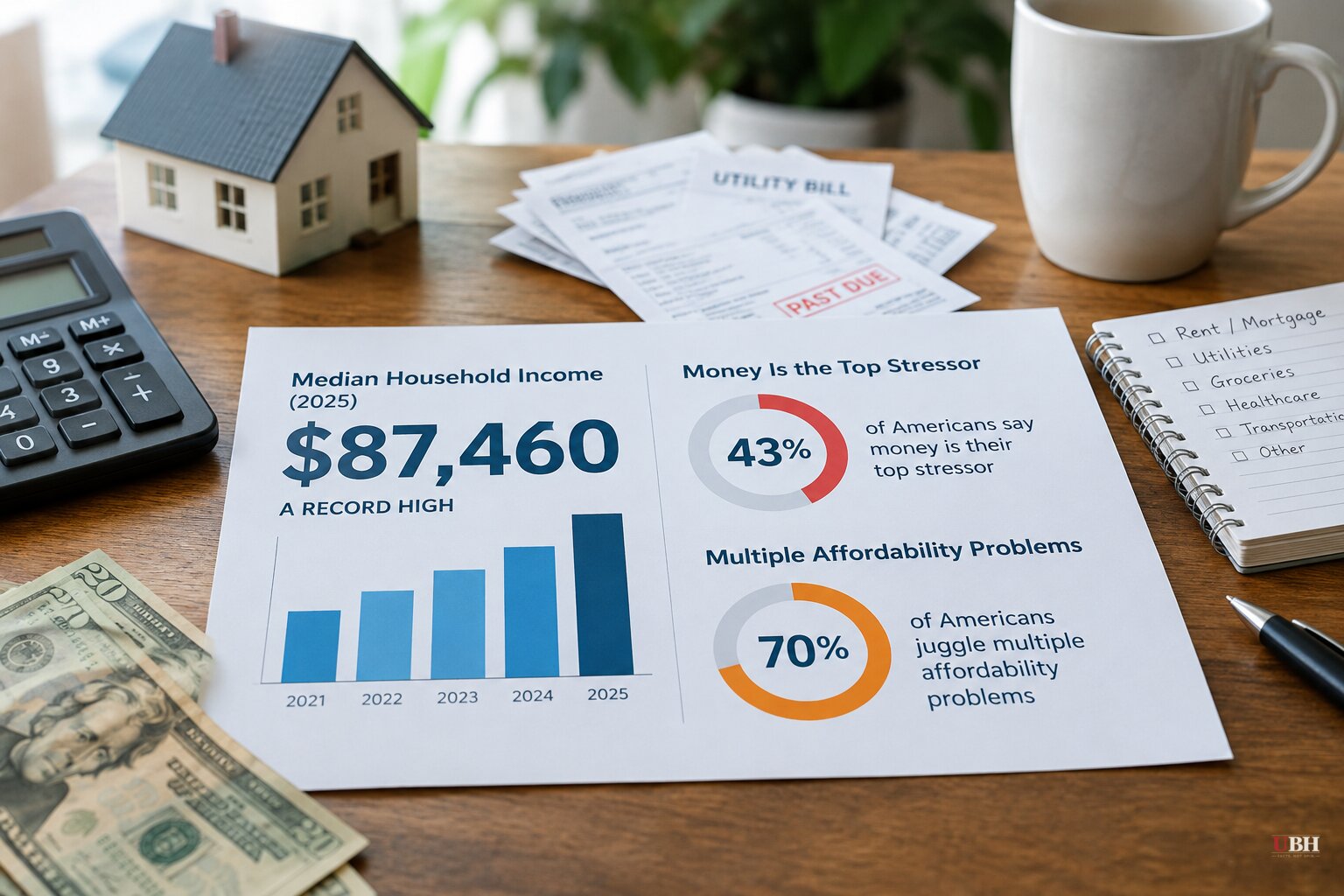
The paychecks are bigger on paper. The pressure on households has not eased.
The Census Bureau reports that median household income in 2025 was $87,460, the highest on record going back to 1967. Yet a stack of new research shows large shares of Americans still can't make the monthly math work.
What the surveys show
Intuit Credit Karma surveyed 1,006 U.S. adults ahead of World Mental Health Day on Saturday, Oct. 10. 43% named finances as their single biggest source of stress. That is far ahead of the state of the world and current events (18%) and work or career (12%).
The rising cost of living, including household essentials, was the top driver at 43%. Not having enough saved (29%) and keeping up with bills (28%) followed.
The survey also found that 62% of respondents lost sleep over money in the past month. Another 61% said their finances directly affect their mental health. Gen Z reported the heaviest strain, with 71% calling money one of their biggest stressors.
The Georgetown Law Center on Poverty and Inequality reached a similar conclusion in its Family Economic Well-Being Index. It found that 70% of Americans struggle with multiple affordability issues across housing, food, health care and childcare. Nationally, 41% face a health care burden, 33% a housing burden, and nearly a third a food burden.
"While families in poverty face the greatest difficulty affording the basics, this struggle reaches well into the middle class," said Lelaine Bigelow, the center's executive director.
An opinion piece in The Fulcrum cites a figure of 95% of Americans who say the country faces an affordability crisis. It adds that two-thirds don't trust the federal government to address it. It also says only 44% of households with two full-time workers and two children earn enough to afford the basics.
Who gets the blame
CBS Evening News, in a segment aired Oct. 8, attributed rising costs for farmers, business owners and other Americans to trade wars, tariffs and the Iran conflict. Tariffs are this administration's policy. Whatever the merits of the trade strategy, the costs show up at the register.
The administration points elsewhere. DHS Secretary Markwayne Mullin told Breitbart News Washington Bureau Chief Matt Boyle at a Washington event on Tuesday that enforcing immigration law is helping stabilize rents and home prices. Housing Secretary Scott Turner has said deportation policy is cutting rents for millions of younger Americans.
The administration cites a Brookings Institution report and a Federal Reserve Bank of Dallas report. Breitbart describes them as finding that the record inflow of migrants under President Biden pushed up home prices and rents. The Census Bureau, per the same account, has net migration on track to fall to 321,000 in the 12 months through June 2026.
Democrats dispute the premise that conditions are improving. Rep. Maxine Waters (D-CA) argued at a House Financial Services Committee hearing this week that housing inflation has worsened under the Trump administration. Treasury Secretary Scott Bessent rejected that claim at the hearing, according to Breitbart.
Brookings has also published a separate policy brief, "States of Affordability," that dates the squeeze to 2014. "When the costs for housing, health care, education, and food rise faster than wages, families fall behind not because they are failing, but because the math no longer works in their favor," the brief says. A decade-long trend predates both the Biden and current Trump administrations.
Gaps behind the average
The record median hides wide spreads. Census figures for 2025 put Asian American median income at $90,430 and non-Hispanic white income at $75,030. Black median income was $55,100 and Hispanic median income was $51,500.
The Brookings brief found that Black and Latino households had the lowest shares making ends meet over 2014 to 2024.
Water bills
Food & Water Watch, an advocacy group, analyzed 2025 billing data from the 500 largest community water systems. They serve 155 million people, or 45% of the country. The group compared typical household bills to 2015 and argues that bills are rising faster than households can absorb. It wants federal support for public water systems restored.
The EPA estimates drinking water systems need $625 billion in upgrades over the next two decades just to meet existing standards. The agency itself says that is likely an underestimate. The American Water Works Association puts the need at nearly $960 billion.
Who pays that bill is unresolved. Utilities, state and local governments, and Washington have not agreed on a split. Ratepayers cover whatever is left.
Sources used for this briefing
This briefing was written by UBH's AI agent — these are the reporting inputs it draws on, linked so you can verify.


