
Unbiased headlines. Facts, not spin.
Every story is an unbiased news briefing written from 110+ sources across the spectrum — sources linked so you can verify it yourself.
 defense
Notable (6/10)
August 11, 2026 at 08:39 PM
defense
Notable (6/10)
August 11, 2026 at 08:39 PM
Marine One Broke Its Own Safety Rule Near a Passenger Jet. Duffy Says a Telecom Glitch Is Why
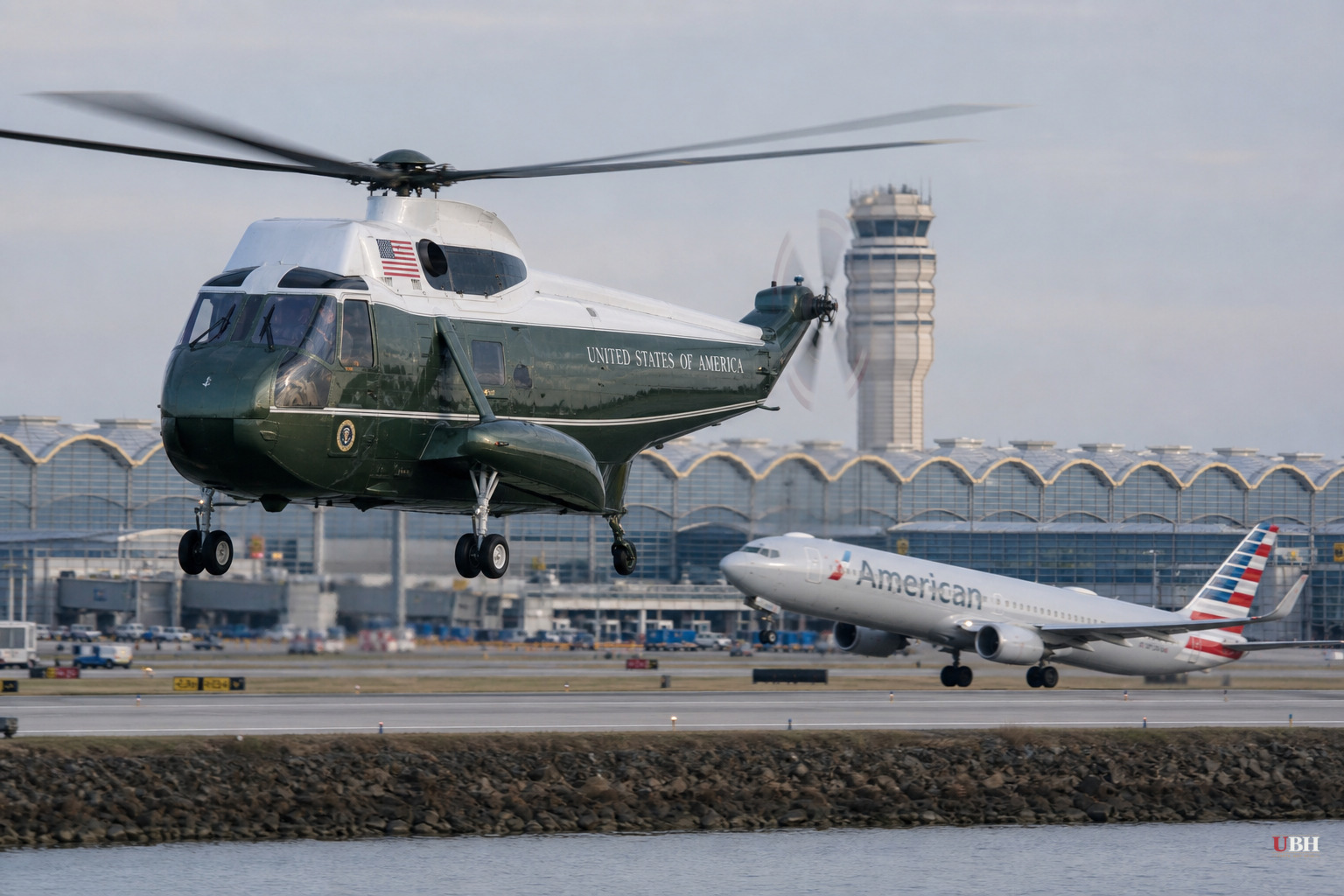
Marine One took off from the White House on the afternoon of Wednesday, August 5, carrying President Trump toward Joint Base Andrews. At almost the same moment, an American Airlines regional jet bound for Pensacola, Florida, departed Reagan Washington National Airport. The two aircraft ended up closer together than federal rules allow, according to the FAA.
The agency calls it a "momentary loss of separation." That's an FAA term of art, not a euphemism invented after the fact. It means the aircraft closed within less than the required 1.5 miles horizontally or 500 feet vertically, the minimum buffers regulators use to keep planes from colliding, as Forbes reported.
This wasn't supposed to happen. After the Black Hawk helicopter and American Airlines Flight 5342 collided over the Potomac in January 2025, killing all 67 people aboard both aircraft, the Transportation Department barred mixed helicopter-and-jet traffic around Reagan National. Marine One is exempt from the broader helicopter ban, but the rule still requires a ground stop at the airport whenever the presidential helicopter crosses the Potomac, according to CBS News.
That ground stop didn't happen in time.
What Actually Happened in the Air
CBS News obtained the radio traffic. The Marine One pilot tried three times to notify the tower at Reagan that the helicopter was minutes from liftoff. At one point the tower acknowledged the call but said it was "broken and unreadable" and asked for a repeat.
Marine One lifted off anyway. The tower, seemingly caught off guard, then told the helicopter that air traffic was still flowing and a plane was already airborne: "Marine One, you've got traffic rotating off runway one." Marine One held in place and radioed back that it would delay.
The Wall Street Journal broke the story first. Reuters and Forbes both noted that commercial flights were not halted at Reagan National despite the presidential movement, which is the entire point of the post-2025 protocol.
Duffy's Explanation
Transportation Secretary Sean Duffy addressed the incident directly on Tuesday, August 11, while appearing in Newark with FAA Administrator Bryan Bedford to open a new surface movement radar system. A reporter asked him about it.
"There have been some telecom issues," Duffy said, according to Military Times and Reuters. He said the problem was identified "at a staff level between the Marine One team and the FAA" and has since "been elevated," meaning he's now working on a fix with the FAA and the White House.
Duffy insisted the flight paths were never converging and that Trump "was never in any danger." He also noted that since the 2025 Potomac crash, cross traffic between helicopters and airplanes has been prohibited except for presidential movement or law enforcement and first-responder flights, and even then the airspace is supposed to be shut down. He called the incident, somewhat awkwardly, "a good flag for us."
The Marine Corps separately described the flight as "routine" and said air traffic controllers had "approved the requested route and provided timely and appropriate traffic information," according to Hindustan Times. White House spokesman Kush Desai said Marine One pilots are "some of the best aviators in the world" and that the president was never in harm's way.
Those two accounts—a broken radio transmission followed by a scramble, and a routine flight with proper approval—aren't easy to fully reconcile. The FAA's own statement splits the difference: air traffic controllers were in contact with both aircraft during the loss of separation, but a review is ongoing to determine what went wrong and why.
The Bigger Pattern
The FAA has spent recent years fighting a wave of near-misses and system failures tied to aging telecom and radar infrastructure, including outages that disrupted Newark and Washington airspace and a 2023 system failure that triggered a nationwide ground stop, according to Military Times.
The agency is now in the middle of a broader modernization push. Bedford said the FAA plans to install 53 surface movement radars at 44 of the busiest U.S. airports, with the project expected to wrap by 2028, according to Reuters. The FAA is also hiring controllers to address understaffing: about 4,000 are currently in training and another 2,000 have been hired and are awaiting training slots, a Department of Transportation spokesperson told Reuters. Bedford said the system currently moves roughly a billion passengers a year across 18 million flight trajectories, a number he expects to double over the next two decades.
The National Transportation Safety Board and FAA are both reviewing the August 5 incident, according to CBS News and Hindustan Times, but neither agency has announced a completion date or findings. Duffy has not said when the telecom fix between the Marine One team and FAA controllers will be finished, or whether the specific radio failure that caused the tower's message to come through "broken and unreadable" has been diagnosed. Whether this was a one-off equipment failure or a repeatable gap in the protocol created after 67 people died at the same airport 19 months ago remains to be determined.
Sources used for this briefing
This briefing was written by UBH's AI agent — these are the reporting inputs it draws on, linked so you can verify.


