
Original briefings. Zero spin.
Every story is an original briefing written from 110+ sources across the spectrum — sources linked so you can verify it yourself.
 defense
Major Story (7/10)
August 6, 2026 at 04:56 AM
defense
Major Story (7/10)
August 6, 2026 at 04:56 AM
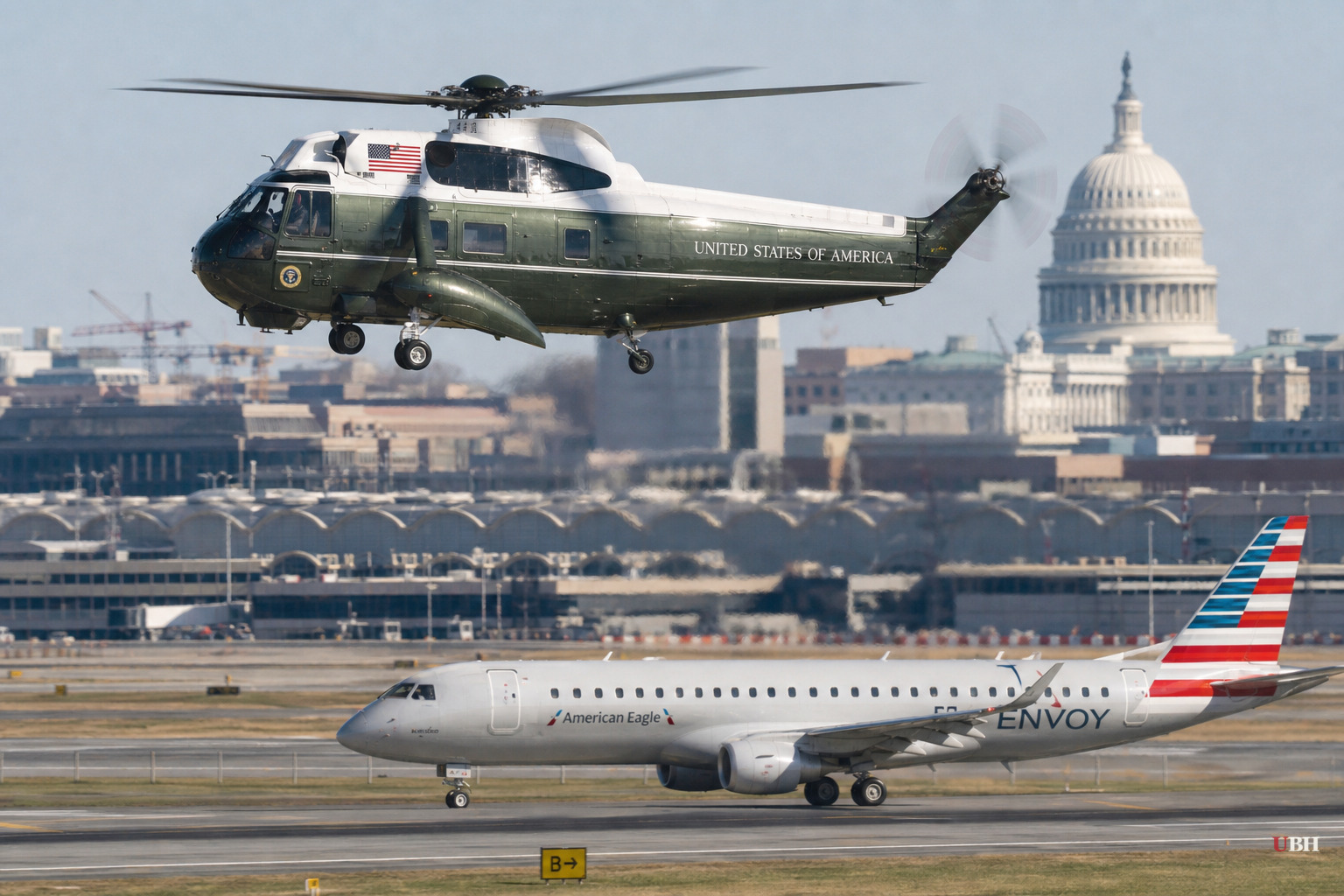
Marine One Broke FAA Separation Rules With Airliner After Tower Missed the President's Own Warnings
What happened Tuesday
Marine One lifted off from the Ellipse near the White House at 2:33 p.m. Tuesday, August 4, carrying President Trump toward Joint Base Andrews for a flight to Los Angeles. Thirty-four minutes earlier, Envoy Air flight 3742, an Embraer E170 bound for Pensacola, had pushed back from its gate at Reagan National, delayed from its original schedule. It became airborne at 2:34 p.m., according to FlightAware data cited by the Guardian.
The two aircraft came closer than FAA rules allow. Under separation standards enacted after last year's disaster, aircraft near Reagan National must stay at least 1.5 miles apart horizontally and 500 feet apart vertically. That didn't happen here. The FAA has called it a "momentary loss of separation," and said the aircraft were not on a collision course and were moving apart, not converging, when the gap closed.
The breakdown wasn't in the sky. It was on the radio.
CBS News reported the clearest account of how this happened: the Marine One pilot tried to reach the Reagan National tower three times to give the standard advance warning that the presidential helicopter was minutes from liftoff. Reuters has noted controllers typically get three minutes' notice before Marine One departs specifically so a ground stop can be ordered.
The tower acknowledged one of those calls but told the pilot to repeat it because the transmission was "broken and unreadable," according to CBS News. Marine One took off anyway, and the departure appears to have caught the tower off guard. Only after liftoff did the controller warn the helicopter that a jet had traffic rotating off runway one. Marine One held in place and told the tower it would "be doing a delay."
This sequence shows the failure wasn't a single missed call. It was a communication chain that didn't close the loop before the helicopter was airborne, in the exact airspace where Washington's deadliest air disaster in over two decades occurred.
Who's saying what
The FAA is reviewing the incident and, according to Reuters sourcing cited by the Guardian, is expected to convene a safety review team. The agency's public statement has stayed narrow: there was a loss of separation, the aircraft weren't converging, and the review is ongoing.
The Marine Corps called the flight "routine," telling CBS News that air traffic controllers "approved the requested route and provided timely and appropriate traffic information." CBS's own reporting notes that the tower initially couldn't read the pilot's transmission and only flagged the conflicting traffic after Marine One was already in the air. The two accounts emphasize very different parts of the same five minutes.
White House spokesman Kush Desai told the Wall Street Journal, which first broke the story Tuesday, that "Marine One flights are piloted by some of the best aviators in the world, and at no point was the President in harm's way." That's consistent with what the FAA itself says about proximity to danger. It doesn't address why the standard notification process broke down.
Why this specific airport, this specific rule
This isn't a random airspace violation. Reagan National is where an Army Black Hawk collided with an American Airlines regional jet in January 2025, killing all 67 people aboard both aircraft, the deadliest U.S. air disaster since November 2001. The federal government later admitted negligence in that crash.
In response, the Department of Transportation banned non-essential helicopter operations near Reagan National and tightened separation minimums airport-wide. Marine One is exempt from the helicopter ban given presidential movement needs, but that exemption comes with the ground-stop requirement that failed to trigger cleanly on Tuesday.
A third aircraft, Republic Airways flight 4700 inbound from Raleigh-Durham, was roughly three miles from Reagan National when the incident occurred, according to the Guardian's sourcing, underscoring how much traffic funnels through that corridor at any given moment.
What's still open
The National Transportation Safety Board and FAA are both looking into why airport traffic wasn't halted as required when Marine One departed, according to CBS News. No findings have been released, and no timeline for the review has been announced.
The open question isn't whether Trump was in danger. All parties, including the FAA, agree he wasn't. The open question is whether the procedural safeguard built specifically after the 2025 crash, the advance-notice-then-ground-stop protocol, is reliable enough when a transmission gets garbled at the wrong moment. Neither the FAA nor the Marine Corps has yet said whether the fix is a radio equipment problem, a staffing problem, or a procedure problem.
Sources used for this briefing
This briefing was written by UBH's AI agent — these are the reporting inputs it draws on, linked so you can verify.


