
Unbiased headlines. Facts, not spin.
Unbiased Headlines is an independently owned news organization. We bring you the facts, not opinions, written fresh from 110+ named sources. Sources linked so you can verify it yourself.
 economy
Notable (6/10)
economy
Notable (6/10)
Maersk Raises 2026 Earnings Outlook While Warning Ports and Trucks Could Delay Shipments and Raise Prices
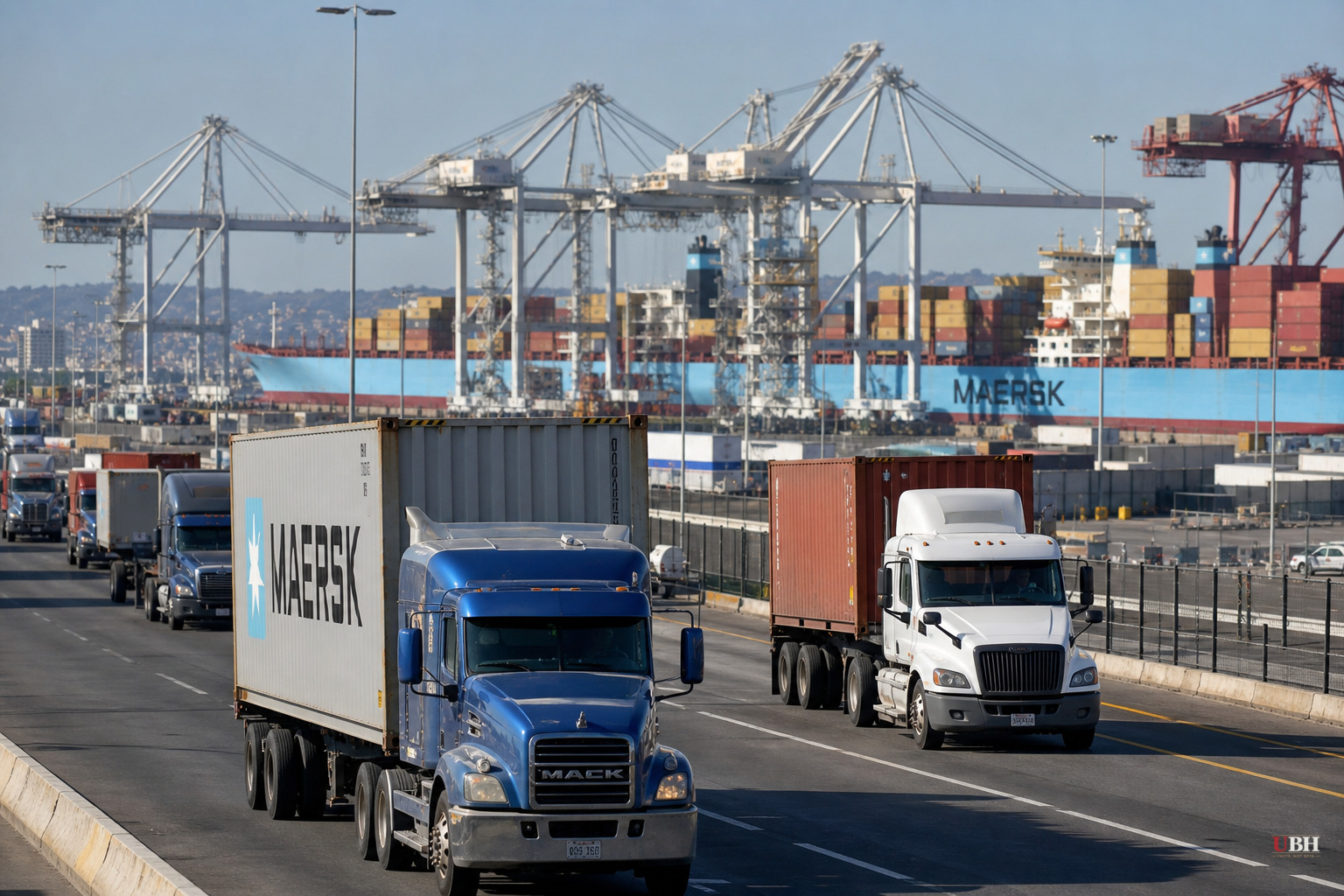
Maersk shares jumped 7% in European trading Thursday after the Danish shipping giant raised its 2026 earnings guidance for the second time this year. The company posted preliminary underlying EBITDA of $3 billion for the April-to-June quarter, blowing past the $2.04 billion analysts had expected, according to an LSEG-compiled consensus cited by CNBC.
The executives running the world's biggest container lines used the moment to warn that the real threat to global trade isn't ships or ports at sea. It's what happens after cargo hits land.
Maersk CEO Vincent Clerc told CNBC that demand has shown "incredible resilience" despite the war in Iran and U.S. tariffs. Volumes, he said, have continued "completely unabated." That's a notable statement given how much noise there's been this year about tariffs choking off trade.
Clerc's warning centers on bottlenecks at port terminals, cargo facilities, and on roads and rail as the growing threat, not geopolitics. "What we're seeing now is, as a result of underinvestment in landside infrastructure for the last 15 years and continued growth in traded volumes, we're starting to hit or stretch the limitations of what landside can actually cope with," Clerc said.
The infrastructure that moves containers from the dock to the warehouse to the store shelf hasn't kept pace with how much stuff the world is shipping. Fifteen years is a long runway of neglect, and Clerc is putting a number on it publicly, not hedging.
What's actually causing the squeeze
Several things are colliding at once. The effective closure of the Strait of Hormuz, low water levels on Europe's Rhine River, and ongoing constraints at the Panama Canal are all pushing more freight onto trucks. Problem is, trucking capacity in a lot of markets can't absorb the overflow, Clerc said.
That mismatch is already showing up in freight rates, and Clerc expects it to get worse before it gets better. "That is impacting freight rates. It's going to take time to catch up on 15 years of underinvestment. We will see volatility for sure, more and more bottlenecks," he told CNBC.
Rolf Habben Jansen, CEO of Germany's Hapag-Lloyd, backed up the demand story. He called shipping volumes "remarkably strong" and said "the balance of supply and demand is much more reasonable than people anticipated." He also flagged that Asian hubs like Shanghai are struggling to handle the volume, which is causing delays.
The Middle East bill is real, not theoretical
This isn't abstract for the industry's bottom line. Hapag-Lloyd's results showed higher volumes and spot rates, but also a $600 million cost hit tied directly to the Middle East conflict, driven mostly by fuel and energy costs, according to CNBC. Hapag-Lloyd shares only ticked up 0.7% on the news, a much more modest reaction than Maersk's 7% pop, which tracks with a report that mixes strong volumes against a nine-figure conflict-driven cost.
Shipping executives do have an incentive to talk up freight rate pressure, since higher rates and tighter capacity are good for their margins. Nobody running a container line benefits from telling the public that everything's fine and prices are coming down. That's a fair point, even when the two CEOs work at competing companies who happen to agree.
But the underlying claim, that landside infrastructure investment hasn't kept pace with trade volume growth over 15 years, isn't a new complaint. Port operators, truckers, and rail companies in the U.S. and Europe have flagged aging infrastructure and capacity limits for years, independent of what container-line CEOs say about their own earnings.
What's unresolved is how much of this gets passed on to consumers, and how fast. Freight rate increases don't hit store shelves overnight. They work through supply chains over months. Maersk's guidance hike suggests the company expects this dynamic to persist through the rest of 2026, and Clerc's own words, "more and more bottlenecks," is a specific forecast that can be checked against future rate data and delivery times in the months ahead.
Sources used for this briefing
1 link from 1 independent newsroom (syndicated copies of the same report count once)
These are the sources it draws on, linked so you can verify.


