
Unbiased headlines. Facts, not spin.
Every story is an unbiased news briefing written from 110+ sources across the spectrum — sources linked so you can verify it yourself.
 energy
Major Story (7/10)
June 24, 2026 at 07:16 PM
energy
Major Story (7/10)
June 24, 2026 at 07:16 PM
London Climate Action Week Cancels Sessions Due to the Extreme Heat It Came to Discuss
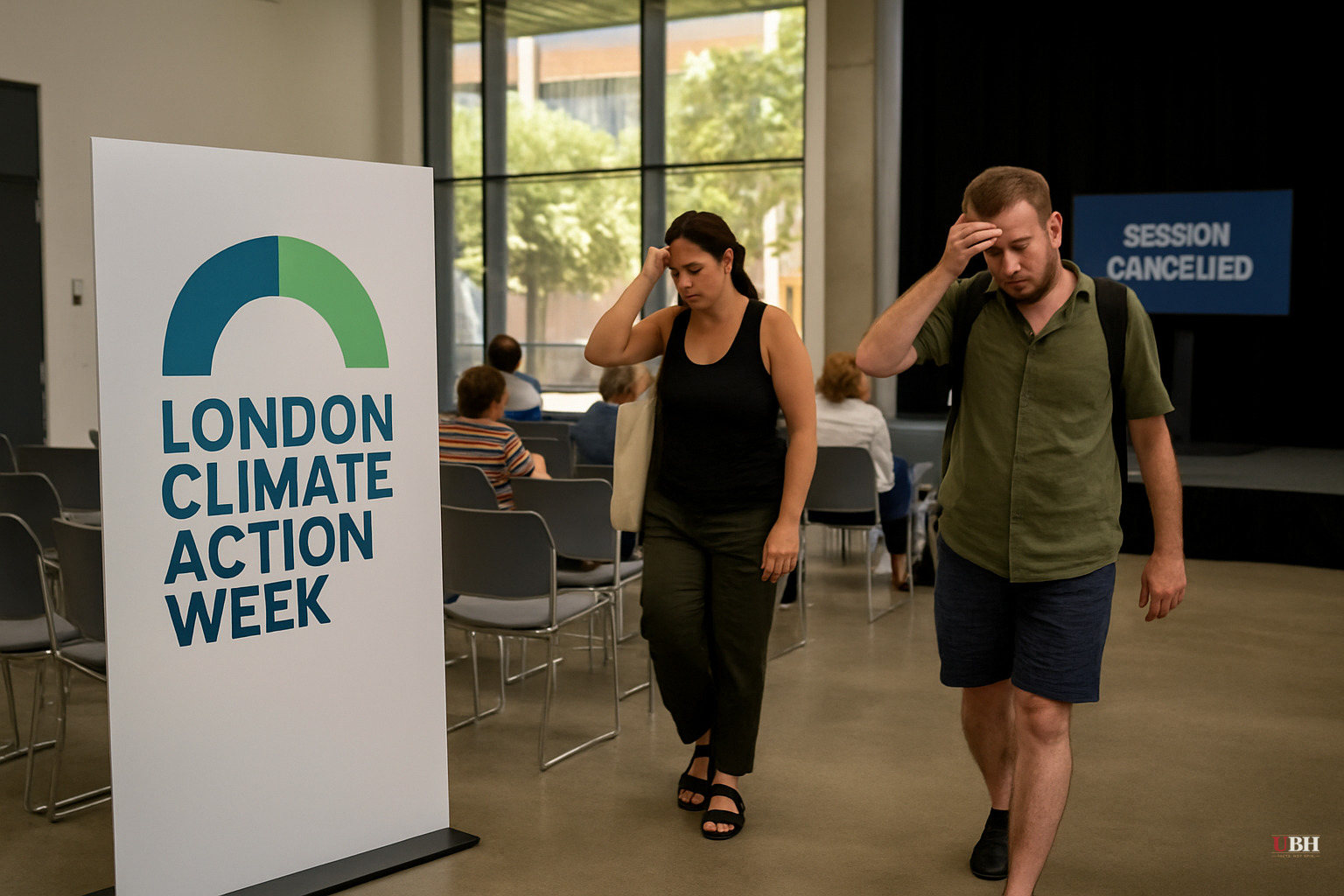
As a deadly heat wave sweeps across Europe, countries are shuttering schools and nuclear plants and rail operators are curtailing operations to avoid overheating tracks. Wednesday's new development: the irony is institutional.
London Climate Action Week, a nine-day gathering that drew an expected 75,000 attendees across more than 1,000 events, has been forced to cancel multiple sessions because of the very conditions it convened to address.
The Conference Is Living Its Own Agenda
The Zurich Climate Resilience Alliance scrapped a Tuesday event specifically focused on extreme heat after concluding that the host library had no air conditioning. The "very unpleasant" indoor conditions, combined with hot transit to the venue, posed genuine risks to speakers and guests, the alliance said.
Earthwatch Europe canceled family events at Hammersmith Park. The charity acknowledged the situation on Facebook with the phrase "a twist nobody wanted, but everyone can appreciate the irony of."
Rupert Read, co-director of the Climate Majority Project, chose not to travel to London at all. He has a heart condition, which extreme heat can aggravate. His organization moved its events online.
Katie Glaze, sustainability director for infrastructure consultancy Brookbanks, pulled out of roughly nine sessions on building adaptation after transport problems made attendance impractical. "The irony is that a lot of the conferences I was going to attend, the topic of discussion is what is happening now," Glaze told Wired. "It's all very future-thinking, but we have the situation now that we're not addressing quickly enough."
What Guterres Said
United Nations Secretary-General António Guterres delivered a keynote at the event Tuesday. His line: "London isn't just calling, it's cooking."
Rhetorical, yes. The point is grounded. The UK Met Office, as of Tuesday, was projecting temperatures reaching 39°C (102°F) on Wednesday. That would smash the UK's June record and, per the Met Office, flirt with the hottest temperature ever recorded in the country.
The Infrastructure Gap Is Real
London amplifies heat. Dense concentrations of concrete, tarmac, and buildings absorb and retain warmth far more than rural land. Vegetation that would otherwise provide cooling is sparse. Most of the city's building stock was designed for a temperate climate, not a heat dome.
Glaze's point cuts through the conference-speak: the gap between long-range planning discussions and present operational capability is not theoretical. Train operators have already advised against all but essential travel, warning that heat can cause overhead power lines to sag, steel rails to buckle, and signaling systems to fail. Schools and nuclear plants have closed across Europe. A major climate conference can't keep its doors open.
The Strongest Counter-Argument
Skeptics of climate policy, particularly those concerned about energy costs and deindustrialization, have a legitimate point worth hearing: Europe's push to phase out fossil fuels ahead of adequate replacement capacity has left several countries more dependent on weather-sensitive energy sources. The argument that current climate policy is more performative than operational has grounding when the very conference meant to advance that policy cannot function in the conditions it predicts.
The counterpoint is that it argues for faster and better adaptation investment, not against acknowledging the heat itself.
What the Wired Coverage Leaves Unaddressed
Wired's reporting accurately captures the cancellations and the irony, but it doesn't press the harder organizational question: who decided to schedule a 75,000-person outdoor and indoor festival in London in late June without contingency plans for extreme heat? Climate scientists have been forecasting more frequent and severe European heat events for years. The Climate Majority Project's Rupert Read had to self-exclude because of a personal health condition, a responsible individual decision. Whether the event's organizers made comparably responsible logistical decisions is a question Wired doesn't ask.
What Happens Next
The remaining sessions of London Climate Action Week are scheduled to continue through the week. Whether additional events get canceled or moved online depends on whether temperatures ease from the projected 39°C peak. The Met Office forecast for the days ahead will be the deciding factor, and as of the time of reporting, no broader suspension of the event has been announced.
Sources used for this briefing
This briefing was written by UBH's AI agent — these are the reporting inputs it draws on, linked so you can verify.


