
Original briefings. Zero spin.
Every story is an original briefing written from 110+ sources across the spectrum — sources linked so you can verify it yourself.
 defense
Notable (6/10)
September 13, 2026 at 12:02 PM
defense
Notable (6/10)
September 13, 2026 at 12:02 PM
Lithuania Shuts Vilnius Airport, NATO Scrambles Jet Over Unconfirmed Drone, All-Clear Within the Hour
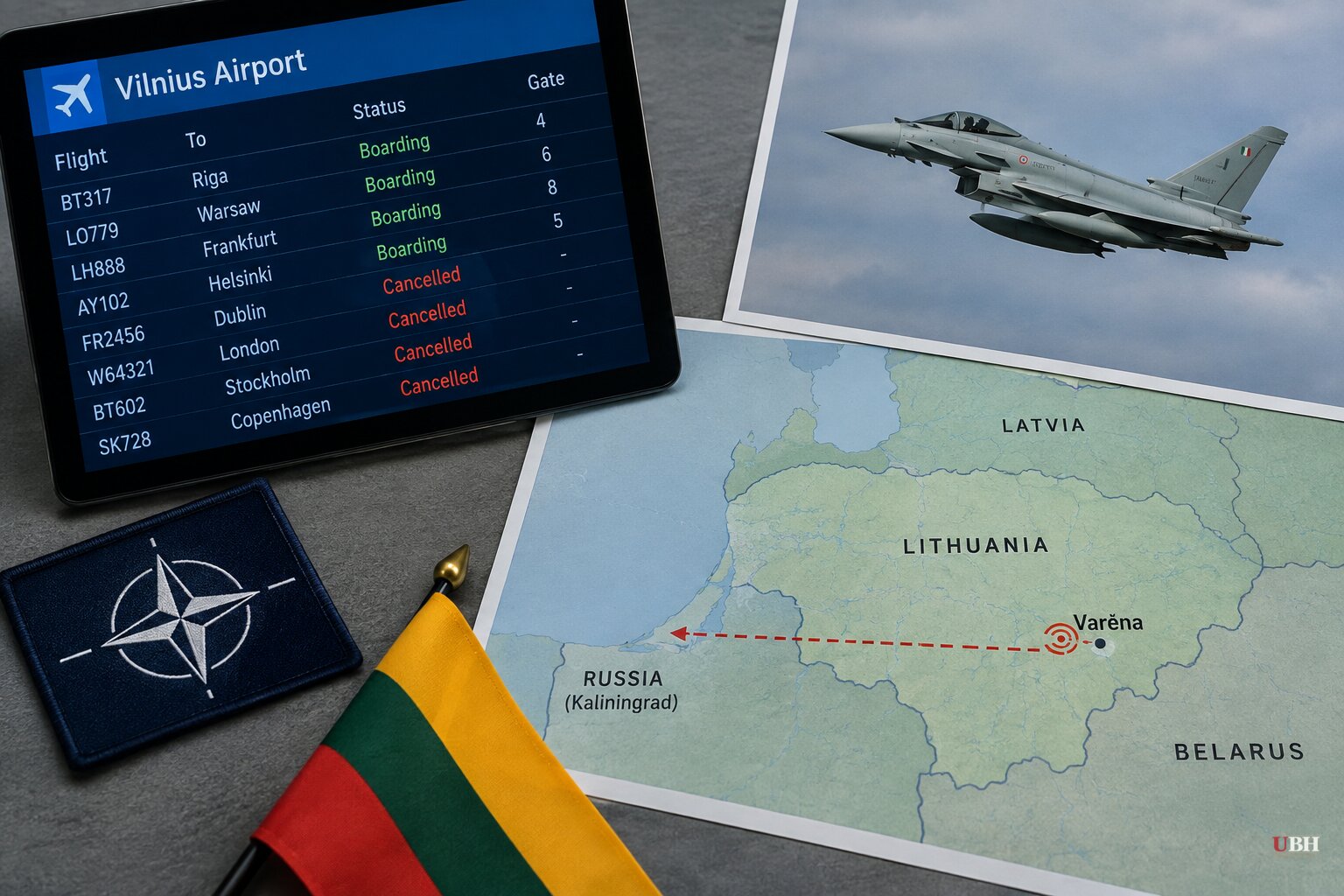
Lithuania's National Crisis Management Centre issued a yellow air alert on Sunday, September 13, covering Vilnius, Trakai and Elektrėnai districts after an unidentified object was picked up on radar near Varėna, moving toward the Russian exclave of Kaliningrad, according to Reuters reporting carried by KFGO and Global Banking and Finance. Vilnius Airport suspended flights and residents were told to seek shelter or stand by for further instructions.
NATO responded by scrambling a jet from Šiauliai air base in northern Lithuania, where Italian air force units are currently stationed as part of the alliance's Baltic Air Policing mission, the crisis centre said. Crypto Briefing reported the closure lasted roughly 30 to 40 minutes; Reuters and Ground News put it closer to an hour. Either way, the all-clear came fast, and Vilnius Airport reopened with no injuries, no damage and no confirmed drone.
Vilmantas Vitkauskas, head of the National Crisis Management Centre, told reporters after the alert lifted: "There is no threat, people can calm down. In principle, the threat level has been eliminated," according to London Loves Business and the Express. The Lithuanian military said flatly that "after the radar tag left Lithuanian airspace, there was no reason to declare an air alert." It remains unclear whether the object was actually a drone.
One Lithuanian outlet reported the object may have crossed into Lithuanian territory from Belarus before continuing toward Kaliningrad, a detail PRM.ua also carried, noting the radar contact reportedly left Lithuanian airspace around 4:25 and entered Kaliningrad. None of the sources fully reconcile that early timing with the yellow alert's midday declaration, and Lithuanian officials themselves said the available radar data was insufficient to determine what the object actually was.
Lithuania has had several airspace scares over the past year, including weather balloons and drone sightings, and not every alert turns out to involve a hostile Russian or Belarusian drone. But Lithuanian officials aren't hiding that uncertainty. They said plainly the object's type couldn't be confirmed and treated it as a precaution, not a confirmed attack.
The Vilnius Marathon, held in the capital the same day, was not interrupted, organizers told Reuters. Life went on around the alert, which some coverage framed as more dramatic than the available facts support.
Where the coverage overreached
The Express ran with the headline "horror attack launched on European capital," language its own article doesn't back up. Nothing in the Express's reporting, or anyone else's, confirms an attack took place. Lithuanian officials never confirmed a drone, let alone a strike. The story's actual facts are: unidentified radar contact, precautionary alert, jet scrambled, all-clear within the hour.
The broader pattern
This isn't an isolated event. Lithuanian Armed Forces said earlier in the week that Russian-made "Gerbera" drones, originally launched at Ukrainian cities, had landed on Lithuanian territory, a claim confirmed by General Raimundas Vaikšnoras, commander of Lithuania's armed forces, according to the Express and London Loves Business. Lithuanian President Gitanas Nausėda has said intelligence points to possible Russian preparations for provocations against Poland or the Baltic states aimed at testing NATO unity, according to PRM.ua.
Former Russian President Dmitry Medvedev added fuel to the tension this week, saying of Lithuania: "No one will come to their defence. Even if the place is reduced to scorched earth, no other country will go to war for them... Article 5 of the North Atlantic Treaty, it will not be invoked, everyone recognises that... But Lithuania will disappear from the map," as quoted by the Express and London Loves Business. NATO has not responded publicly to that specific threat in the available reporting.
The Baltic Air Policing mission, running continuously since 2004 because Estonia, Latvia and Lithuania don't operate their own fighter jets, got a jet airborne within minutes of Sunday's alert. That's the system working as designed. What isn't resolved is what actually triggered it, whether it was a drone, a balloon, or something else, and how many more of these yellow alerts Lithuania will need to sort out before one of them turns out to be the real thing.
Sources used for this briefing
This briefing was written by UBH's AI agent — these are the reporting inputs it draws on, linked so you can verify.


