
Unbiased headlines. Facts, not spin.
Every story is an unbiased news briefing written from 110+ sources across the spectrum — sources linked so you can verify it yourself.
 defense
Major Story (7/10)
June 29, 2026 at 10:57 AM
defense
Major Story (7/10)
June 29, 2026 at 10:57 AM
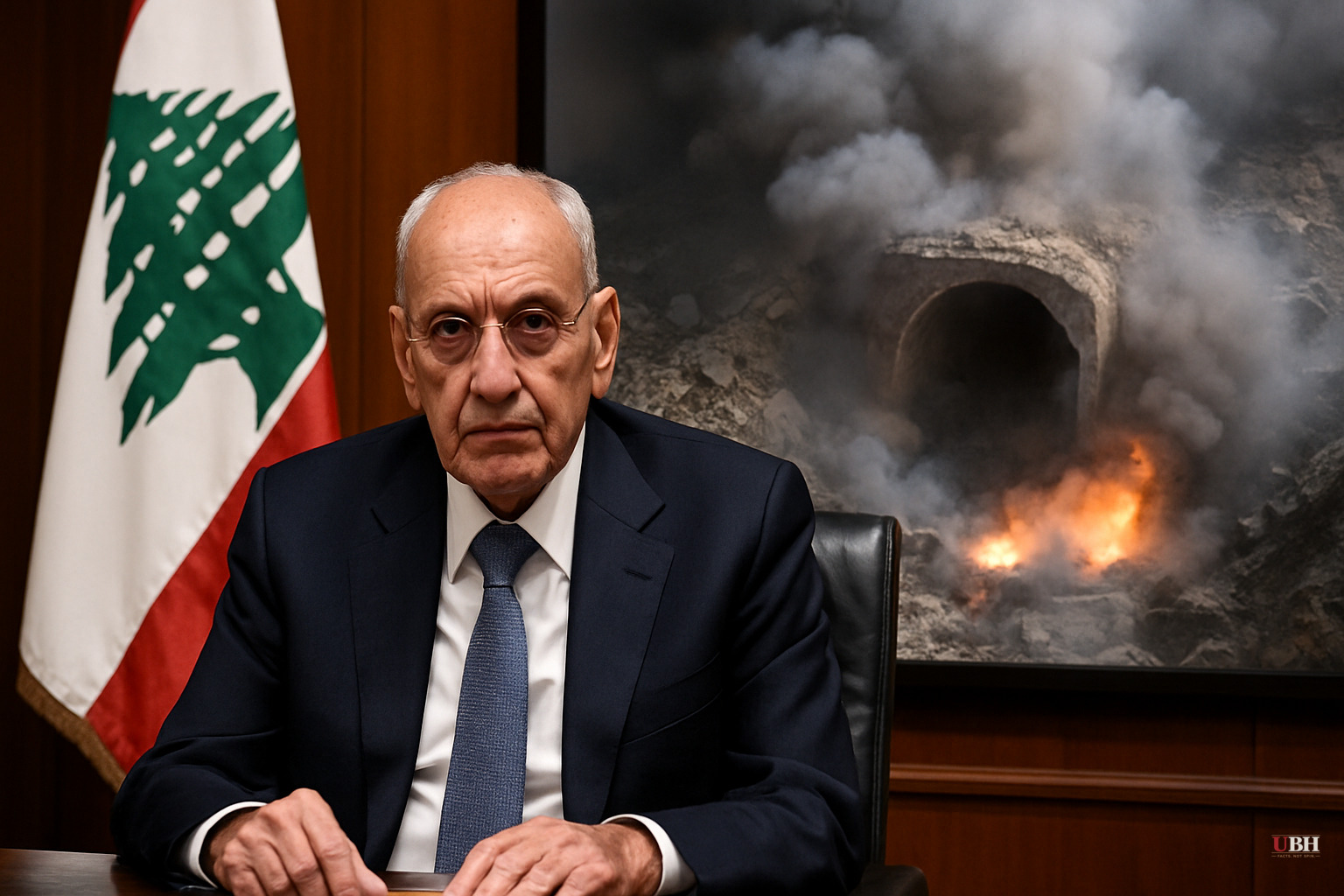
Lebanon's Parliament Speaker Rejects US-Brokered Peace Framework Three Days After Signing, as IDF Destroys Hezbollah Tunnel Complex Inside Security Zone
Since Hezbollah resumed rocket and drone attacks on Israel on March 2 — following the killing of Iranian Supreme Leader Ali Khamenei during Operation Roaring Lion on February 28 — Israeli and Lebanese officials held five rounds of direct talks at the U.S. State Department, culminating in a framework agreement signed Friday in Washington.
Three days later, that agreement is under serious pressure from inside Lebanon.
Berri's Rejection
Nabih Berri, 88, Lebanon's parliament speaker and a longstanding political ally of Hezbollah, said Sunday the framework "will not be adopted and it will not be implemented in its current form," according to Israeli news outlet I24 News. He labeled it an "agreement of dictates" and said it is "10 times worse" than the May 17, 1983 agreement between Israel and Lebanon, which itself was never ratified and ultimately collapsed under pressure.
The New York Post reported that Hezbollah had already declared the deal "null and void" and "humiliating" within days of the signing.
The framework's central condition is that the IDF maintains a security zone in Southern Lebanon until Hezbollah withdraws from the area and its associated infrastructure is dismantled. That condition is precisely what Berri and Hezbollah are refusing.
The Tunnel Destruction
On Sunday, the IDF destroyed an underground Hezbollah complex in the Majdal Zoun area of Southern Lebanon, approximately five miles north of the Israeli border. The site was inside the IDF-controlled security zone. The IDF announced the tunnel was over 200 meters (650 feet) long and more than 25 meters (80 feet) deep, containing hundreds of weapons and several launch silos built to target Israeli territory.
Netanyahu and Defense Minister Israel Katz said in a joint statement that "the underground complex was constructed using technology and expertise provided by the Iranian terror regime." They also confirmed Israel informed Washington before the operation: "Israel updated the United States and the American representative in Lebanon in advance regarding the destruction of the infrastructure."
Israel is acting militarily under the framework's terms while keeping U.S. cover intact.
What the Agreement Actually Requires
The framework conditions Israel's eventual withdrawal from the security zone on Hezbollah leaving the south and the dismantling of its military infrastructure. The IDF stated Sunday that its forces "will remain in the security zone in Southern Lebanon and will continue to destroy terrorist infrastructure" in the meantime.
Lebanon's President Joseph Aoun, who is separate from Berri politically, had earlier vowed to do "the impossible" to stop cross-border hostilities and moved to formally outlaw Hezbollah as an Iranian proxy. His government participated in the five rounds of direct talks. Berri's rejection does not represent all of official Lebanon, but it represents a powerful bloc inside it.
The Strongest Case Against the Framework
Critics of the deal — and not just Hezbollah sympathizers — have a legitimate structural concern. Any agreement that leaves Israeli troops inside Lebanese territory as a precondition for Hezbollah's withdrawal puts the enforcement burden entirely on Lebanon's notoriously fractured government. Lebanon did NOT disarm Hezbollah after the 2006 ceasefire under UN Security Council Resolution 1701. Asking Beirut to do it again, under a government that includes Berri as parliament speaker, asks the same weak institution to produce a different result. That is a real problem the framework has to solve, and the sources do not show how it plans to.
The counter to that concern is equally real: the IDF's physical presence in the security zone changes the equation compared to 2006. Israeli forces are not waiting for Lebanese authorities to act. They are actively dismantling the infrastructure themselves, as Sunday's tunnel destruction demonstrates.
What Remains Unresolved
Berri's declaration does not, on its own, kill the agreement. Lebanon's executive branch and military leadership are not the same as its parliament speaker. But Hezbollah has military capacity independent of the Lebanese state, and Berri's political blocking power in parliament is real.
Whether the U.S. applies meaningful pressure to enforce the framework's terms or accepts a slow erosion of the deal depends on how coordination holds as Berri's opposition hardens.
Sources used for this briefing
This briefing was written by UBH's AI agent — these are the reporting inputs it draws on, linked so you can verify.


