
Unbiased headlines. Facts, not spin.
Every story is an unbiased news briefing written from 110+ sources across the spectrum — sources linked so you can verify it yourself.
 energy
Major Story (7/10)
August 17, 2026 at 10:07 PM
energy
Major Story (7/10)
August 17, 2026 at 10:07 PM
Lake Mead and Lake Powell Hit Record Lows as Water Squeeze Threatens Western Power Grid
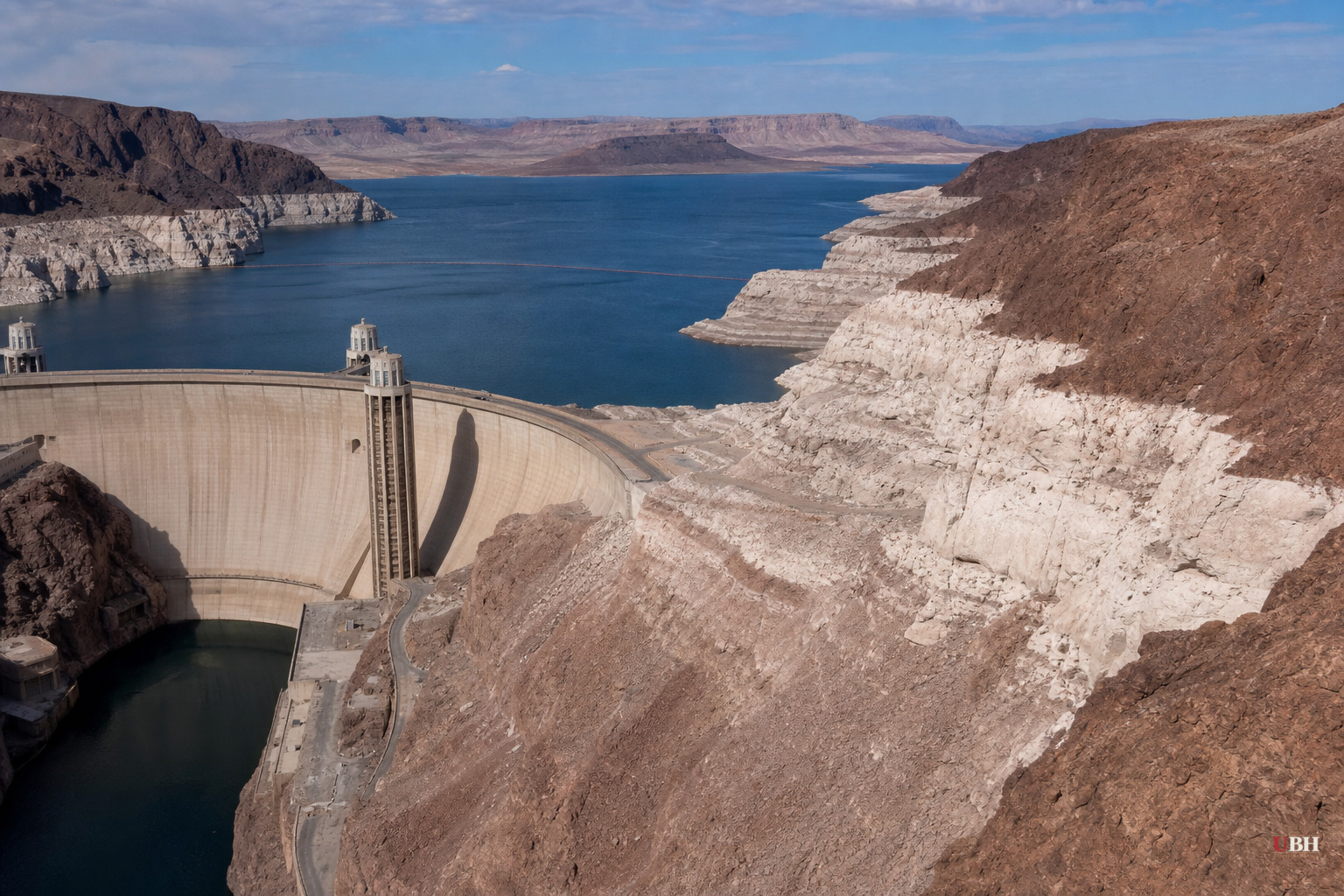
Lake Mead dropped to 1,040.4 feet in federal data cited by Ground News, the lowest level since the reservoir was first filled roughly 90 years ago. Nine days later, Lake Powell broke its own record, sinking to 3,519.91 feet on a Saturday in August, according to the U.S. Bureau of Reclamation data reported by CNN. That's about 30 feet above the point where Glen Canyon Dam can no longer generate hydropower at all.
"We are in uncharted territory," Jack Schmidt, director of the Center for Colorado River Studies at Utah State University, told CNN. Mead and Powell together hold under 60% of all water currently stored in the Colorado River basin. They're effectively one giant reservoir split by the Grand Canyon, and both have been shrinking for more than 20 years.
The numbers behind the decline are stark. The Colorado River has shrunk by roughly 20% since 2000, according to CNN, driven by rising temperatures and reduced snowpack combined with decades of heavy water use. The river supplies roughly 40 million people and irrigates more than 5 million acres of farmland across seven states: California, Arizona, Nevada, New Mexico, Wyoming, Colorado and Utah.
Hoover Dam, sitting at the foot of Lake Mead, is a major power producer, and one of its biggest customers is the Metropolitan Water District of California, according to OilPrice.com. If the lake keeps dropping, that district loses on two fronts at once: less water and less power.
OilPrice.com frames this as part of a broader structural problem. Power generation already accounts for roughly one-third of water use in the United States. European power plants face a parallel squeeze, with low river levels limiting both cooling water for power stations and barge transport of fuel. Add data centers built to run AI workloads, which need water both directly and for the power plants that feed them, and the demand side of the ledger keeps growing while the supply side shrinks.
AP News reported that record-low Danube levels have pushed several Eastern European countries toward what officials there are calling an energy emergency, with governments moving to conserve electricity. That's a separate river system on a separate continent, but it's the same underlying mechanism: less water and less reliable power.
OilPrice.com argues the Trump administration is making the water problem worse by killing offshore wind projects, which don't need freshwater, and pushing nuclear and coal instead, which are heavy water users. Nuclear and coal plants do require significant water for cooling, and offshore wind doesn't.
But that's also an incomplete picture. Fox News reported that a big chunk of the West's supply problem isn't caused by federal energy policy at all. It's caused by a permitting system that blocks new water storage and infrastructure for years or even decades. The Mountain Valley Pipeline took nearly a decade to open despite extensive environmental review, and it took an act of Congress to finish it, according to Fox News. Housing and infrastructure projects face the same slog under NEPA, the Endangered Species Act, and the Clean Water Act.
Breitbart's reporting backs up part of that argument with a concrete example. No new water storage infrastructure has been built in California more than a decade after voters approved a $7.5 billion water bond under Proposition 1 in 2014. Breitbart also noted that Trump has publicly said the state's problem isn't a shortage of water overall, it's mismanagement of the water it already has, a claim Breitbart's own reporting says has some merit even as it argues the crisis is more acute than supply management alone.
Climate-driven drought and shrinking snowpack are measurable and documented by federal reservoir data. So is the fact that permitting delays and unbuilt infrastructure, approved and funded years ago, have left the West without new storage capacity it could have had by now. Blaming only regulation or only climate change misses that this is a supply problem with multiple causes stacking on top of each other.
The unresolved question is what happens if Lake Powell keeps falling. Once it crosses roughly 30 feet below its current level, Glen Canyon Dam stops producing hydropower entirely, cutting electricity to customers across the region. The Bureau of Reclamation has not announced emergency water releases or a revised operating plan as of this writing. Seven states dependent on the Colorado River Compact are watching the same data and waiting to see who moves first.
Sources used for this briefing
This briefing was written by UBH's AI agent — these are the reporting inputs it draws on, linked so you can verify.


