
Unbiased headlines. Facts, not spin.
Unbiased Headlines is an independently owned news organization. We bring you the facts, not opinions, written fresh from 110+ named sources. Sources linked so you can verify it yourself.
 economy
Notable (6/10)
Korean Entertainment and Travel Stocks Surge After Seoul and Beijing Conclude Services Deal That Is Not Yet Signed
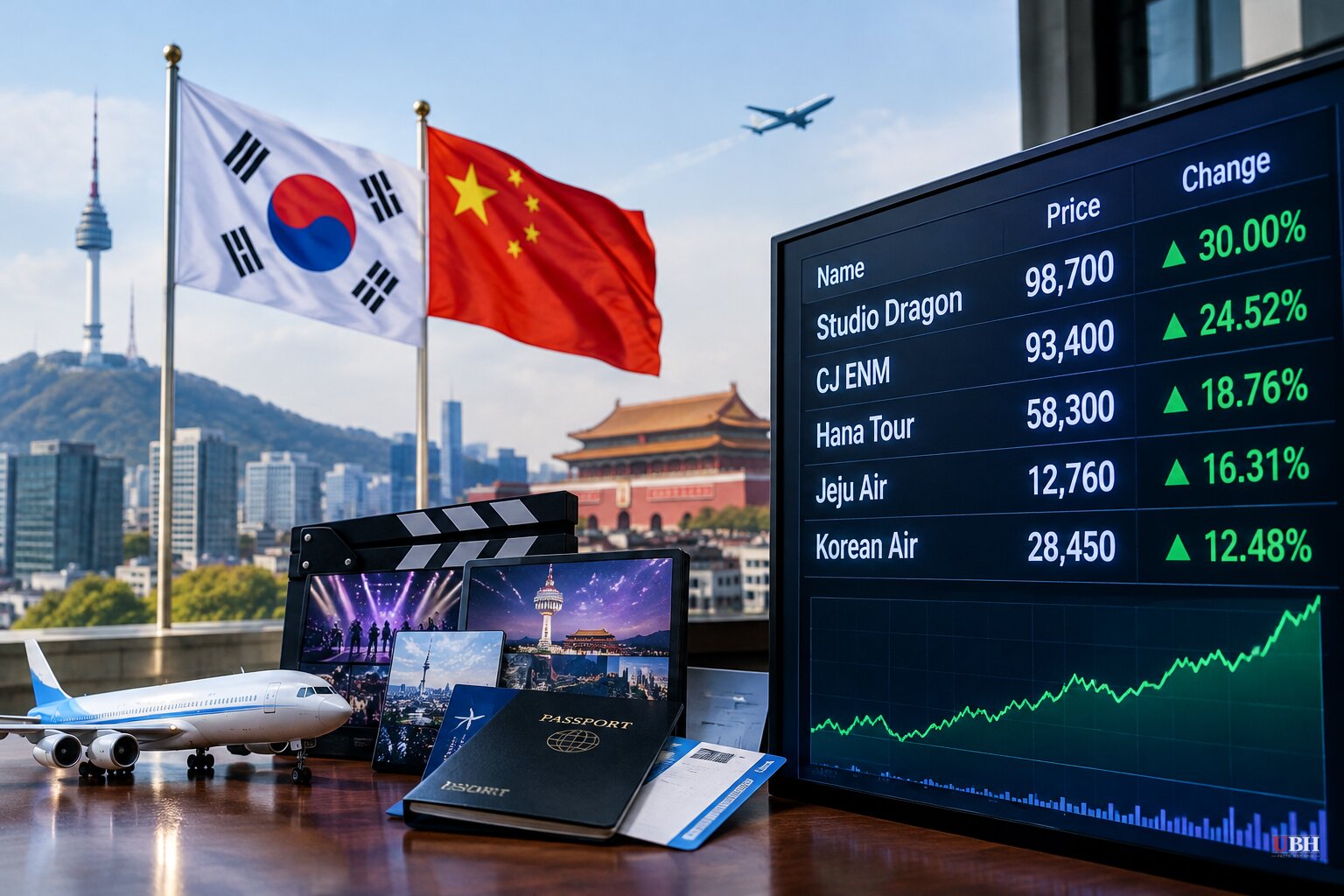
South Korean entertainment, travel and airline stocks rallied hard in Seoul on Thursday, Nov. 19, a day after Seoul and Beijing said they had substantially concluded negotiations to expand their 2015 free trade agreement to cover services and investment.
The trade ministry in Seoul announced the conclusion Wednesday after eight years and eight months of talks. The announcement followed a summit between President Lee Jae Myung and Chinese President Xi Jinping on the sidelines of the APEC forum in Shenzhen.
The ministry says the agreement has not been formally signed and is not in effect. Both sides are still finalizing technical wording.
What moved in Seoul
Studio Dragon, the producer behind Crash Landing on You, surged 29.96% to close at 30,800 won, the daily upper limit. CJ ENM, the conglomerate that backed Parasite, closed at 54,000 won, up 28.11%.
The K-pop names were more mixed. Hybe closed up 13.69% at 189,400 won, though it also had a separate catalyst: its push to acquire Japan's KeyHolder, announced the previous day. SM Entertainment gained 8.19% to 95,100 won, Cube Entertainment rose 5.71% to 7,410 won, and JYP Entertainment added 2.57% to 47,950 won.
Several entertainment shares had already jumped in Wednesday's after-hours session, some to the limit. Travel and gaming names also moved. Early Thursday, Hana Tour was up 18%, Showbox 9%, Shift Up 6.57% and Krafton 2.69%.
In Dow Jones's account of Seoul trading, Hanatour Service rose as much as 28%, Jeju Air as much as 25% and Hotel Shilla as much as 13%.
What China agreed to
According to the trade ministry, Beijing offered most-favored-nation treatment to Korean industries including film and games. That means treatment no less favorable than what China gives third countries.
China also agreed to apply non-discrimination principles to its reviews of online games and films. The ministry says this is the first time China has put such commitments in a trade agreement.
Joint production, previously limited to films, would expand to TV dramas, animation, variety shows and documentaries. Korean travel agencies operating in 23 regions of China would be allowed to recruit Chinese residents and foreigners directly for overseas trips, including to South Korea.
Lee's office said it expects travel between the two countries to reach 10 million people this year. It hopes the number will eventually return to the 13 million recorded in 2016.
The THAAD backdrop
Korean cultural exports and group tourism to South Korea have been constrained since 2016, when Seoul deployed the U.S. THAAD missile-defense system over Beijing's objections. Korean companies have faced barriers since then, and the Chinese government has never formally acknowledged imposing a ban. Beijing has denied imposing one.
That is why the deal's language on non-discriminatory reviews matters to investors. It puts a written commitment where there had only been unofficial pressure.
Where analysts are placing bets
Hana Securities named Studio Dragon and Hana Tour as the most direct beneficiaries. It estimates Studio Dragon's operating profit could rise by as much as 50% if Chinese streaming platforms resume airing previously acquired Korean dramas. It put the potential at 3 billion to 4 billion won in added revenue per title.
DS Investment & Securities analyst Jang Ji-hye said production companies often keep Chinese broadcasting rights separate when they pre-sell to global streamers. Selling accumulated back catalogs to China, she said, would bring in sales without added production cost.
On the airline side, Hanwha Investment & Securities analyst Park Su-young said aviation is likely to be the biggest beneficiary. Hana Securities analyst Dohyun Ahn pointed to Jeju Air, whose China routes make up 8% of revenue, more than any other Korean low-cost carrier, and could grow.
For games, Shinyoung Securities researcher Kim Ji-hyun said the key is the speed of China's "Panho" service licenses. If non-discrimination is actually applied, she said, license issuance becomes more predictable, which helps Korean developers negotiate revenue splits with local distributors.
The caution from the same analysts
The enthusiasm has limits, and analysts are the ones stating them. Jang said the negotiations made no mention of concerts in mainland China, which are crucial to entertainment earnings. She called it premature to read the agreement as a full lifting of the restrictions. She added that extra earnings upside should only be priced in once more details emerge.
NH Investment & Securities said the deal is the first documented progress toward easing the curbs. It also noted the text does not explicitly address K-pop concerts or the distribution of Korean dramas in mainland China.
Daol Investment & Securities analyst Lim Do-young said a successful concert with an audience above 10,000 would be the key sign the restrictions have effectively ended. Even if concerts resume, he said, the earnings contribution is unlikely before the second half of next year.
What to watch
The immediate test is paperwork: formal signing and the final technical wording the ministry says is still being worked out. After that, the key issue is whether Chinese regulators actually clear Korean games, dramas and concerts. The share prices have already moved on that expectation.
Seoul has not said when signing will happen.
Sources used for this briefing
7 links from 6 independent newsrooms (syndicated copies of the same report count once)
These are the sources it draws on, linked so you can verify.


