
Unbiased headlines. Facts, not spin.
Unbiased Headlines is an independently owned news organization. We bring you the facts, not opinions, written fresh from 110+ named sources. Sources linked so you can verify it yourself.
 economy
Notable (6/10)
Event date: November 13, 2026 ·
Federal Deficit Totals $404 Billion in First Month of Fiscal 2027, Up 42% From a Year Earlier
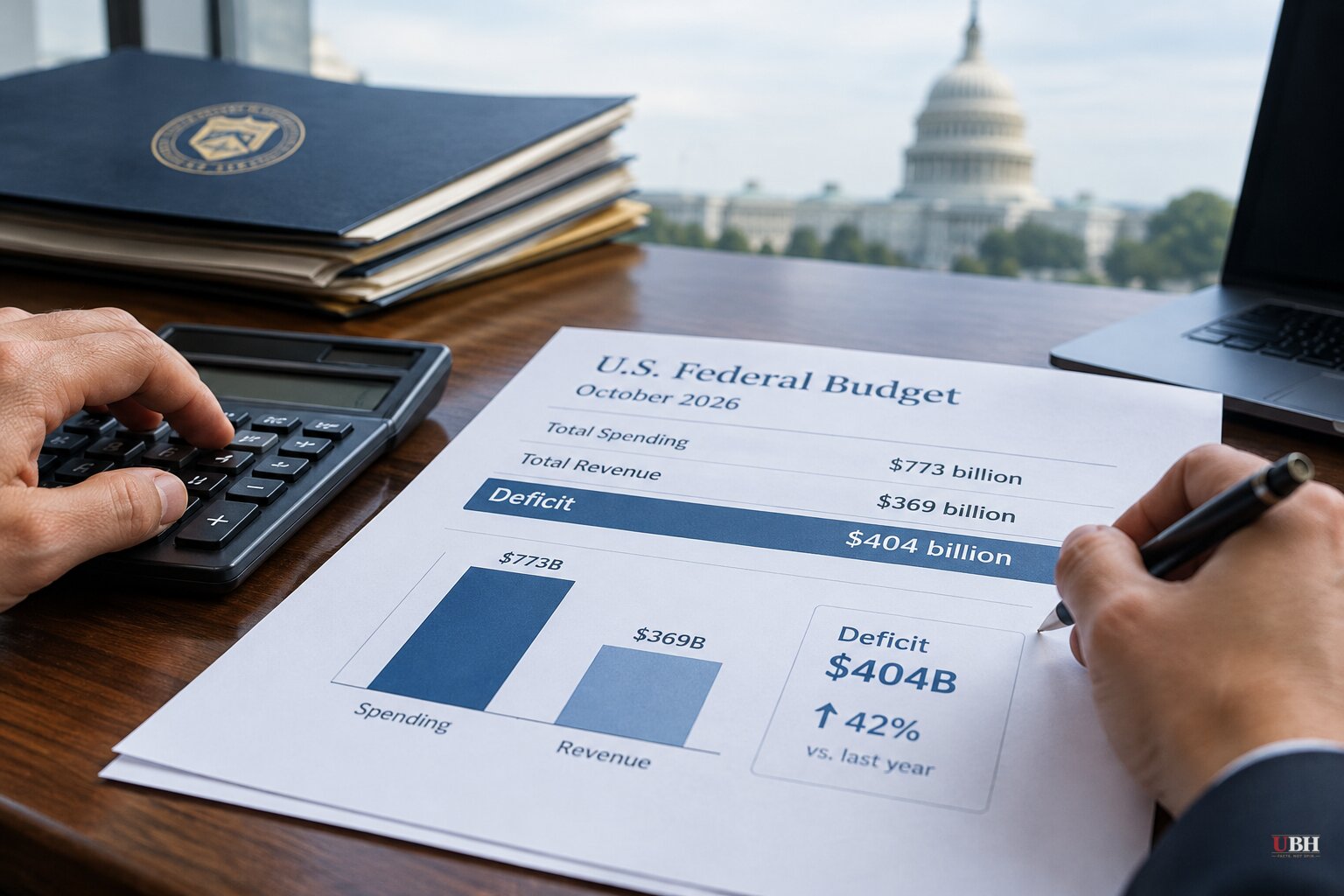
The federal government spent $773 billion in October and collected $369 billion. The difference, $404 billion, is the deficit for the first month of fiscal year 2027, according to the Treasury Department's Monthly Treasury Statement.
That is $120 billion, or 42 percent, more than the gap in October 2025. Spending rose $84 billion (12 percent). Revenue fell $35 billion (9 percent).
Where the money went
Defense was the biggest mover in percentage terms. National defense outlays rose $29 billion, or 29 percent, on higher military personnel and research spending, according to the American Action Forum's breakdown of the Treasury data.
The entitlement programs added their usual weight:
- Medicare: up $19 billion (13 percent), on higher enrollment and payment rates.
- Social Security: up $9 billion (6 percent), on larger average benefits and more beneficiaries.
- Medicaid: up $7 billion (13 percent), on higher per-enrollee costs.
- Veterans benefits and services: up $5 billion (9 percent).
Income security programs, including SNAP, SSI and TANF, fell $4 billion (6 percent). AAF attributes part of that to reforms in the One Big Beautiful Bill.
Where the money didn't come from
Individual income tax receipts dropped $31 billion (14 percent). Payroll taxes rose $4 billion (3 percent). Corporate income tax receipts rose $3 billion (20 percent).
Customs duties fell $12 billion, or 39 percent. They have been declining since May, when the government began refunding businesses that paid tariffs imposed under the International Emergency Economic Powers Act. The Supreme Court ruled those tariffs illegal.
The tariff reversal matters beyond one month. The Committee for a Responsible Federal Budget wrote last November that CBO projections showed tariffs enacted in 2025 would cut debt by $3.0 trillion over a decade, including interest. Those projections were already $1 trillion lower than earlier estimates. The refunds now moving through the system push in the opposite direction.
The full-year picture
October is one month, but the annual figures are no better. The deficit for the fiscal year ended September 30, 2026 came to $1,992 billion, up from $1,775 billion the year before, according to figures from Treasury and the Bureau of the Fiscal Service analyzed by ICAEW. That is 6.2 percent of GDP.
Receipts reached $5,403 billion. Outlays hit $7,395 billion.
ICAEW's decomposition shows where the growth came from. After adjusting for inflation and economic growth, health programs added $57 billion, debt interest $49 billion, Social Security $34 billion, education and social services $34 billion, veterans programs $27 billion, justice $22 billion and defense $18 billion. On the revenue side, corporate income tax fell $96 billion, mainly because of tax cuts. Customs duties fell $33 billion, as a large tariff increase was more than offset by refunds for tariffs ruled unconstitutional.
Total debt stood at $40.2 trillion on September 30, or 125 percent of GDP. About $32.4 trillion of that is held by the public. The remaining $7.8 trillion is owed to federal trust funds, Social Security among them.
Alarm and its limits
The pressure is showing up in the bond market. A City Journal essay argues that this August, with 30-year Treasury yields above 5 percent, Treasury Secretary Scott Bessent told CNBC that such rates "don't reflect the underlying fundamentals." Treasury doubled its scheduled long-bond buybacks to $4 billion, then raised them to $6 billion in mid-September. The essay says yields were still about 5.25 percent in late September. Its author reads the failure as a market signal Washington should heed. Bessent's stated position is that the market has the yield wrong.
Not everyone sees a cliff. SCS Financial argues the deficit is "a slow burn, not a breaking point." Its case: household and corporate debt have fallen relative to the size of the economy, and combined public and private debt of about 370 percent of GDP sits below the 403 percent of 2009 and 427 percent of 2020. The firm adds that the government collected roughly $5 trillion in revenue against a little over $1 trillion in net interest, so a missed payment would be a political choice, such as a debt-ceiling standoff, not a lack of resources.
SCS does not wave the problem away. It calls the direction of travel "not sustainable." It cites CBO projections of debt held by the public reaching 120 percent of GDP by 2036 and net interest roughly doubling from about $1 trillion to $2.1 trillion. Federal interest costs already run about 3.2 percent of GDP, near early-1990s highs. SCS estimates each one-point rise in average borrowing cost eventually adds about $300 billion in annual interest.
What comes next
The 120th Congress starts work on January 3, 2027, with the deficit on its agenda, as ICAEW notes. The Committee for a Responsible Federal Budget said in a November 18 press release that "any reconciliation package should not add to the debt." The group has not yet described the package in the material it has posted, and lawmakers have not released a bill.
Wealth advisers are already planning for the other side of that ledger. A Fortune commentary notes that the federal estate and gift tax exemption is $15 million per person, or $30 million for married couples. It warns that high-net-worth families should not assume the current thresholds will last as Washington looks for revenue.
The next test is the November Treasury statement. It will show whether October's $404 billion gap was a one-month spike or the start of a wider pattern.
Sources used for this briefing
6 links from 6 independent newsrooms (syndicated copies of the same report count once)
These are the sources it draws on, linked so you can verify.


