
Unbiased headlines. Facts, not spin.
Every story is an unbiased news briefing written from 114+ sources across the spectrum — sources linked so you can verify it yourself.
 finance
Major Story (7/10)
October 12, 2026 at 01:11 AM
finance
Major Story (7/10)
October 12, 2026 at 01:11 AM
Korea Cuts October Bond Sales by 5 Trillion Won as 3-Year Yield Holds Above 4%
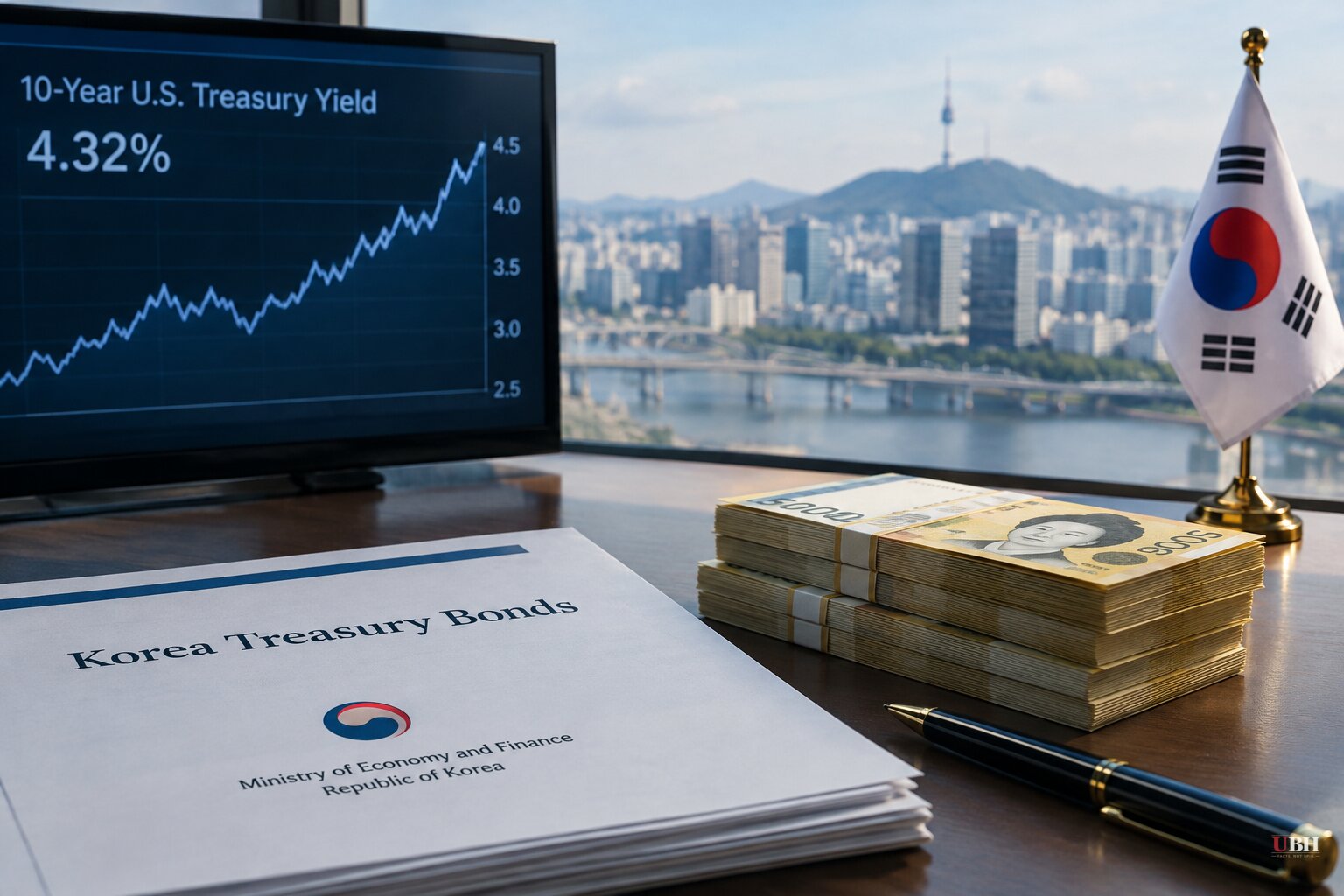
South Korea's government is shrinking its bond supply and buying back its own debt to hold off a global yield surge that has reached Seoul.
The finance ministry announced it will cut October Treasury bond issuance by 5 trillion won ($3.7 billion) from the original plan. It will also run 3.5 trillion won of buybacks covering two-, three-, five- and 10-year bonds. A buyback means the government repurchases bonds before maturity, which adds demand and eases upward pressure on yields.
The trigger: U.S. yields at 2002 levels
The 10-year U.S. Treasury yield climbed as high as 5.338% in intraday trading, its highest since 2002. Korea's bond market has been dragged along.
Deputy Prime Minister and Finance Minister Lee Hyoung-il said the three-year Korean Treasury yield has risen above 4%. "Yields have risen broadly across the bond market beyond Treasury bonds, while credit spreads have also widened this year," he said at his first market assessment meeting since taking office, held at the Korea Federation of Banks in Seoul.
Lee said the government will "consider further reducing government bond issuance if necessary" and will work with agencies on stabilization steps, "including emergency buybacks, depending on market conditions."
Bank of Korea Gov. Shin Hyun-song attended, along with Financial Services Commission Chairman Lee Eog-weon and Financial Supervisory Service Gov. Lee Chan-jin. The usual four-official "F4" group was expanded to include Land Minister Hong Jee-sun, so real estate is now part of the same review as banking, currency and bond markets.
Where Korean yields have been
The three-year yield jumped 11 basis points to 4.11% on Sept. 28, the highest since November 2022, when Korean markets reopened after the Sept. 24-27 holidays. Oil had rallied after President Donald Trump rejected Iran's latest proposal to reopen the Strait of Hormuz.
Korea imports most of its energy, so the Middle East war and high oil prices feed directly into inflation fears. Kang Seungwon, a fixed-income analyst at NH Investment & Securities, said at the time: "The fact that Korean yields are surging as well shows that this isn't just a US issue, and it shows the market is growing concerned the Bank of Korea (BOK) will have to deliver more hikes."
The Bank of Korea has already raised rates in back-to-back moves in July and August, taking its base rate to 3.00%. Stronger-than-expected growth driven by a semiconductor boom added to price pressure. September consumer prices rose 2.9% from a year earlier, approaching 3%.
The rally the government is trying to engineer
Government measures have helped steady the market for now. Strategists at Gama Asset Management SA and Hana Securities Co. say that effect will fade. They expect Korean three- and 10-year yields to resume climbing and retest the four-year highs hit in September.
Won swaps price about a 70% chance that the Bank of Korea raises rates by a cumulative 50 basis points over the next six months.
The Federal Reserve is a major factor. Minutes of its September meeting, released Oct. 7, show a majority of participants judged one more rate hike by year-end would be appropriate, after the Fed lifted its policy rate by 0.25 percentage point to 3.75% to 4.00% last month. Participants differed on the need for further increases.
Kang said a second straight Fed hike in October would most likely cement a Bank of Korea hike in November.
The case for patience
Not everyone expects the central bank to move quickly. Woori Finance Research Institute expects the Bank of Korea to hold at 3.00% at its Oct. 22 Monetary Policy Board meeting. Its reasoning is that the board needs time to gauge the effects of two consecutive hikes, the recent jump in market rates, and a stabilizing won-dollar exchange rate.
Analysts also caution that high borrowing costs weigh unevenly on consumption and investment, which calls for careful assessment before more tightening. Woori said a hold paired with strong language on inflation risks could still be read by markets as a tightening signal.
Securities firms are floating an October hold followed by a November hike, with the terminal rate possibly reaching 3.50% to 3.75%.
Who gets squeezed
Minister Lee warned that persistently high rates could raise refinancing burdens for lower-rated companies rolling over corporate debt. That is the exposure behind the widening credit spreads he cited.
The Bank of Korea held a market review after the September holidays and said authorities would closely monitor markets because volatility could expand.
It is unclear whether 3.5 trillion won of buybacks and a 5 trillion won issuance cut can offset a global selloff driven by U.S. yields and oil. If the Fed hikes again in October, Korean yields could revisit their September highs before the Bank of Korea's Oct. 22 decision.
Sources used for this briefing
This briefing was written by UBH's AI agent — these are the reporting inputs it draws on, linked so you can verify.


