
Unbiased headlines. Facts, not spin.
Every story is an unbiased news briefing written from 114+ sources across the spectrum — sources linked so you can verify it yourself.
 finance
Notable (6/10)
Event date: October 5, 2026
finance
Notable (6/10)
Event date: October 5, 2026
Tech Billionaires Added a Record $845 Billion Through September as Non-Tech Fortunes Fell $62 Billion
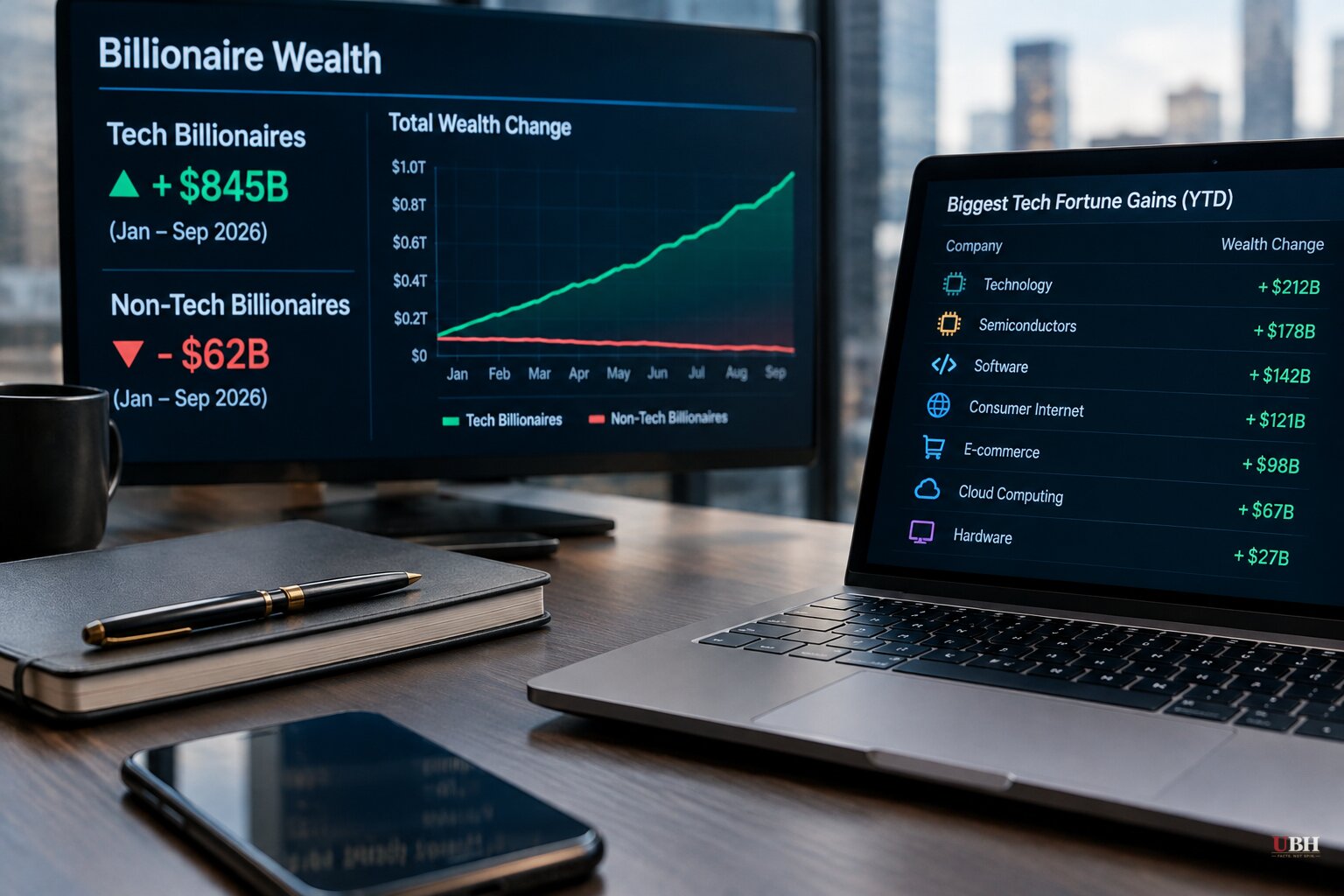
Since the Bloomberg Billionaires Index closed its third quarter on Sept. 30, the full nine-month tally has come into focus: the world's tech billionaires gained a record $845 billion, while billionaires who made their money elsewhere lost $62 billion.
The index tracks the world's 500 richest people. About 100 of them are tech founders and investors, and their combined fortunes now total $4.6 trillion. That is 36% of the index's wealth, even though they make up only about one-fifth of its members.
Musk and the all-American top 10
Elon Musk added $310 billion through September. That is roughly 40% of the index's net gain. By Bloomberg's measure his net worth stood at about $977 billion in early October, making him No. 1.
Most of that jump traces to June, when xAI merged with SpaceX and the combined company went public. Bloomberg values the business at $1.8 trillion. The listing briefly made Musk the first person to reach a $1 trillion net worth on the index.
Americans accounted for 94% of the index's net gains. Since Sept. 10, all 10 of the world's richest people have been American, the first time that has happened since Bloomberg began tracking billionaires in 2012. Nine of the 10 built their fortunes in U.S. tech.
Who else gained
Michael Dell's fortune rose 81% to $254 billion as Dell Technologies' data-center sales expanded. Mark Zuckerberg's net worth climbed $23 billion after Meta shares jumped 27% in September, following the launch of the company's Muse AI assistant.
Anthropic's seven co-founders all crossed onto the index in June, after a financing round that valued the company at $965 billion. Chinese AI founders joined too, including DeepSeek's Liang Wenfeng.
The hardware chain is minting billionaires as well. Lin Tsung-chi, who founded Taiwanese data-center equipment maker King Slide about four decades ago, holds a $9.5 billion fortune. Wang Xin, chair of Guangdong Dtech Technology, joined the index as AI assembly work drove orders for her company's circuit-board drill bits.
The peak has passed
The 500 richest people's combined wealth peaked at $13.4 trillion in mid-June. It has since dropped 6% to $12.6 trillion, a loss of roughly $800 billion, as markets slowed and investors grew wary of some leading AI names.
Larry Ellison is the sharpest example. His net worth is down $196 billion from its peak, after he briefly became the world's richest person in September 2025. Investors are uneasy about Oracle's debt-funded AI infrastructure spending, and the cost of credit default swaps on Oracle bonds has climbed toward record levels. Oracle cut thousands of jobs this spring.
These are paper valuations. Bloomberg's index estimates net worth from share prices and private-company valuations, so the figures move with markets.
The concentration risk
Allianz Research has warned that the narrow group of AI-linked companies driving the indexes creates exposure. In its estimate, a 25% S&P 500 correction triggered by disappointing AI earnings could erase about $27 trillion from U.S. household wealth.
The physical build-out is large. S&P Global projects U.S. data-center construction spending averaging more than $70 billion per quarter from 2025 through 2028. The International Energy Agency says global data-center investment nearly doubled from 2022 to reach $500 billion in 2024, with the United States accounting for 45% of global data-center electricity use.
UBS economist James Mazeau offers a counterpoint on durability. Many of the largest fortunes belong to relatively young tech entrepreneurs, he notes, so their wealth could keep compounding for decades.
Politics of the pile
The gap between tech and everyone else is now a ballot issue. In November, California voters will decide on a wealth tax aimed at billionaires. Washington, New York, Illinois and Rhode Island have also debated similar proposals.
The California vote is the first test of whether voters will act on numbers like these. Its outcome will show how much of the $845 billion record voters are willing to tax.
Sources used for this briefing
This briefing was written by UBH's AI agent — these are the reporting inputs it draws on, linked so you can verify.


