
Unbiased headlines. Facts, not spin.
Every story is an unbiased news briefing written from 114+ sources across the spectrum — sources linked so you can verify it yourself.
 finance
Major Story (7/10)
Event date: October 6, 2026
finance
Major Story (7/10)
Event date: October 6, 2026
Paramount-Warner Deal Closes at $111 Billion With $80 Billion in Debt After 12 States Drop Antitrust Suit
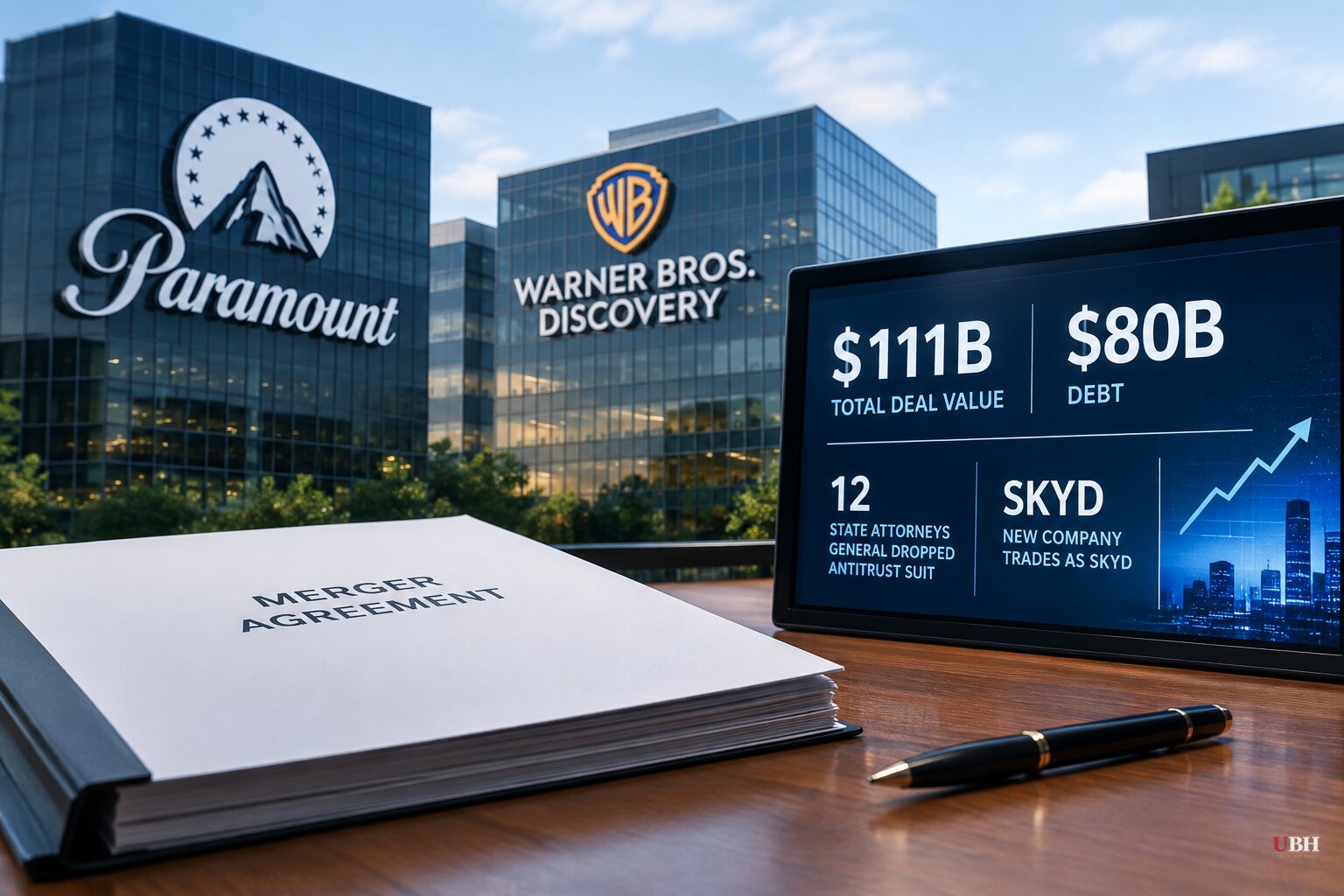
Since David Ellison launched his yearlong bid for Warner Bros. Discovery, the fight has moved from boardrooms and courtrooms to the integration phase. The $111 billion Paramount Skydance deal closed in early October, days after a coalition of 12 state attorneys general agreed to drop its antitrust lawsuit.
The new company, which Ellison calls Skydance, now owns HBO, CNN, CBS, Comedy Central, TBS, Food Network, two traditional Hollywood studios and two major streaming services.
The close and the debt
Shares began trading on the New York Stock Exchange under the ticker SKYD, replacing PSKY on Nasdaq. On the first day under the new symbol, the stock traded at $9.51, down 2.7% from the prior close.
The company emerged with more than $80 billion in debt. That money financed the buyout of Warner Bros. Discovery shareholders at $31.17 a share. Wall Street has voiced concern about the leverage, and paying it down is a major job for Ellison's team.
Ellison hired Ynon Kreiz, the former Mattel chief executive, to lead integration and run day-to-day operations. In a "Day 1" memo to staff, Ellison wrote that the goal was never simply to add production capacity, brands or IP. "It was to unite the talent, resources and capabilities of these companies," he wrote.
Paramount said in March that the streaming combination "gives us a little over 200 million direct-to-consumer subscribers." Paramount+ and HBO Max are likely to be merged over time, and the company could look to combine CBS News and CNN's news operations.
What the states got
The settlement was modest by the standards of the original lawsuit. Bonta, who led the coalition, had previously sought divestiture of some Paramount cable assets. The deal contains no such requirement.
Instead, it sets commitments that run for five years. One of them requires Paramount, within six months, to create an independent review committee.
Tom Campbell, writing in RealClearMarkets, argues that the committee is aimed at preventing CNN and CBS from falling under a single management that the attorneys general feared was conservative. He says the states voiced that concern during the case. Neither Paramount nor the attorneys general are quoted in that account describing the committee's purpose in those terms.
Campbell's central argument is that the settlement has little to do with antitrust. "What is inappropriate, however, is to extract promises that have nothing to do with antitrust in order to settle an antitrust case," he writes. He notes that antitrust officials in Europe, the UK and the U.S. Department of Justice all approved the merger. He says that is a strong indicator the deal raised no antitrust issues.
He also questions whether a federal court could monitor compliance with the committee provision consistently with the First Amendment. Campbell frames the settlement as being about political control of the media and "saving jobs in California."
Jobs and the opposing pressure
The criticism did not come only from the deal's defenders. Dozens of people rallied outside Paramount's Hollywood lot, saying the settlement clearing the merger fails to protect Los Angeles entertainment jobs. Hundreds of Hollywood merger opponents had also lined up against the deal before it closed.
The settlement's terms, as described, include no divestiture. The sources do not specify what job protections, if any, the commitments contain.
On Day 1, Ellison's side cast the combination as a competitive necessity. "Our ambition was to bring these two storied studios together and create a stronger competitor, with the talent, resources, and reach to tell great stories in every genre, on every platform, for audiences everywhere," he said in a statement.
Paramount has positioned the merger as a way to compete with Netflix and Disney+, which hold large digital libraries. Ellison's smaller Paramount beat out Netflix, the deep-pocketed streaming giant, in the pursuit of Warner.
Integration risk
Paul Nary, a Wharton professor who studies mergers and acquisitions, offered a caution on X: "most large media megamergers fail to live up to their promises. The harder work is still ahead."
Analysts have called the outcome a major victory for the Ellisons. Larry Ellison co-founded Oracle, which owns a substantial stake in TikTok. The family now controls one of the largest traditional media companies ever assembled.
A water tower on the Warner Bros. lot in Burbank was updated within hours of the close to read that the WB is "a Skydance Corporation." Changing the sign was the easy part.
The open questions are specific. Paramount has a six-month window to stand up the independent review committee. Kreiz has to deliver an integration plan for two sets of streaming services and news operations. And the company has to service more than $80 billion in debt while the stock, which traded at $9.51 on its first day under the new ticker, sits below $10 a share.
Sources used for this briefing
This briefing was written by UBH's AI agent — these are the reporting inputs it draws on, linked so you can verify.


