
Unbiased headlines. Facts, not spin.
Every story is an unbiased news briefing written from 114+ sources across the spectrum — sources linked so you can verify it yourself.
 finance
Notable (5/10)
Event date: October 4, 2026
finance
Notable (5/10)
Event date: October 4, 2026
Spot Ether ETFs Shed $542.1 Million in Week Ending Oct. 9, Largest Weekly Outflow Since January
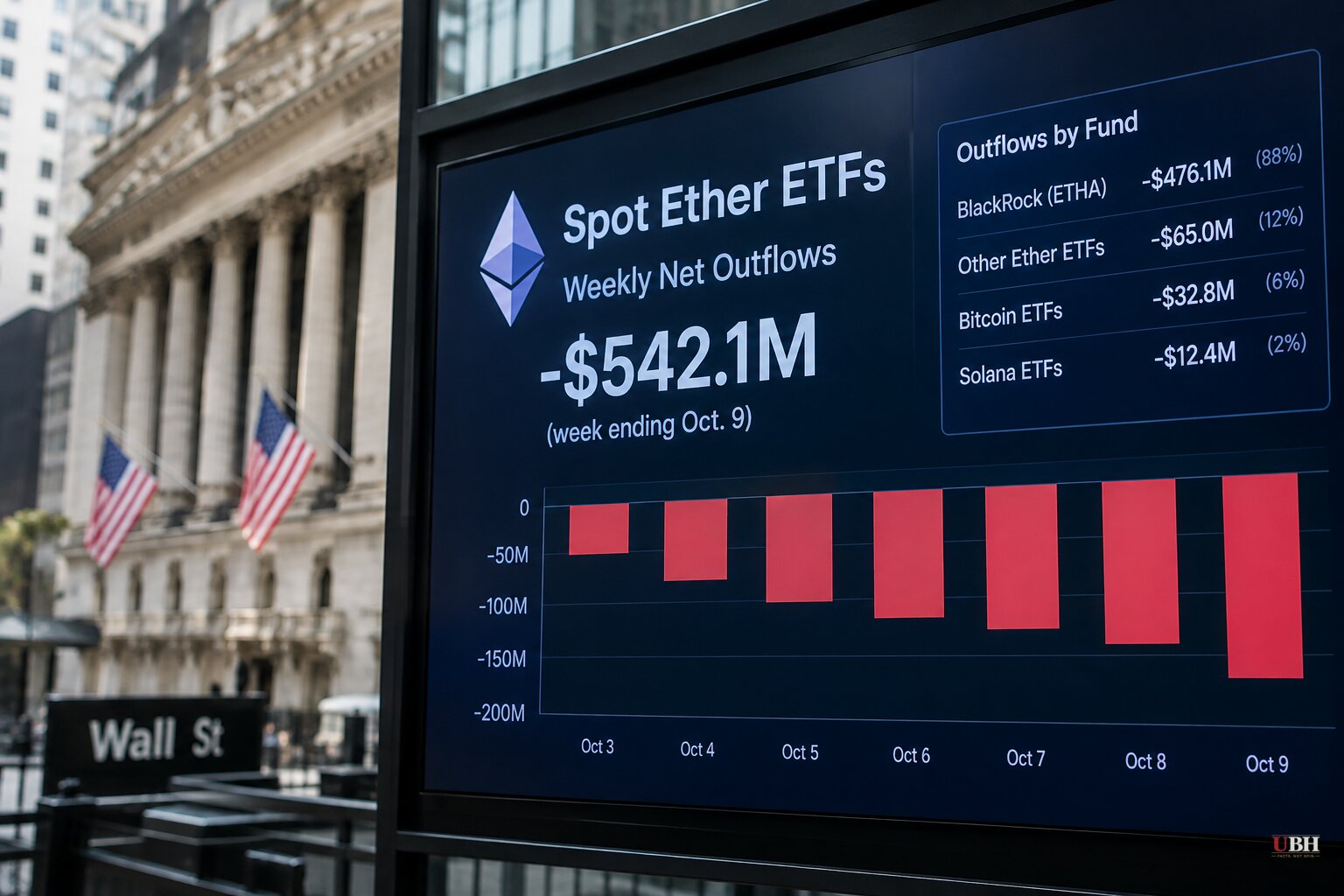
Now that Bitcoin ETF flows have reversed, the selling has spread across the crypto fund complex. U.S. spot Ethereum ETFs lost $542.1 million in the trading week that ended Friday, Oct. 9, according to SoSoValue data. That is the largest weekly net outflow since late January, when the funds shed $611 million.
One fund did most of the selling
BlackRock's iShares Ethereum Trust (ETHA) accounted for about $477 million of the weekly total. That is roughly 88% of all redemptions in the category. Grayscale's ETHE was a distant second at $31.9 million.
ETHA's outflow on Tuesday, Oct. 6 alone was $201.9 million. A reverse split, which consolidated three fund shares into one, took effect the same day.
The weekly figure is part of a longer run. Ether funds have now gone nine consecutive trading days without a net inflow, starting Sept. 29, with $697.2 million leaving over that stretch.
Assets and price both fell
Total net assets in the Ethereum ETFs dropped from $17.69 billion on Oct. 5 to $15.71 billion on Oct. 9, a decline of about $1.98 billion. Redemptions explain only part of that. The rest reflects the lower price of the ether the funds hold.
Ether settled near $2,491 on Saturday, Oct. 10, down more than 7% on the week. It slipped below $2,500 and under its 50-day simple moving average. Trading volume for ETH fell 61% to $7.2 billion. Other price snapshots from Saturday put it between roughly $2,491 and $2,510, so the token is hovering right at the threshold.
The funds are still sitting on large cumulative inflows. Net inflows since launch stood at about $13.26 billion as of Oct. 9.
Bitcoin and Solana funds took hits too
U.S. spot Bitcoin ETFs lost $681.1 million for the week. Most of it, $487.1 million, left on Wednesday, Oct. 7. Friday brought a net inflow of $21.1 million. The outflows ended a three-week inflow run.
Bitcoin funds are still ahead for 2026, with net inflows of $494.1 million. They hold $105.84 billion in net assets, and cumulative net inflows since launch total $57.11 billion. Bitcoin traded around $82,900 on Saturday morning.
Solana ETFs posted net outflows on all five trading days, ending a 14-week inflow streak. The $24.8 million total was about triple the previous weekly outflow record of $8.9 million. Two weeks earlier, the same funds had taken in a record $188.2 million.
Bitwise's BSOL accounted for $20.9 million, or about 84%, of the Solana outflows. Morgan Stanley's MSOL and Invesco's QSOL together took in $2 million. Category net assets fell from $1.90 billion to $1.73 billion. Solana traded near $110.50.
Across the three products, net outflows came to about $1.25 billion for the week, per The Block's analysis of the SoSoValue figures.
Not everyone is selling
The fund numbers measure only what moves through listed products. On-chain analyst Ali Martinez said large wallets added more than 166,000 ETH, nearly 15,000 BTC and about 45 million XRP over 72 hours. That points to buyers stepping in while the funds shed assets.
The picture is mixed. Exchange balances of ETH rose by about 90,000 over the same period, and futures open interest declined. Both are readings that can accompany selling pressure and position cutting. Large-wallet balances can also rise while smaller holders or funds distribute coins.
ETF redemptions do not show that every investor is selling ether. They do remove one source of demand while the price is falling.
Levels to watch
Technical traders are focused on $2,370 as the next support. A break there would expose the $2,200 area, where the 100-day average sits. Holding it could steady the market.
The week's data was released on a Saturday. U.S. markets are closed, and the next trading session opens Monday, Oct. 12. The first sign of whether the nine-day outflow streak ends will come in that day's fund flow figures.
Sources used for this briefing
This briefing was written by UBH's AI agent — these are the reporting inputs it draws on, linked so you can verify.


