
Unbiased headlines. Facts, not spin.
Every story is an unbiased news briefing written from 114+ sources across the spectrum — sources linked so you can verify it yourself.
 finance
Notable (6/10)
Event date: October 7, 2026
finance
Notable (6/10)
Event date: October 7, 2026
Kospi Down 22% in Second Half as Turnover Falls 70% From May Peak and Foreigners Pull $131 Billion
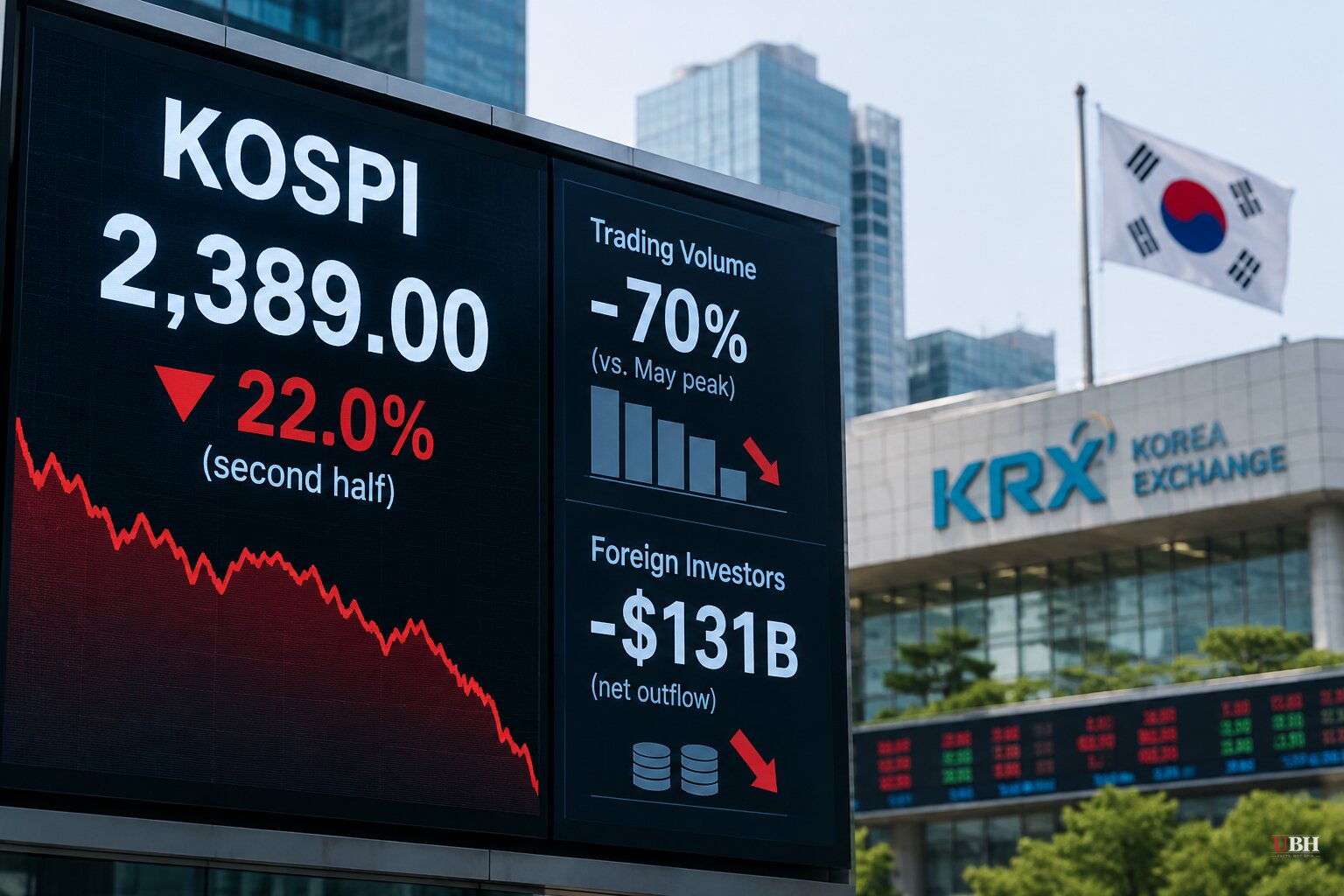
South Korea spent the first half of 2026 as the poster child for the AI trade. The Kospi rose roughly 100% in six months. Since then it has been the worst major benchmark of the second half, down 22% according to Bloomberg data, while U.S. and Taiwanese peers set new highs.
As of the Oct. 8 close, the Kospi stood at 6,625.93. On Korea Exchange figures, it fell from 8,303.41 on July 1 to 6,838.04 on Sept. 30, a drop of 17.65% in the third quarter. It was about 25% below its June 22 closing high at the end of September. It is still up more than 60% for the year.
The money is leaving
Turnover has fallen 70% from its late-May peak, Bloomberg reports. The average daily trading value on the Kospi was 50.35 trillion won in June and 21.36 trillion won last month, a 57% drop, according to the Korea Exchange.
Foreign funds have pulled $131 billion out of Korean stocks this year, the most of any major Asian market, per exchange data compiled by Bloomberg. Retail investors, a major force behind the first-half surge, have not come back. Margin loans outstanding have hovered around 33 trillion won over the past month.
"The liquidity of the Korean stock market is depleted compared to the first half of the year," said Kim Dae-joon, a researcher at Korea Investment & Securities. He added that a steep recovery in large-cap stocks will be hard to expect.
Kim Jae-seung of Hyundai Motor Securities said individual investors have been sitting on losses since June, which has hurt sentiment, and foreign net selling continues.
Two stocks carry the index
Samsung Electronics and SK Hynix together make up more than half of the Kospi's weighting. That helped power the climb. It is now the problem.
Shares of the two fell between 19% and 33% last quarter. Samsung stock dropped on Thursday even after the company reported a nearly nine-fold jump in quarterly operating profit. Investors are questioning how long the memory-chip upcycle can last.
"The biggest challenge I see for most investors, especially those who only recently got into Korea for the memory chip trade, is that the easy money in that theme has been made," said Phillip Wool, head of portfolio management at Rayliant Global Advisors. His fund has been taking profits and is now underweight both stocks.
Richard Tang, head of research Hong Kong at Julius Baer, said capital has been moving back toward U.S. equities, feeding the foreign outflows.
The two chipmakers have also been a main source of demand. Their combined 55 trillion won in buybacks is nearing completion. JPMorgan Chase data show those repurchases made up the bulk of the $23 billion in buy orders in the Korean market last month.
What set off the July rout
The sharp selloff began in early July. BigGo Finance attributes it to the blowup of Situational Awareness, a hedge fund run by Leopold Aschenbrenner that held large leveraged positions in Korean memory-chip stocks. It says the unwind coincided with Korean retail investors piling into leveraged single-stock ETFs. That account rests on a single source, and the fund's own position has not been detailed here.
Korean media cite other pressures in the quarter. A prolonged war in the Middle East pushed oil prices and global interest rates higher, and a surge in U.S. Treasury yields added to the strain. The Kospi hit an intraday low of 5,262.77 at the end of July before rebounding. Korean authorities then regulated single-stock leveraged products tied to Samsung and SK Hynix.
BigGo also says the Bank of Korea has raised rates.
Over the same quarter, the S&P 500 rose 2.25%, from 7,483.23 to 7,651.54. China's CSI300 fell 12.13%.
Taiwan takes the lead
The TAIEX is up 72% this year, the best of more than 90 indexes Bloomberg tracks. The Kospi ranks second at about 63%. Last quarter the TAIEX beat it by roughly 23 percentage points, the widest margin since the turn of the century.
Earnings estimates for the TAIEX rose about 19% last quarter against about 15% for the Kospi. In a Bank of America survey last month, about 40% of fund managers said they were overweight Taiwan, versus 25% for South Korea.
Vikas Pershad, a portfolio manager at M&G Investments (Singapore), put the difference in terms of earnings quality. "Taiwan's earnings come from volume and that makes its earnings upgrades broader and stickier," he said. "Korea's earnings, in the near-term, are coming from price." Chun-Lai Wu of UBS Global Wealth Management said the bank prefers to position for AI through Taiwan. Societe Generale strategists also prefer Taiwan.
The valuation gap is large. The TAIEX trades at about 18 times one-year forward earnings, the Kospi at about 5.5 times. BigGo puts forward multiples for Samsung and SK Hynix at 4 to 5 times.
The bullish case
Not everyone has given up on Korean chipmakers. Jongmin Shim, head of Korea research at CLSA, remains bullish. He argues U.S. cloud companies will keep ramping AI capital spending. He also said bond markets will weigh on equities, calling that "a global phenomenon."
Prashant Bhayani, Asia chief investment officer at BNP Paribas Wealth Management, said valuations look more attractive after the July selloff. He added that there is limited room for another big expansion. Other investors warn that Korea's corporate governance structure could turn cheap valuations into a "value trap."
What comes next
The open question is who buys when the buybacks finish. Samsung and SK Hynix repurchases supplied most of last month's bids. Foreign funds are net sellers, and retail leverage has not recovered. Analysts are now watching whether the Kospi can win back any of its third-quarter losses in the fourth quarter.
Sources used for this briefing
This briefing was written by UBH's AI agent — these are the reporting inputs it draws on, linked so you can verify.


