
Unbiased headlines. Facts, not spin.
Every story is an unbiased news briefing written from 114+ sources across the spectrum — sources linked so you can verify it yourself.
 finance
Major Story (8/10)
Event date: October 9, 2026
finance
Major Story (8/10)
Event date: October 9, 2026
AI Borrowing Nears $500 Billion in 2026 as 10-Year Treasury Yield Sits Above 5.25%
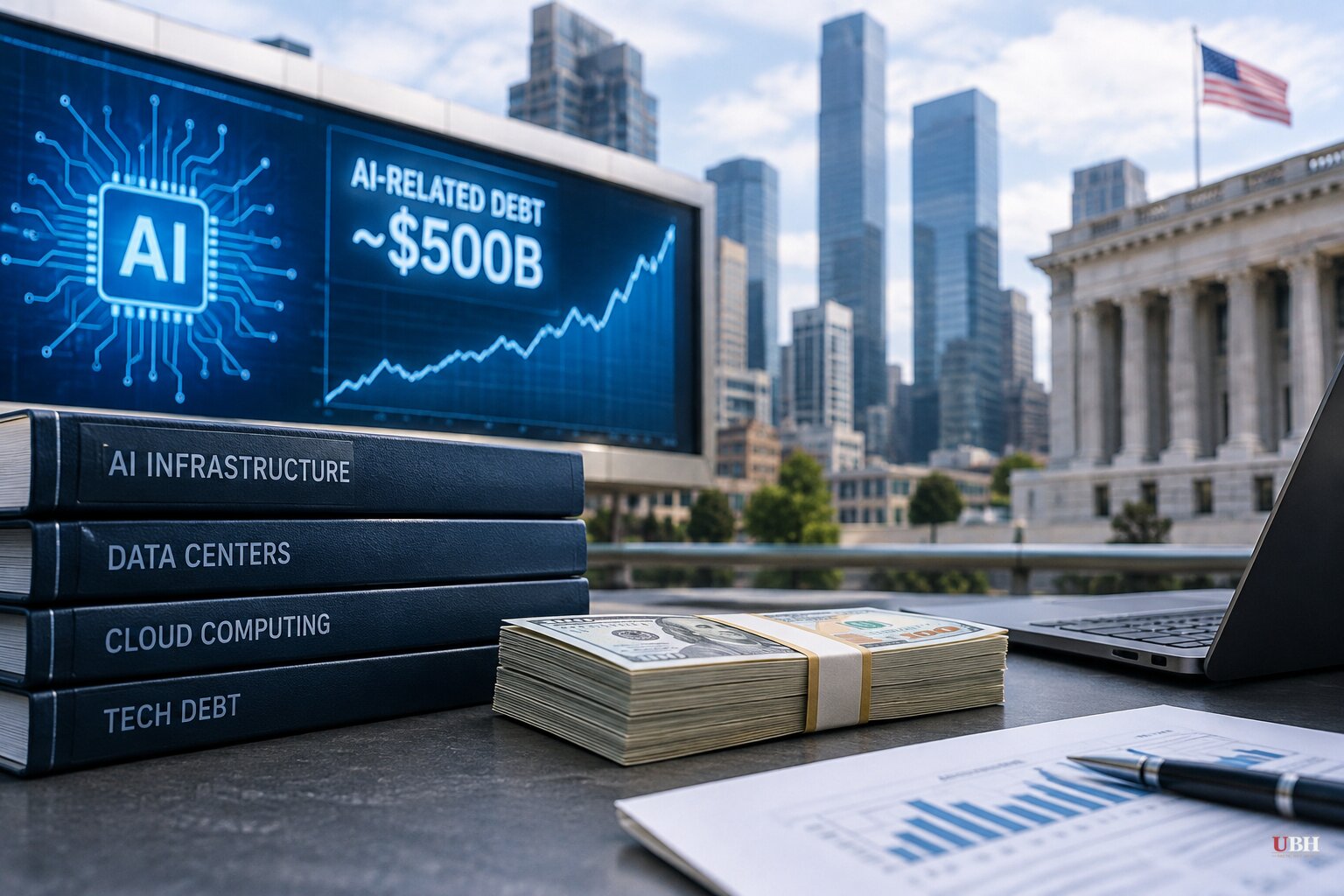
Since SpaceX sold $25 billion of bonds in June to a crowd of eager buyers, the market for AI-linked debt has grown heavier, and the price of money has gone up. Nearly $500 billion in AI-related debt has been issued so far in 2026, according to Bloomberg's tally. The 10-year Treasury yield now sits around 5.25%.
The borrowers
The five big cloud operators account for roughly $200 billion or more of that total. Amazon raised about $54 billion in its latest sale, Alphabet $31.5 billion and Meta $30 billion. Oracle's issuance falls somewhere between $18 billion and $30 billion.
Bank of America analysts raised their 2026 hyperscaler debt forecast from $140 billion to $175 billion after the latest wave. Estimates for total AI financing this year run from $300 billion to more than $570 billion. Goldman Sachs projects AI debt could exceed $1 trillion a year in the coming years.
The borrowing is spreading beyond U.S. giants. Bloomberg reported Thursday, citing people familiar with the matter, that Tencent is weighing an offshore bond sale of up to $5 billion in dollars and offshore yuan, possibly this month. Tencent did not immediately respond to a Reuters request for comment. Its June offering of $4.66 billion was its largest debt deal since 2020. SoftBank Group raised about $11.1 billion last month through a junk-bond offering to fund its AI plans.
SpaceX goes back to the well
The Financial Times reported on Oct. 7, citing people familiar with the matter, that SpaceX is seeking $40 billion to buy Nvidia chips. The proposed package is $10 billion in bank loans and $30 billion in investment-grade bonds, led by Apollo Global Management, with PIMCO reportedly weighing a stake. Talks are at an early stage, the deal is expected to close next year, and it could still fall through. Other accounts of the talks, which cite CNBC, describe the financing as bank and private-credit borrowing.
The June bonds drew $90 billion in orders. The $6 billion 10-year slice carried a 5.875% coupon, about 120 basis points over the 10-year Treasury at the time, and was rated BBB by S&P Global and BBB+ by Fitch.
Those notes have since fallen. Wolf Street, citing TradingView data, puts the 10-year slice at about 90 cents on the dollar with a yield of 7.20%, a spread of nearly 200 basis points. That is about where BB-rated junk bonds trade. SpaceX's 30-year bonds have dropped to roughly 85% of face value with a spread near 227 basis points, and any new 30-year paper is expected to price at yields approaching 7.5% to 8%.
The company's equity raise was far larger. Its June 12 IPO priced at $135 a share, and the 555.55 million newly issued shares in the base offering brought in $75 billion. SEC filings show every share in the base offering was newly issued, not sold by existing holders.
Bloomberg also reports market-implied five-year default rates of above 20% for Oracle and about 16% for SpaceX. Broadcom's five-year credit default swaps hit a record 136 basis points.
Yields: debt or growth?
Treasury data show the 10-year yield rose from 4.75% at the end of August to 5.29% at the end of September, a 54-basis-point jump in one month. The 10-year real rate accounts for about 49 basis points of that, and inflation compensation for only about 5. Last week the 10-year closed at a 24-year high above 5.3%.
What is driving that is disputed. Charlie Ripley, chief investment strategist at Allianz Wealth Management, points to supply: "When you see corporate 10-plus duration [debt] issued at a 100% higher level than it was last year, you have to imagine there's a little bit of crowding out there." Blaine Townsend, a financial adviser writing in Kiplinger, argues that debt-funded AI spending is adding long-duration bonds to the market and pressuring Treasury yields, with trouble ahead for a government already carrying heavy debt.
Others say the cause is growth. Jeffrey Buchbinder, chief equity strategist at LPL Financial, says "most of the increase in interest rates has been related to stronger economic growth, not increased fears of inflation." Mason Mendez of Wells Fargo notes that real yields, at their highest since 2007 per the Cleveland Fed, have risen faster than inflation expectations. Harry Mamaysky of QuantStreet Capital offers a similar reading, that markets may be pricing stronger growth and the capital demands of the AI buildout. That interpretation remains unverified, and higher real rates could instead reflect a bigger premium for holding long bonds.
Stocks have so far shrugged it off. FactSet analysts forecast S&P 500 earnings growth of 29.5% for last quarter, the third straight above 25%, and tech profits are expected to rise about 65% in the third quarter. The Fed raised rates in September and signaled more hikes, citing oil prices tied to the Middle East conflict.
Capacity questions
U.S. corporate bonds outstanding total about $12 trillion, per SIFMA, so AI issuers are adding roughly $500 billion to that pile this year. They are not alone. The Paramount Skydance purchase of Warner Bros. Discovery is financed by $52 billion in debt sales, including $44 billion of bonds, $12 billion of them junk, per Wolf Street.
Wolf Street says some borrowing has moved off balance sheet into special-purpose vehicles, leases and purchase commitments, with private credit stepping in. It also notes that Nvidia-backed Firmus pulled an Australian IPO that sought about US$5.5 billion.
What to watch: whether Tencent prices its bonds this month, how SpaceX's financing is structured, and whether the Fed's signaled hikes arrive before the next big issuance wave.
Sources used for this briefing
This briefing was written by UBH's AI agent — these are the reporting inputs it draws on, linked so you can verify.


