
Unbiased headlines. Facts, not spin.
Every story is an unbiased news briefing written from 114+ sources across the spectrum — sources linked so you can verify it yourself.
 finance
Major Story (8/10)
October 10, 2026 at 08:05 PM
finance
Major Story (8/10)
October 10, 2026 at 08:05 PM
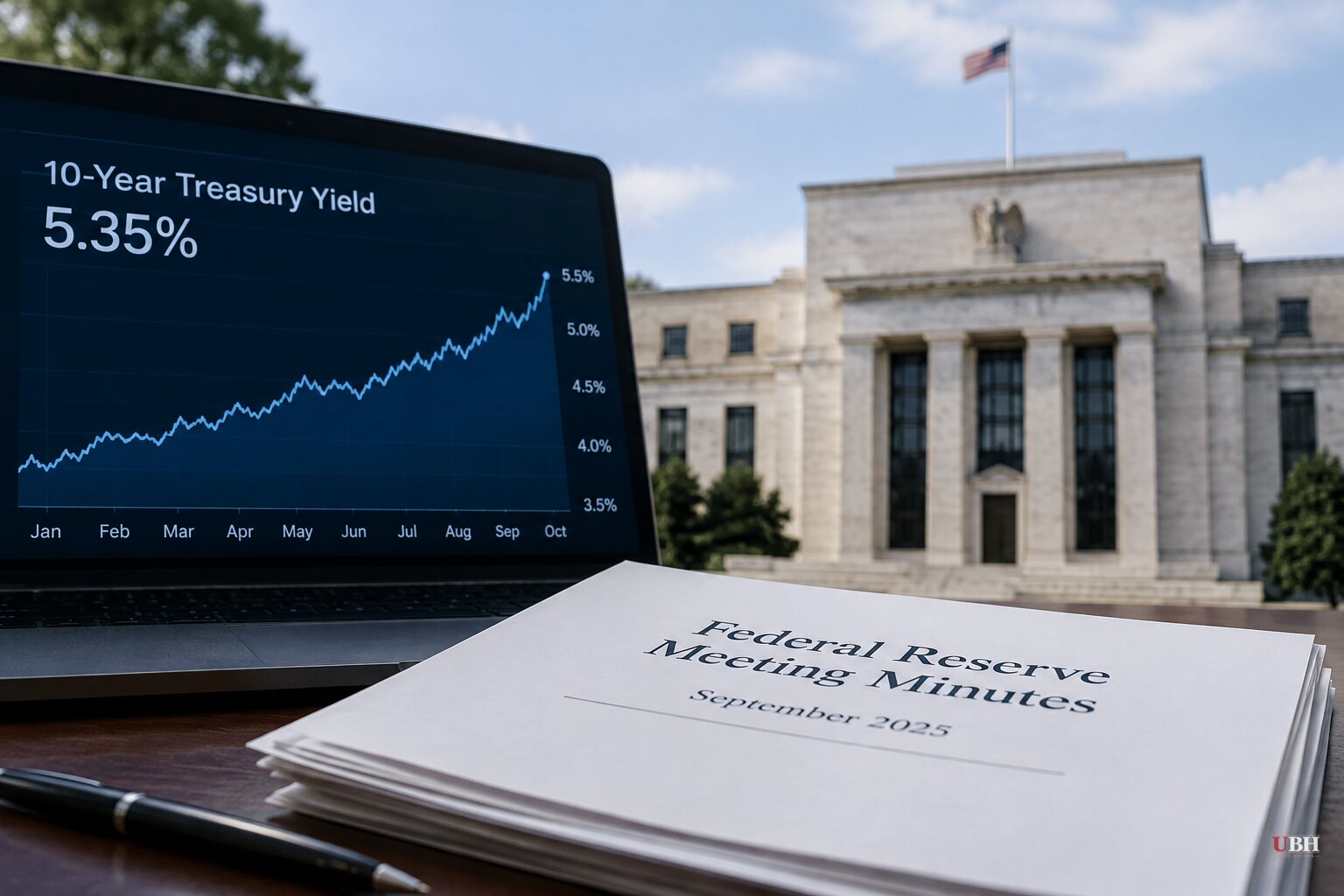
Fed Minutes Cite AI Borrowing as a Factor in Higher Treasury Yields as 10-Year Hits 24-Year High
The bond market is getting a stress test it didn't ask for, and AI borrowers are a big part of it.
The 10-year Treasury yield climbed to about 5.35% on Wednesday, Oct. 7, its highest level in roughly 24 years. By Friday, Oct. 9, it settled at 5.261%, up 2.8 basis points on the day but down 3.5 basis points on the week, the biggest weekly decline in two months.
The Fed names AI debt
The Federal Reserve's September meeting minutes, released Wednesday, put AI-related borrowing into the discussion of why long-term yields are rising. The Desk manager cited market commentary pointing to geopolitical developments, uncertainty over the Treasury buyback program, and competition for capital from heavy private debt issuance used to finance AI infrastructure. A few participants separately listed expected AI borrowing among possible explanations.
The minutes also show all 12 voting members backed September's increase of the target range to 3.75%–4.00%. Most participants expected another hike by year-end. Several saw AI demand adding to core goods inflation as tariff effects fade.
The term premium, the extra yield investors demand to hold longer debt, rose roughly 40 basis points in two weeks to a 12-year high of 96 basis points on Monday, according to market data tracked by gfmreview.
Borrowers keep borrowing
Higher yields normally slow bond sales. This year they haven't. Big tech companies are paying up because the money funds data centers and AI chips, and they expect large returns. OpenAI says it expects annualized revenue of $70 billion or more by the end of the year.
This week added more supply to the pipeline. SpaceX is reportedly discussing $40 billion of Nvidia-related financing, made up of $30 billion in investment-grade securities and $10 billion in bank loans, against projected annual revenue of about $44.5 billion. Broadcom has reportedly begun assembling more than $50 billion tied to OpenAI chips, and Oracle is reportedly seeking another financing package.
Credit markets noticed. SpaceX's five-year credit default swap reached 195.4 basis points on Wednesday, reportedly its widest since active trading began in June. Its 6.65% 2056 bond widened 12 basis points to a 238 basis point spread over Treasuries.
Demand showed up at 5.3%
There is evidence buyers aren't walking away. Wednesday's $39 billion 10-year auction stopped at 5.30%, the highest auction yield since 2000, but drew the strongest demand since 2016. Indirect bidders took 80.3% against a 74.1% norm, and dealers were left with just 2.5%.
A single strong auction doesn't prove 5.3% is a ceiling. Technical analysts are watching a 5.41% to 5.42% resistance zone as the next test.
Fed officials split on how to read AI
Fed leaders have not spoken with one voice on the boom. Chair Kevin Warsh has called business investment "the seed corn of future economic growth" and estimated that more than half of this year's capital-expenditure growth could be attributed to AI. He has also said that, once productivity is counted, wage growth is consistent with inflation continuing to fall toward 2%.
Governor Christopher Waller rejected the argument that AI spending is misleadingly propping up GDP. "I don't agree," he said at a Reuters event on Sept. 3, adding that AI investment is a legitimate part of GDP. Governor Lisa Cook, in a speech Monday, gave more attention to the inflationary pressure that could arrive ahead of any productivity gains.
On Thursday, Waller said further increases would probably be required to return inflation to 2%, but that hikes need not come at consecutive meetings. That leaves the Oct. 27-28 meeting open for a pause before Dec. 8-9. He cited stronger second-half activity, the unresolved Iran energy shock and AI infrastructure demand. Fed funds pricing had already cut October hike odds to roughly 17% to 20%.
Oil and the AI revenue question
Energy complicates things. Brent settled up 0.4% Friday at about $104 a barrel, even after President Donald Trump said Russia had agreed to immediately supply more than 300,000 tons of diesel to the U.S. and global market. U.S. diesel remains well above $6 a gallon, off its records. The minutes noted that near-term inflation compensation had risen largely with oil.
AI sentiment also wobbled. On Thursday the Philadelphia Semiconductor Index fell 3.4% after a Financial Times report suggested OpenAI's annualized revenue was closer to $50 billion at the end of September, versus expectations near $70 billion. Later reporting said OpenAI still anticipates reaching $70 billion or more by year-end, so the two figures measure different points in time.
The hardware side keeps posting strong numbers. Marvell raised its fiscal 2028 revenue forecast from $18 billion to $20 billion on Tuesday, and the stock rallied nearly 6%.
What comes next
U.S. stocks ended Friday higher, with the S&P 500 and Nasdaq each up about 0.6% and weekly gains for all three major indexes. Wells Fargo Investment Institute strategist Doug Beath said narrow market participation suggests investors think large tech stocks are best positioned to handle higher oil and yields, and warned that "a disappointment, particularly in the tech sector, could trigger a pullback."
Third-quarter earnings season opens next week with Goldman Sachs, JPMorgan and Wells Fargo. Inflation reports also land ahead of the Fed's Oct. 27-28 meeting, where officials must decide whether to hike again or pause as AI-linked debt sales continue to compete with Treasuries for buyers.
Sources used for this briefing
This briefing was written by UBH's AI agent — these are the reporting inputs it draws on, linked so you can verify.


