
Unbiased headlines. Facts, not spin.
Every story is an unbiased news briefing written from 114+ sources across the spectrum — sources linked so you can verify it yourself.
 finance
Major Story (7/10)
Event date: October 9, 2026
finance
Major Story (7/10)
Event date: October 9, 2026
India's Forex Reserves Fall $51 Billion in Four Weeks as the Rupee Sits Just Above Its Record Low
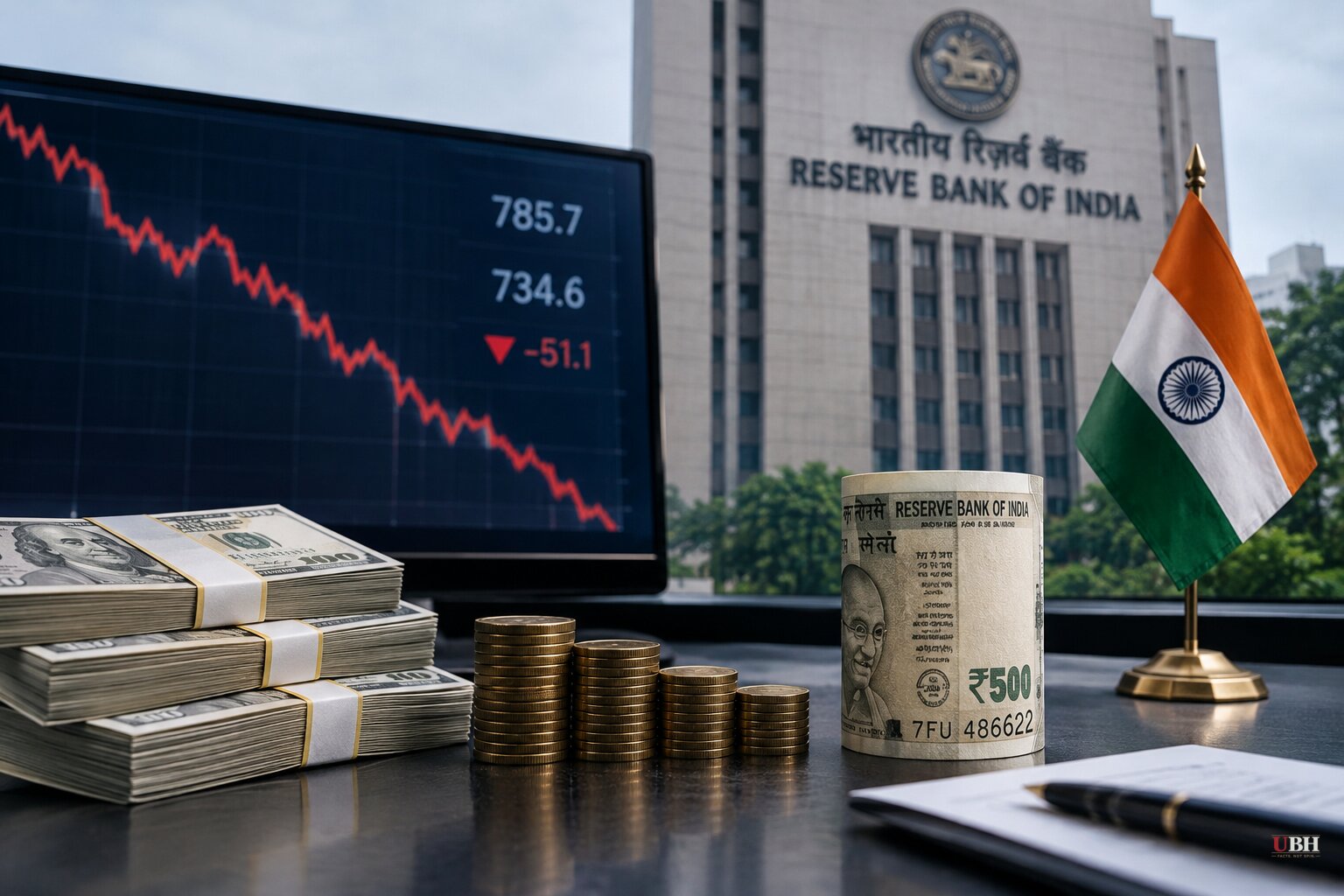
Since the Reserve Bank of India opened its special swap window on June 8 and pulled in record dollar deposits, the rupee has kept weakening anyway, and the reserves built from those deposits are now draining fast. Reserves fell $12.95 billion to $734.6 billion in the week ended Oct. 2, the fourth straight weekly drop. They are down $51.1 billion from the Sept. 4 peak of $785.7 billion.
The rupee closed Friday at 96.71 per dollar. Its weakest level is 96.97, set in May.
Where the $51 billion went
Market estimates attribute the decline to a mix of RBI intervention and valuation losses on foreign currency and gold holdings.
The central bank is estimated to have net sold about $30 billion in September, with the rest of the fall from revaluation losses. Gaura Sen Gupta, chief economist at IDFC FIRST Bank, estimated the RBI sold about $7.5 billion in the latest week. She put most of the remainder down to valuation effects, and said the decline in gold reserves was also driven by revaluation losses.
Foreign currency assets, the largest piece of the reserves, fell $10.7 billion to $604.7 billion. Gold fell $2.3 billion to $106.4 billion. Gold prices fell 2.5 percent during the week to $4,177 an ounce, while the dollar index rose 1.12 percent to 102.10.
Traders say the RBI has been selling dollars in the spot market while running sell/buy swaps in the forward market to remove excess liquidity. Both cut the headline reserve figure. Those traders also put the RBI's negative forward book at $200 billion, which reflects its repayment obligations and means effective reserves are even lower than the headline number.
The FCNR(B) money
The swap window that opened June 8 brought in $143.6 billion in foreign currency by Sept. 18. Deposits under the FCNR(B) scheme made up $132.98 billion of that. The FCNR(B) window closed Aug. 31.
The rupee was around 95.74 when the window was announced. It is weaker now. A $51 billion drop against roughly $133 billion in FCNR(B) inflows suggests more than a third of those inflows have already been lost.
Pressure from oil and outflows
The rupee is down more than 7% this year, the worst performance in Asia. India imports most of its oil, and the Middle East conflict has kept crude elevated. A dealer at a state-owned bank said Brent is trading above $100 a barrel and that outflows are continuing. A tanker north of Qatar was struck by multiple projectiles this week, according to the UK Maritime Trade Operations agency, and oil rebounded.
Global investors have sold almost $30 billion of Indian stocks this year, and foreign portfolio investors have taken out Rs 2.85 lakh crore in equities. They sold Rs 35,861 crore in September and another Rs 25,126 crore through Oct. 7. Rising U.S. Treasury yields add to the pull away from rupee assets.
The rate hike and the new rules
On Wednesday, Oct. 7, the Monetary Policy Committee voted unanimously to raise the repo rate 25 basis points to 5.50%. It was the first hike in nearly four years. The committee also moved to a stance of calibrated tightening. The rupee still touched 96.84 that day.
On Saturday the RBI announced a second round of measures. Starting Monday, Oct. 12, it will sell dollars through designated banks to cover the entire daily needs of Indian Oil, HPCL and BPCL. The window stays open until further notice. The facility is meant to pull predictable oil-import demand out of the open market. Unlike the 2013 arrangement, it involves outright sales rather than a later buyback of dollars, and it will drain rupee liquidity.
On derivatives, the RBI:
- barred authorised dealers from letting clients rebook cancelled contracts
- cut the no-proof-of-exposure threshold from $100 million to $5 million
- imposed a Foreign Exchange Risk Reserve requiring banks to hold cash equal to 20% of the rupee value of any contract above $2 million notional
Rollovers at maturity remain allowed.
Governor says reserves are adequate; traders disagree on the cure
Governor Sanjay Malhotra said Wednesday that reserves remain adequate, with import cover of about 11 months and equal to 94.4% of external debt. "By a number of estimates, including the REER (real effective exchange rate), the rupee is not overvalued. It may be undervalued," he said. He added that markets can behave irrationally in the short run.
Market voices are less settled. "The sharp decline in the RBI's reserves is a cause of concern and it is something that the market is closely watching," said Ritesh Bhansali of Mecklai Financial Services. "At present, the central bank's intervention is the only factor that is keeping the rupee where it is."
Ashhish Vaidya, head of treasury at DBS Bank in Mumbai, argued the 25 basis point move was too small. "The only way out of this spiral is to hike rates sufficiently like about a 100 basis points in one go," he said. "The longer the geopolitical conflict persists and oil remains high our window to manage this will get narrow and narrower."
HDFC Bank sees the rupee in a 96 to 98 range for the second half of the fiscal year.
What to watch
The oil-company window starts Monday, Oct. 12. That is the first test of whether taking state refiners' dollar demand off the open market eases the pressure. The record low of 96.97 is the next line the rupee has to hold. The RBI's next weekly reserve figures will show whether the drain slowed.
Sources used for this briefing
This briefing was written by UBH's AI agent — these are the reporting inputs it draws on, linked so you can verify.


