
Unbiased headlines. Facts, not spin.
Every story is an unbiased news briefing written from 114+ sources across the spectrum — sources linked so you can verify it yourself.
 finance
Major Story (7/10)
Event date: September 25, 2026
finance
Major Story (7/10)
Event date: September 25, 2026
NFL Tells Supreme Court Prediction Markets Are Sports Gambling, Backs New Jersey Against Kalshi
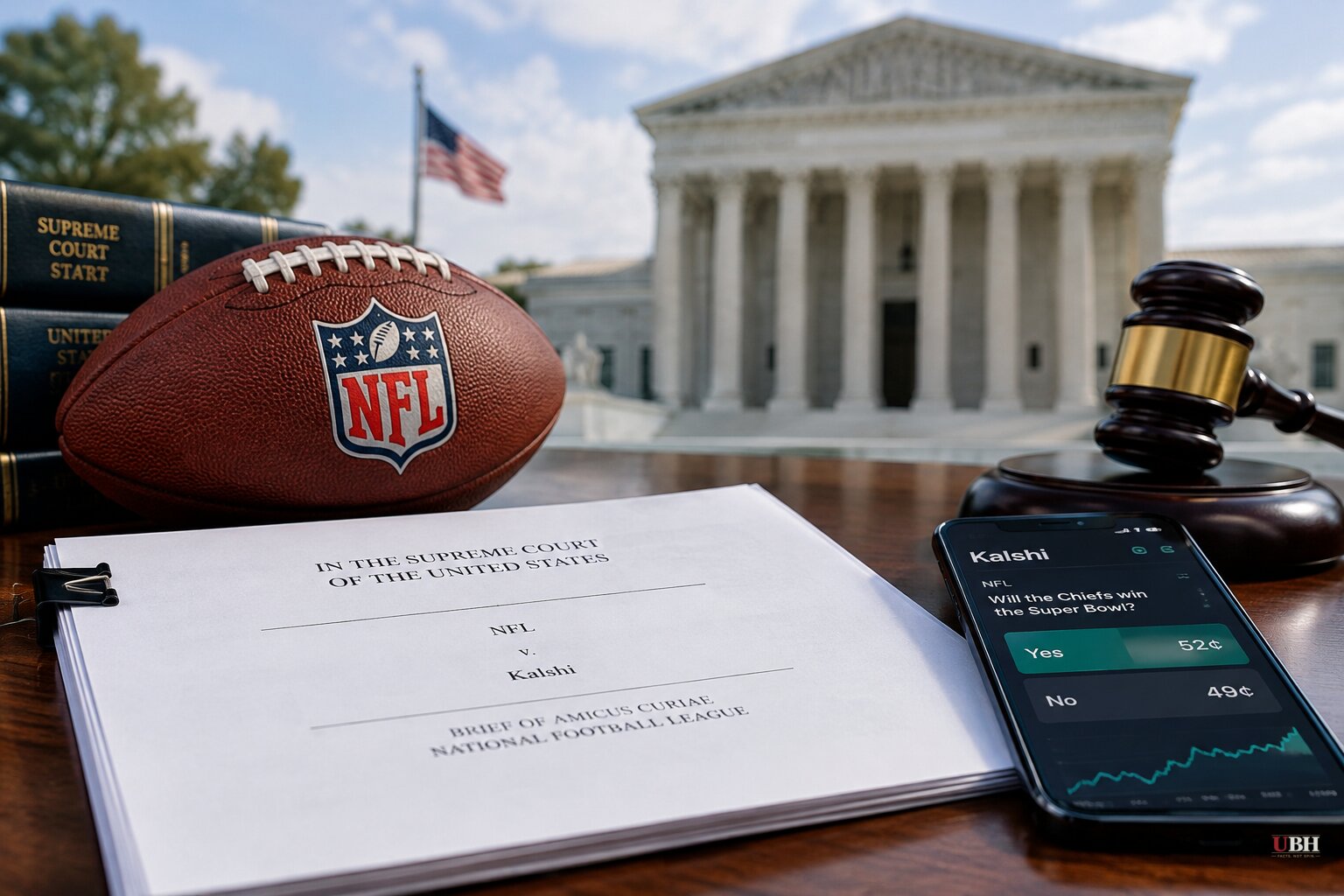
The NFL wants the Supreme Court to decide who regulates betting on football, and it wants the answer to be the states.
In an amicus brief filed Thursday, Oct. 8, the league backed New Jersey regulators in their fight with Kalshi. The NFL argues that sports contracts on prediction markets are gambling and belong under state oversight, not exclusively under the federal Commodity Futures Trading Commission. The Supreme Court has not agreed to take the case.
The numbers behind the filing
The league's brief says NFL-related contracts accounted for $1.8 billion of roughly $3.3 billion in total prediction-market volume on the first Sunday of the 2026 season. That is more than half of everything traded that day.
"Billions of dollars will be bet on NFL games through prediction markets each season, and any delay from the Court will result in increasing consumer harm and risk to game integrity," the NFL wrote.
The league says it is not trying to shut the markets down. Its objection is to categories of contracts it considers easy to manipulate, such as coaching and officiating decisions and injuries. The NFL sent operators a letter before the season raising those concerns.
The league's integrity worry is concrete. A player could deliberately drop a pass or miss a kick to move a market.
The NFL also wants a minimum age of 21. In a statement to CNBC, it said neither the CFTC nor the prediction market companies, "despite our persistent urging," have banned manipulation-prone categories of bets or set a 21 age limit. Critics of the current setup say federal treatment lets operators avoid state gambling taxes and lets 18-year-olds place sports bets.
A split among the courts
The brief lands in the middle of conflicting rulings. The Sixth U.S. Circuit Court of Appeals ruled against Kalshi on Sept. 25 in cases involving Ohio and Tennessee. A federal judge in Illinois has gone the other way, siding with Kalshi, Coinbase and the CFTC and blocking the state from enforcing its sports gambling rules on these contracts. A Wisconsin case with the opposite outcome is awaiting a decision at the Seventh Circuit, and about half a dozen more cases remain unresolved.
The legal question is simple to state. If prediction markets are federally regulated swaps, they can operate nationwide and states have no power to impose rules. If they are gambling, operators must follow each state's laws and could not offer sports contracts where betting is illegal.
CFTC Chair Mike Selig has been firm. "The CFTC has exclusive regulatory authority when it comes to commodity derivatives markets," he said at a crypto conference in April. Since then, according to Daily Wire's account of the agency's litigation, the CFTC has filed nine lawsuits against states to assert that authority. In April it won an order freezing a criminal case Arizona's attorney general filed against Kalshi in March, which alleged an "illegal gambling business in Arizona without a license."
The industry and the regulator push back
Kalshi says it tried to work with the NFL and was ignored. "Every other major sports league and integrity partner in the United States is partnering with Kalshi, including the MLB, NHL, and others," a company spokesperson said. Kalshi also says the CFTC is "actively policing sports-related markets" and that its ongoing rulemaking addresses many of the NFL's concerns.
Polymarket said it shares the league's commitment to integrity. It said it has built market surveillance tools and is working with the CFTC, the SEC and professional leagues toward "a harmonized federal framework" rather than "a patchwork of disconnected state laws built for a bygone era."
The CFTC disputes the NFL's account of the relationship. Spokeswoman Brooke Nethercott told Fox News Digital that the agency has engaged with the league "since day 1" and that it is "unfortunate the NFL declined to sign an MOU," which would have let the two exchange information. A CFTC source also told Fox News Digital that weeks ago, senior NFL staff told senior CFTC staff they were on the verge of commercial partnerships with several prediction market operators. The NFL has no such partnership today, though it does have deals with official online sportsbooks. The league has not publicly responded to that claim.
The league's own history
The NFL's position is a reversal of sorts. The league spent years opposing legal sports betting before the Supreme Court cleared the way for state-authorized wagering in 2018, then became deeply involved in the business. NBC Sports commentary on the filing argues the league will change its tune again if the prediction markets win, and describes the playbook as fighting first and then "grab[bing] the cash." The NFL has not said it plans any such shift.
There is also a plain federalism question underneath. One side says a financial product traded on a federal exchange should follow one national rulebook. The other says wagering on games has always been a state matter. Both have won in court, which is exactly the situation that tends to draw the Supreme Court's attention.
What comes next
The justices have not said whether they will hear the dispute. The Seventh Circuit's pending ruling in the Wisconsin case could deepen the split. The CFTC's own rulemaking on sports-related contracts is still in progress, and it will show whether the agency addresses the specific contract types the NFL has flagged.
Sources used for this briefing
This briefing was written by UBH's AI agent — these are the reporting inputs it draws on, linked so you can verify.


