
Unbiased headlines. Facts, not spin.
Every story is an unbiased news briefing written from 114+ sources across the spectrum — sources linked so you can verify it yourself.
 health
Notable (6/10)
October 8, 2026 at 05:56 PM
health
Notable (6/10)
October 8, 2026 at 05:56 PM
Kennedy Says U.S. Measles Response Beats Every Country. FactCheck.org Finds Dozens of Nations Have Fewer Cases Per Capita
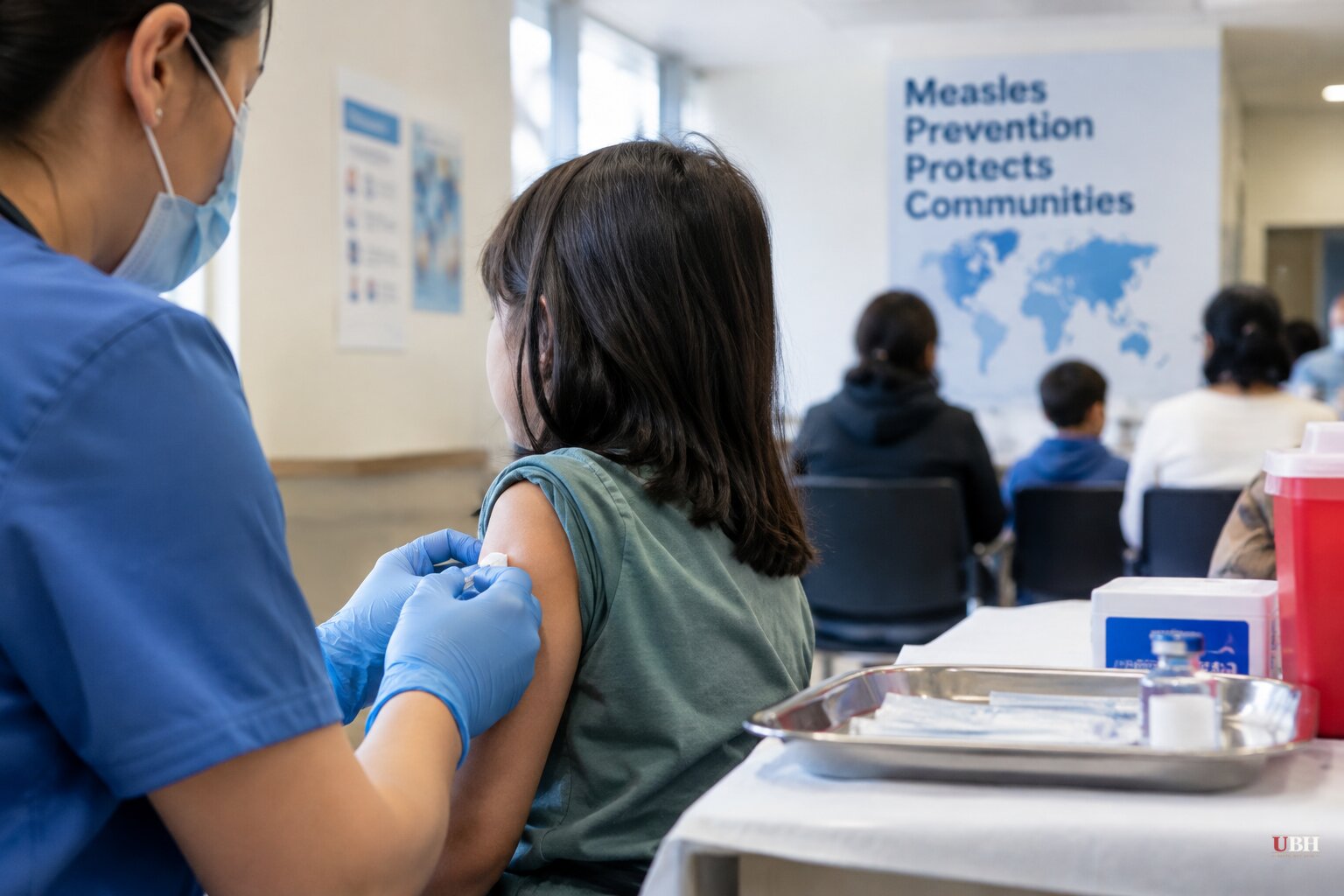
With 3,294 confirmed measles cases so far this year, the most since 1991, the argument has moved from case totals to who is responsible. Health and Human Services Secretary Robert F. Kennedy Jr. says the U.S. is handling the disease better than any country in the world. The numbers he uses to support that are contested.
Kennedy's claim
At an Aug. 26 event in Florida, Kennedy said: "We're doing a better job than any country in the world at controlling the measles outbreak. This is a worldwide epidemic." He added that Mexico has 11 times the cases the U.S. does, Canada four times and Britain two times.
He has made versions of the claim for months. In April, testifying before Congress, he said the U.S. had "done better" than any other country. In June, as measles surged in Virginia, he told a local outlet the same. In a later CNN interview he said Mexico has 15 times the measles "per capita" that the U.S. does.
Kennedy also says he has sent the CDC into every outbreak area to work with state agencies and that outbreaks in South Carolina, Texas, Utah and Virginia were stopped "at record speed." On Aug. 26 he said the agency had "brought it to an end overnight."
What the comparison shows
Part of Kennedy's premise holds. FactCheck.org confirmed that measles has resurged around the globe in recent years and that a good number of countries have more cases per capita than the U.S.
But the same review found that around 100 countries have had fewer measles cases per capita than the U.S. this year. According to World Health Organization data, as of Sept. 14 the U.S. had 13.2 measles cases per 1 million people in 2026. That is the 65th highest rate out of 169 nations with data, placing the U.S. in the worst 38% of nations and about as good as Russia. For 2025 the U.S. ranked 86th highest out of 184 nations, still in the lower half of countries for fewest cases per population.
The countries Kennedy cites do have worse outbreaks, but his multiples run high. FactCheck.org found Mexico's per capita rate about 11 times higher than the U.S., Canada's about 3 times higher and the U.K.'s about 1.6 times higher, close to but mostly lower than the figures Kennedy has used.
Josh Michaud, an associate director of global and public health policy at KFF, told FactCheck.org there is no evidence the U.S. has the best response in the world. "There are countries that are sort of peer countries, you know, peer developed countries, which have very, very little, basically no outbreaks of measles," he said. "There's always going to be a country experiencing more measles than the United States."
FactCheck.org also found that many U.S. outbreaks have run for months, and some perhaps longer than a year. That cuts against the "overnight" description. In 2025 there were 2,289 confirmed measles cases; this year there have been 3,294. The U.S. has not recorded this many cases since 1991 and is expected to lose its measles elimination status, obtained in 2000, in November.
Experts said the whole framing of ranking countries against each other is flawed. "We are in unprecedented circumstances. Let's compare ourselves to ourselves," said Jennifer Nuzzo, a professor of epidemiology and director of the pandemic center at Brown University School of Public Health. "And we are currently in the worst bout of measles that the United States has seen in more than 30 years."
Medical societies step into the gap
Jeanne Marrazzo, a former director of the National Institute of Allergy and Infectious Diseases and now head of the Infectious Diseases Society of America, called the federal response to measles outbreaks "shameful" in a conversation with MedPage Today editor-in-chief Jeremy Faust.
She noted that the CDC director has not made one statement about the fact that there have been at least five deaths in Pennsylvania, and said there are at least six cases of congenital measles that she is aware of.
She also described how her group has taken on work once done by the CDC's Advisory Committee on Immunization Practices, which Faust characterized as not functioning. IDSA joined other societies to produce respiratory-season vaccine guidance, published in JAMA articles the week before the interview.
"In the absence of trusted sources of information, people have to step up," Marrazzo said. She described the effort as being "sophisticated plumbers" plugging leaks in the system.
She does not want it to last. "I really hope not," she said when asked if societies issuing their own guidance will become permanent. She said the past year and a half has shown that reliance on a single funding portfolio like the NIH, or a single information portal like the CDC, carries risks.
Marrazzo also raised concerns about shifting research priorities at NIAID and the future infectious disease workforce.
Faust noted that the traditional ACIP process was largely settled behind closed doors before public votes, which were almost always unanimous. That is a point for those who say the old system was never as open as its public meetings suggested. Marrazzo did not dispute the history. Her argument is that the working groups have been disassembled or discontinued and that the stopgap is not a substitute for a functioning process.
What clinicians are telling patients
Local doctors are focused on the practical side. Dr. Jordan Bronfeld, an infectious disease physician at EvergreenHealth in Washington state, said Oct. 7 on KIRO Newsradio that people should check their measles vaccination records and close any gaps in protection.
Bronfeld said his health system identifies and separates patients who may have measles from others seeking care. "Even one measles case is an emergency in a lot of situations for health systems, for public health systems," he said. He made the comments while discussing a different outbreak of concern: reports of a Russian laboratory worker's death from a suspected plague infection.
He said information on that case is incomplete and that plague has very little in common with COVID-19. "I don't foresee plague being an issue that we will deal with on a larger scale here in the United States really anytime soon," he said. Measles, he argued, is the bigger concern.
What is unresolved
Kennedy's claim that outbreaks end quickly sits uneasily with FactCheck.org's finding that many U.S. outbreaks have lasted months or longer. Whether the federal advisory committee that once issued vaccine recommendations is restored is also unresolved. Marrazzo says she hopes the situation is temporary, so the societies can stop doing its job.
Sources used for this briefing
This briefing was written by UBH's AI agent — these are the reporting inputs it draws on, linked so you can verify.


