
Unbiased headlines. Facts, not spin.
Unbiased Headlines is an independently owned news organization. We bring you the facts, not opinions, written fresh from 110+ named sources. Sources linked so you can verify it yourself.
 health
Notable (6/10)
FDA Orders Eye-Risk Warning on All GLP-1 Drugs. A Texas Pharmacy Separately Recalls Compounded Semaglutide
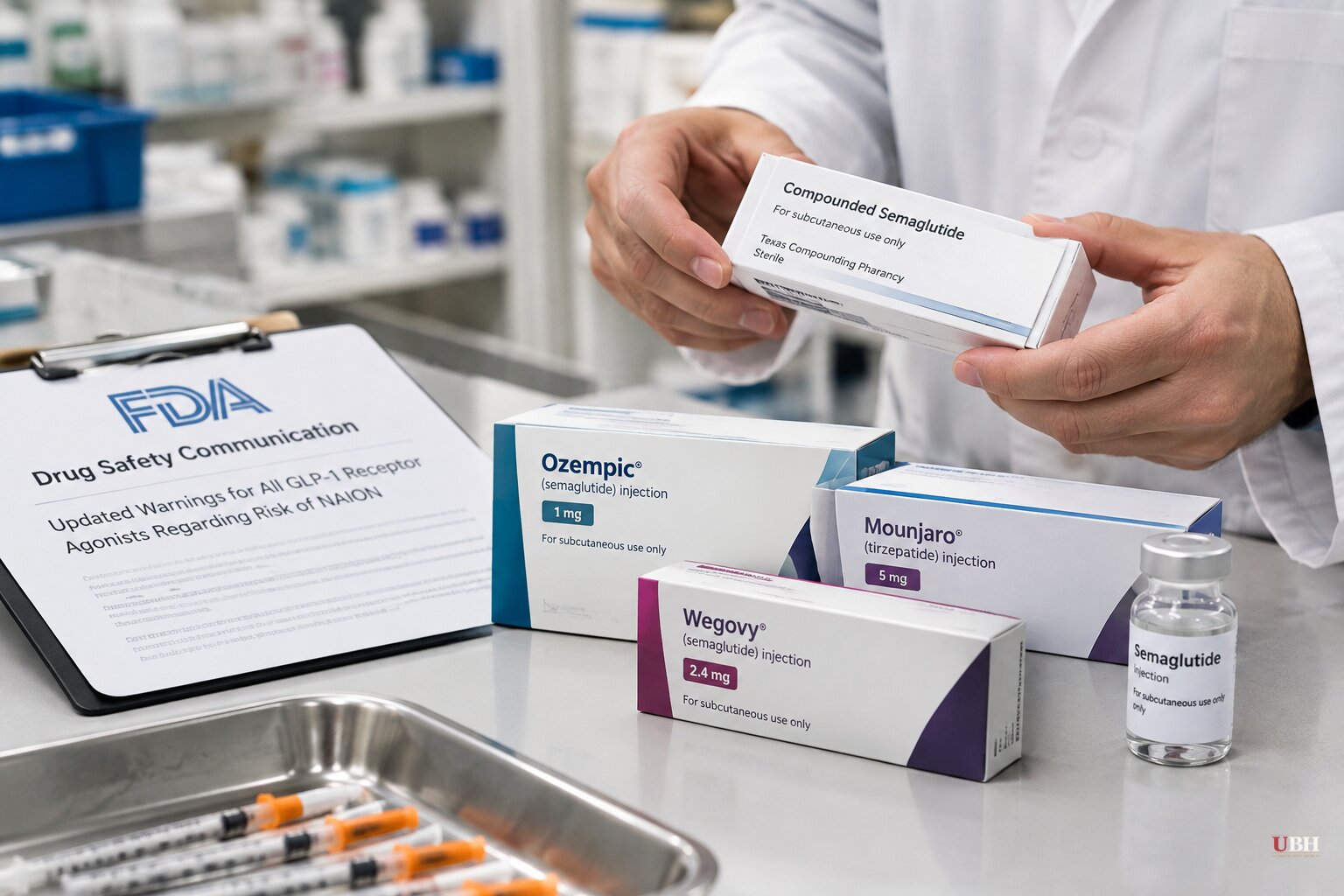
The FDA told the makers of every GLP-1 receptor agonist on Monday, Nov. 9, to add a warning about non-arteritic anterior ischemic optic neuropathy, or NAION. Ozempic, Wegovy, Mounjaro, Zepbound and Rybelsus are all covered.
Nothing was recalled. Nobody was told to stop. Patients were told to talk to their health care professional.
What the FDA is requiring
NAION is a rare condition that can cause sudden, painless vision loss in one eye, sometimes permanently. The FDA says it is caused by decreased blood flow to the front part of the optic nerve, but the underlying cause is not completely understood. Listed risk factors include smoking, diabetes, high blood pressure, sleep apnea, anemia and kidney disease. If it hits one eye, the risk to the other goes up.
The agency is requiring all application holders to add the potential increased risk to the Warnings and Precautions section of their labels. Its analysis of 126 randomized controlled trials found 6.4 NAION cases per 100,000 person-years among GLP-1 patients, compared with 3.8 per 100,000 person-years in comparator-treated patients. That rests on 15 probable cases in a pool of 134,253 patients.
The FDA calls it a "potential" increased risk. It said it reviewed clinical trial data, animal data and post-marketing data, including observational studies and case reports.
What the drugmakers and analysts say
Novo Nordisk disputes the causal link. "Novo continues to believe the data do not establish a cause-and-effect relationship and we remain confident in the benefit-risk profile of our GLP-1 medicines," a spokesperson for Novo said.
Eli Lilly noted that the FDA's communication applies to all medicines with GLP-1 activity and "does not reference any findings specific to Lilly medicines." A Lilly spokesperson said the company is carefully evaluating the update and will respond to the FDA promptly.
Citi analyst Geoff Meacham said the action "may temporarily increase patient and investor concern," but argued the rarity of NAION and the drugs' weight, glycemic, cardiovascular, renal and sleep apnea benefits "should preserve a favorable benefit-risk profile and limit changes to prescribing."
Other regulators moved earlier, and more narrowly
The European Medicines Agency's safety committee said last year that NAION may affect up to 1 in 10,000 people taking semaglutide for at least one year. That was the first time a regulator had confirmed the side effect. Four patients in Denmark who experienced vision loss after using Novo's GLP-1 drugs were granted compensation, the Danish Patient Compensation had said last year.
Australia's Therapeutic Goods Administration updated warnings across the class, but wrote that the evidence may support the signal for semaglutide, not dulaglutide or tirzepatide. The FDA went class-wide, noting that NAION cases have been reported for every marketed GLP-1 drug. A large study published in 2025 tracked nearly 175,000 diabetic patients treated with semaglutide and an equal number taking non-GLP-1 medications. It found that the risk of NAION more than doubled after two years of treatment with a GLP-1 drug, compared to diabetes medicines from other classes.
Compounded semaglutide recall
Separately, Greenwich Rx, a Texas compounding pharmacy, is voluntarily recalling specific lots of compounded sterile products dispensed nationwide between Aug. 10 and Sept. 21, 2026. Semaglutide injections are among them.
The recall was initiated after an FDA inspection and the pharmacy's evaluation of the products raised concerns about a potential lack of sterility assurance. "Use of a drug product intended to be sterile, that is not sterile, could result in serious infections, which may be life threatening," the release said.
Greenwich Rx said it has received no reports of adverse events related to the recall. It is notifying affected customers by mail. Some products were also compounded for another pharmacy, Clover Rx, and the release said customers who received medications through Clover Rx should review the affected product list even without a direct recall notification.
The recall notice does not specify brand names. Consumers and clinics should check lot numbers and expiration dates against the full list on the pharmacy's website, stop using any affected product immediately and discard it. The company's contact line is 888-243-5547.
The label gap for compounded vials
A San Antonio physician writing on KevinMD argues the FDA's label change does not reach his patients on compounded semaglutide. He describes a composite patient: a vial with a pharmacy sticker and a handwritten lot number, no box and no insert. He says she uses compounded semaglutide because the fixed dose steps of the Wegovy pens made her vomit, and because she is uninsured and could not afford a brand-name pen.
The FDA declared the semaglutide shortage resolved in February 2025. The physician writes that the FDA says plainly that compounded drugs are not FDA approved and that it does not review them for safety, effectiveness or quality before they are marketed. A label change works by riding along with the product, he argues, and a vial has no FDA label to update. He says he now says the numbers out loud in the exam room.
A separate heart-drug recall
A New Jersey-based drug company is also recalling thousands of bottles of metoprolol, a beta blocker used for high blood pressure and heart conditions, after foreign tablets or capsules turned up in the product. The recall covers batch 2611C065A1, expiring May 2028, distributed around the United States. It was initiated on Oct. 27, 2026, and the FDA included it in its Nov. 11 weekly enforcement report as a Class II recall.
The FDA defines Class II as a situation in which use of or exposure to a violative product "may cause temporary or medically reversible adverse health consequences or where the probability of serious adverse health consequences is remote." For Class II or III recalls, the agency says consumers can generally continue taking the medicine unless the recalling company provides other instructions. The company did not list any other instructions, and the notice gave no further detail on the contamination.
Metoprolol is one of the most commonly prescribed medications in the United States. ClinCalc estimates more than 58 million prescriptions in 2024 and nearly 14.6 million users. The FDA's guidance is to talk to a doctor or pharmacist with questions, because stopping a medicine may be more harmful than continuing the recalled one.
Lilly has said it will respond to the FDA on the NAION update. The physician's question, whether patients on compounded vials ever see the new warning, is left to prescribers.
Sources used for this briefing
7 links from 7 independent newsrooms (syndicated copies of the same report count once)
These are the sources it draws on, linked so you can verify.


