
Unbiased headlines. Facts, not spin.
Unbiased Headlines is an independently owned news organization. We bring you the facts, not opinions, written fresh from 110+ named sources. Sources linked so you can verify it yourself.
 health
Notable (6/10)
Neonatal Deaths 5.5% Higher Than Expected in Abortion Ban States, JAMA Network Open Study Finds
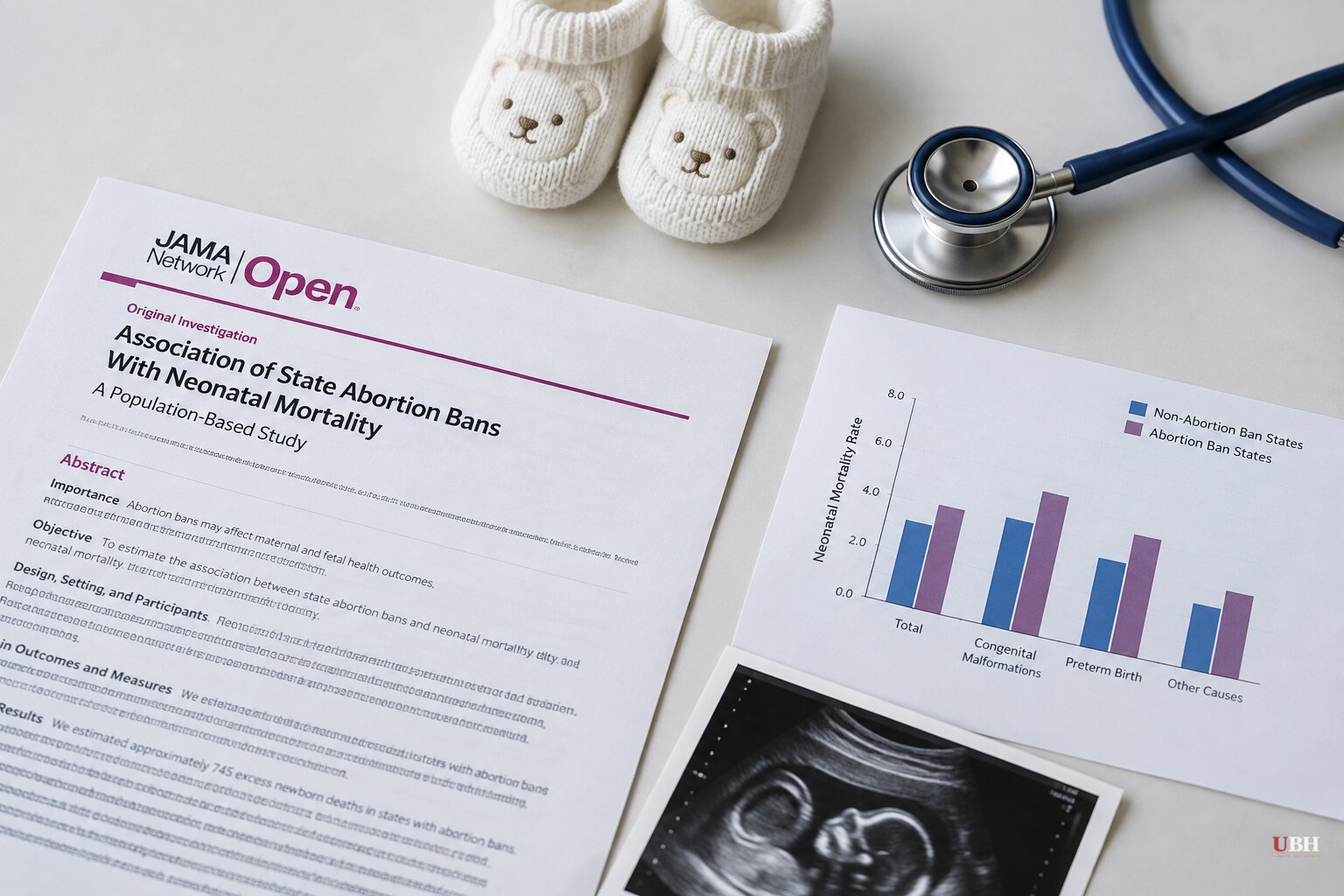
A new retrospective analysis in JAMA Network Open estimates that neonatal deaths ran 5.5% higher than expected in states that enacted abortion bans. The lead author is Nansi Boghossian, PhD, of the University of South Carolina in Columbia.
The 95% credible interval runs from 2.6% to 8.5%. That works out to roughly 745 excess neonatal deaths across those states, with an interval of 367 to 1,139.
What the study found
Infant deaths, which cover the first year of life, rose 1.8% above expectation. That equals about 288 excess deaths. The interval runs from a 0.2% decline to a 4.3% increase, so the authors say the figure is not statistically significant.
The researchers followed neonatal deaths for about three years after most bans took effect. They followed infant deaths for about two years. They said they wanted a longer window than earlier work and wanted to include states that banned abortion more recently.
The largest increases showed up in subgroups. Among Black infants, deaths were 8.8% above expected (interval 3.3% to 14.2%). Boghossian noted that Black infants in the U.S. already die at more than twice the rate of White infants. "Abortion bans may make that gap wider," she said.
By cause, infant mortality from congenital anomalies was 6.9% higher than expected (interval 1.8% to 12.5%). By timing, the excess was concentrated in the neonatal period, at 5.0% (interval 1.7% to 8.4%).
Texas drives much of the result
Texas is the largest state to ban abortion. Its early pregnancy ban took effect in 2021, before the 2022 Dobbs v. Jackson Women's Health Supreme Court decision ended the federal right to abortion. Earlier research found infant and neonatal deaths rose in Texas after that ban.
When the authors dropped Texas, the neonatal estimate fell to 2.2% (interval from a 0.5% decline to a 5.2% increase). The infant estimate fell to 0.2% (interval from a 1.2% decline to a 2.0% increase). Neither is statistically significant. Texas and Alabama showed the biggest state-level increases in neonatal mortality.
The figures are modeled comparisons against what researchers expected to happen, not counted cases tied to individual bans. The study is observational.
The proposed mechanism
The authors do not claim that postnatal care got worse. Boghossian told MedPage Today the findings suggest "that the link between bans and these deaths operates mainly during pregnancy and at birth, rather than through postnatal care."
The paper lays out the reasoning. "Neonatal deaths are more likely to reflect conditions originating in utero, including congenital anomalies, consistent with our findings of increased mortality from these causes," the researchers wrote.
Their hypothesis is that bans may "increase the continuation of pregnancies affected by severe fetal anomalies that would otherwise have been terminated." That is a proposed explanation, not a demonstrated one. The study reports a rise in anomaly-related deaths. It does not trace individual families' decisions.
Boghossian said the results suggest abortion bans "may have meaningful downstream effects on infant health outcomes."
What remains open
The headline neonatal result rests on a credible interval that excludes zero. Once Texas is removed, it no longer does. The infant mortality result does not clear that bar either way.
The unresolved question is whether the neonatal increase appears across ban states generally or mostly reflects Texas, where the ban began earliest. Longer follow-up in states that banned abortion after Dobbs would help answer that.
Sources used for this briefing
1 link from 1 independent newsroom (syndicated copies of the same report count once)
These are the sources it draws on, linked so you can verify.


