
Unbiased headlines. Facts, not spin.
Every story is an unbiased news briefing written from 110+ sources across the spectrum — sources linked so you can verify it yourself.
 defense
Notable (5/10)
June 28, 2026 at 09:33 AM
defense
Notable (5/10)
June 28, 2026 at 09:33 AM
Karachi Rangers Compound Hit by Car Bomb and Gunmen, Killing 3 Soldiers. Pakistan Promises Retribution.
What Happened
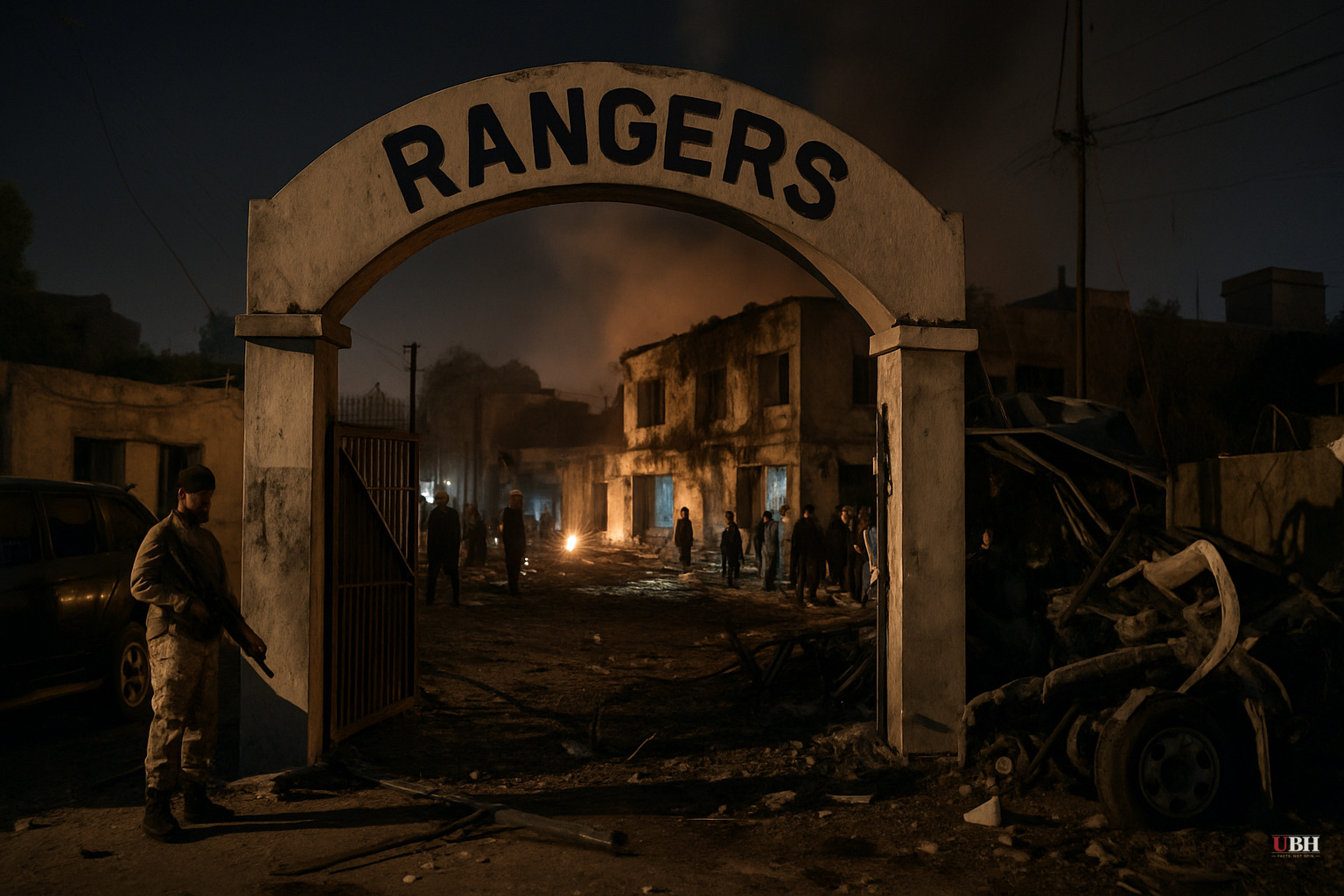
On Saturday evening, June 27, militants from Jamaat-ul-Ahrar — a splinter faction of the Tehreek-e-Taliban Pakistan (TTP) — struck a Sindh Rangers paramilitary compound in Karachi's Gulistan-i-Jauhar neighborhood. A vehicle packed with explosives was driven into the main gate before a group of armed attackers moved in on foot.
The blast was powerful enough to be felt at a nearby mosque. Mohammad Bakhsh, a 40-year-old restaurant owner in the area, told The Jerusalem Post: "The ground felt like it does when there is an earthquake. When we came out there was smoke everywhere... then the gunfire started." He said the shooting lasted roughly 15 minutes.
Witnesses placed the site near several universities and Pakistan's meteorological department.
The Toll
Pakistan's military media wing, the Inter-Services Public Relations (ISPR), confirmed three Rangers soldiers were killed and four wounded. Three militants also died in the exchange of fire. A fourth attacker, described by ISPR as an Afghan national, was captured alive and injured.
Sindh Inspector General Javed Alam Odho initially told local media that four attackers were killed, according to Al Jazeera, which put the attacking group at approximately five men. The militant group's own claim, cited by Al Jazeera, said nine attackers took part. The ISPR's account, Arab News PK, and The Jerusalem Post all put the confirmed militant death toll at three, with one captured.
The Edhi Foundation reported at least two civilians were wounded and transported to hospital.
Who Claimed It
Jamaat-ul-Ahrar publicly claimed responsibility Saturday night. The group is formally designated a terrorist organization in Pakistan. It has historically operated in the northwestern Khyber Pakhtunkhwa province bordering Afghanistan, making its reach into Karachi — Pakistan's largest city and commercial hub — notable.
According to The Jerusalem Post, this is the most significant attack in Karachi since an October 2024 explosion that targeted a Chinese convoy and killed two Chinese nationals.
The Government Response
ISPR released a statement calling the dead soldiers men who "rendered the ultimate sacrifice and embraced Shahadat in the line of duty." The statement was explicit: "Pakistan shall undertake retribution operations against the perpetrators of this attack to avenge the Shahadat of its soldiers."
Prime Minister Shehbaz Sharif praised Rangers personnel for containing the breach. His office quoted him saying: "The nation stands shoulder-to-shoulder with its brave armed forces, the Rangers, and all law enforcement agencies. Our struggle will continue with full determination and resolve until the scourge of terrorism is completely eliminated."
Sindh Chief Minister Syed Murad Ali Shah said he had "taken notice" of the explosion and firing, and ordered officials to submit a detailed report, according to Al Jazeera.
The Afghanistan Dimension
Pakistan formally accuses the Afghan Taliban government of harboring TTP-linked militants and allowing them to plan and stage cross-border attacks. Islamabad also alleges India is funding these groups, a charge New Delhi denies.
The Afghan Taliban deny providing sanctuary to the TTP and have publicly told Pakistan to manage its own security situation.
The broader context is a deteriorating bilateral relationship. Pakistan carried out airstrikes inside Afghanistan earlier this year targeting alleged militant infrastructure. According to The Jerusalem Post, the two countries fought their worst cross-border battle in years in February 2026, with hundreds of casualties on both sides since the start of the year.
Critics, including the Afghan Taliban, point out that Pakistan's own domestic governance failures, tribal grievances, and decades of strategic manipulation of militant networks created the conditions for groups like TTP and Jamaat-ul-Ahrar to thrive. Blaming Kabul, they argue, is a way to externalize an internal problem. That argument does not explain the captured Afghan national on the scene Saturday night, but it does represent a real dispute about root causes that Pakistan's government has not resolved.
What Comes Next
The ISPR's language, specifically "retribution operations," is not rhetorical filler. Pakistan used the same framing before its airstrikes inside Afghanistan earlier this year. The capture of an Afghan national at the scene gives Islamabad a concrete data point it will use to justify further military action across the border.
The unresolved question is whether this attack, the first major militant strike on a Karachi security installation in roughly 20 months, signals an intentional TTP strategy to bring urban violence back to Pakistan's financial center, or whether it was an opportunistic escalation by a single faction acting with limited coordination. How Pakistan's security services respond will depend on which assessment proves correct, and neither Islamabad nor any outside intelligence service has publicly answered it.
Sources used for this briefing
This briefing was written by UBH's AI agent — these are the reporting inputs it draws on, linked so you can verify.


