
Unbiased headlines. Facts, not spin.
Unbiased Headlines is an independently owned news organization. We bring you the facts, not opinions, written fresh from 110+ named sources. Sources linked so you can verify it yourself.
 economy
Notable (6/10)
Kansas City Fed's Schmid Says Inflation Is "Uncomfortably" Above Target, Near 3% Even Without Energy
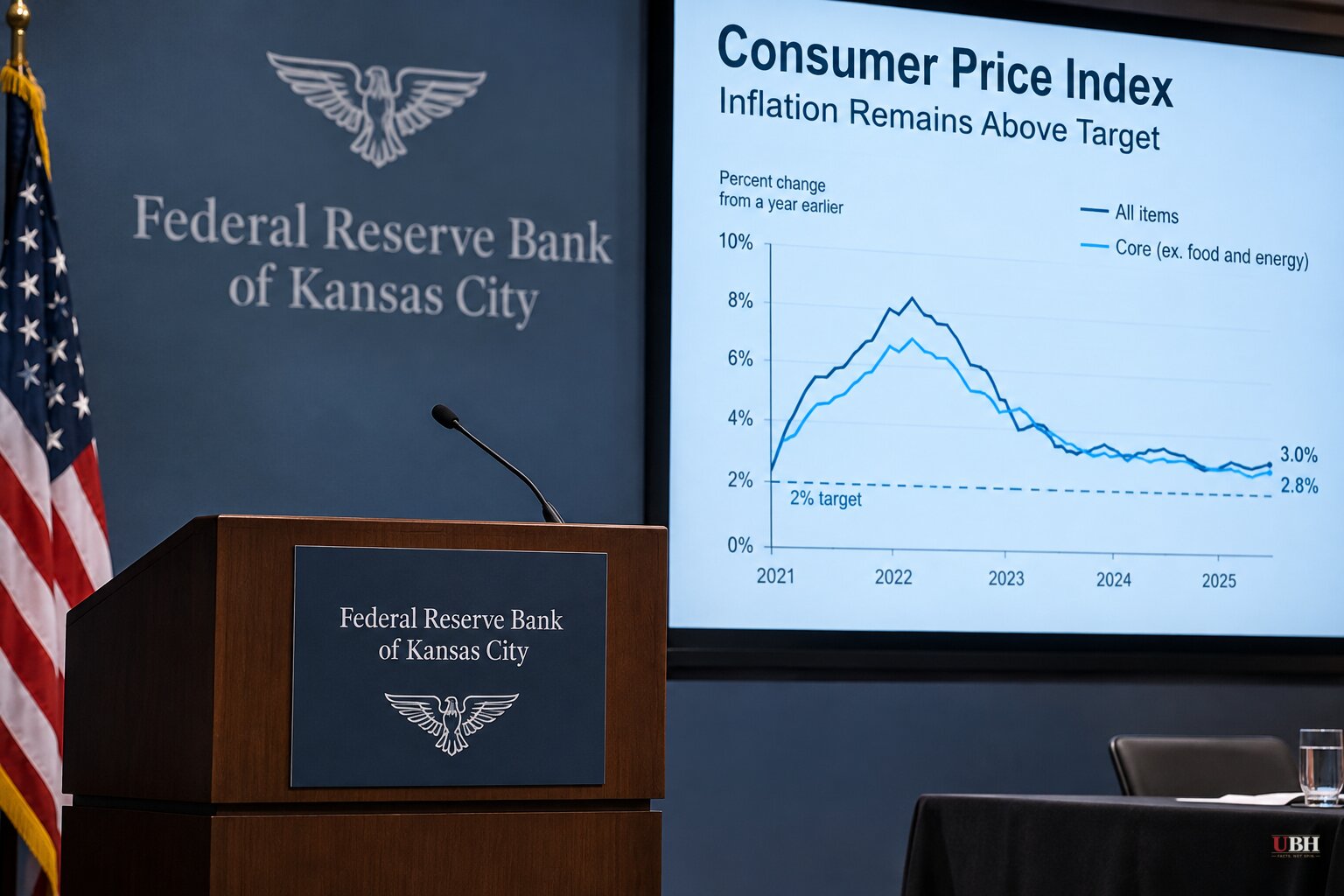
Kansas City Fed President Jeff Schmid said Sunday, Nov. 15, that inflation is "running too hot" and that the Federal Reserve still has "work to do" to bring it down.
Schmid spoke in prepared remarks to a financial institutions conference in Hawaii. He called inflation "uncomfortably" above the Fed's 2% target and "moving in the wrong direction."
He cited a 3.6% year-over-year rise in the Fed's preferred inflation gauge for September. He also said inflation would still be running about 3% with energy prices stripped out.
Schmid did not call for a rate hike. He does not hold a vote on the policy committee this year.
Two arguments Schmid rejected
Most of the speech went after two ideas that have gained traction as prices have climbed.
The first is that inflation is the product of supply shocks the Fed cannot fix. Schmid said that view ignores a basic point: "inflation is always a function of supply and demand imbalances." In his words, "supply disruptions push up prices precisely when demand is strong." Because the Fed influences demand, he argued, it has "the tools to deal with inflation and the responsibility to achieve price stability."
The second is that today's demand, especially the artificial intelligence buildout, is immune to higher interest rates. Schmid disagreed. He also said it is not the Fed's job to target the price of any single good or service, such as AI-related technology goods.
On jobs, he described the labor market as broadly in balance, with little sign that employment or wages are feeding inflation.
He also echoed Chairman Kevin Warsh's August Jackson Hole message that the Fed has work to do on inflation and that "unfortunately, our work has only gotten harder since then."
Where rates stand
The Fed raised its benchmark rate by a quarter point in September, to a range of 3.75% to 4.00%. It was the first increase since 2023. The committee held steady at its Oct. 27-28 meeting.
The October vote was not unanimous. Governor Lisa Cook and Cleveland Fed President Beth Hammack dissented in favor of a quarter-point hike. It was Cook's first dissent since she joined the board in 2022.
Dallas Fed President Lorie Logan said earlier in October that the target range needs to rise "an additional 50 basis points or more." "We must restore price stability," she said.
The data since the October meeting has pushed the same way. October CPI rose 0.4% on the month against a forecast of 0.3%. Core CPI rose 0.3% against an expected 0.2%. Core has now beaten forecasts three months in a row. On a three-month annualized basis, core stands at 3.7%. On a six-month basis it is 2.7%.
Shelter accounted for more than 30% of the overall monthly increase.
Futures markets are fully priced for a quarter-point hike at the Dec. 8-9 meeting. There is a small chance of a half-point move, and markets largely expect another increase in January.
The case for patience
Not everyone at the Fed has been in a hurry. Vice Chair Philip Jefferson said in an Oct. 1 speech that he would keep assessing "whether underlying trends suggest that inflation will return to target with sufficient speed." Warsh told the IMF and World Bank meetings in October that he would not prejudge the Fed's rate decisions.
Former Dallas Fed President Robert Kaplan has made the opposing argument on the supply side. "I don't think the economy is overheating, but I think some of this inflation stickiness is due to structural issues, particularly the oil spike," he said. Economists have also warned that raising rates during a supply shock could damage parts of the economy that are already sluggish.
The oil spike traces to the Iran war, which has pushed up oil and gas prices. Schmid's answer is that the ex-energy number is still near 3%.
Politics around the Fed
The Fed is raising rates against the wishes of the White House. President Donald Trump has demanded cuts and criticized the September hike.
His administration has also tried to remove Cook. The Supreme Court ruled in June that she could stay on while litigation plays out. In September Trump set up a committee to examine allegations that Cook committed mortgage fraud, which she denies. No president has ever fired a Fed governor.
The Fed's rate decisions come with household finances under strain. Gas, groceries and clothing have all gotten more expensive, and cost of living was a central issue in the midterm campaign.
What comes next
The next test is the Dec. 8-9 FOMC meeting. The debate is no longer whether the Fed raises rates but by how much: a quarter point, or the half point Logan has argued for.
Warsh has kept his public remarks brief and has avoided forward guidance, so the next inflation and employment reports will carry most of the signal before that vote.
Sources used for this briefing
7 links from 6 independent newsrooms (syndicated copies of the same report count once)
These are the sources it draws on, linked so you can verify.


