
Unbiased headlines. Facts, not spin.
Unbiased Headlines is an independently owned news organization. We bring you the facts, not opinions, written fresh from 110+ named sources. Sources linked so you can verify it yourself.
 finance
Notable (6/10)
Event date: November 13, 2026 ·
Kalshi Says Trump Jr. Is Out as Adviser Over Polymarket Conflict as Its Stock Perpetuals Top $5 Billion in Volume
Since the CFTC and the Justice Department sued Louisiana over its order barring Kalshi, Polymarket and others from offering event contracts, the prediction-market industry has produced three more headlines in a matter of days: a high-profile adviser exit, a new leveraged product with huge early volume, and a fresh crop of 2028 odds.
Trump Jr. leaves Kalshi
Kalshi said Thursday, Nov. 12, that Donald Trump Jr. will no longer serve as an adviser. The reason, according to the company, is that his investment firm, 1789 Capital, has put heavy money into a direct competitor.
A Kalshi spokesperson said talks about his exit began in August, after 1789 announced it had bought about $300 million of Polymarket on top of an earlier $200 million stake. That is roughly $500 million in a rival. "Both parties understood that advising two competitors in a growing sector was complicating things," the company said in a statement. Trump Jr.'s spokesperson told The New York Times the split was mutual.
Kalshi hired Trump Jr. in January 2025 and gave him shares as part of his compensation. Those shares are now estimated to be worth millions. Neither Kalshi nor Trump Jr.'s spokesperson has said whether he keeps them.
Kalshi CEO Tarek Mansour told MS NOW in October that Trump Jr.'s connection to the company creates an "optics issue." He also said Kalshi has never relied on that relationship to win favor with the government.
The regulatory backdrop
The Trump administration has pushed hard for prediction markets. Some incoming Democratic lawmakers have vowed to investigate the regulatory approvals Kalshi has received from it. No investigation has been announced, and no wrongdoing has been alleged by any regulator.
One approval stands out. Since May, the CFTC has allowed Kalshi to offer perpetuals, a product that has never before been permitted in the United States, according to The New York Times. Perpetuals let customers bet on the price of a stock or crypto asset without owning it. A trader can bet that Tesla falls and profit if it does.
The Chicago Mercantile Exchange and Cboe Global Markets have sued the CFTC over this. They argue that letting prediction markets offer the product violates federal laws that protect investors from insider trading, market manipulation and other abuses. The CFTC's response to that suit is not in the record so far.
Those are the incumbents' words, and they have a commercial stake. They are also the ones who run the regulated exchanges that Kalshi is now competing against.
$5 billion in perpetuals in about a week
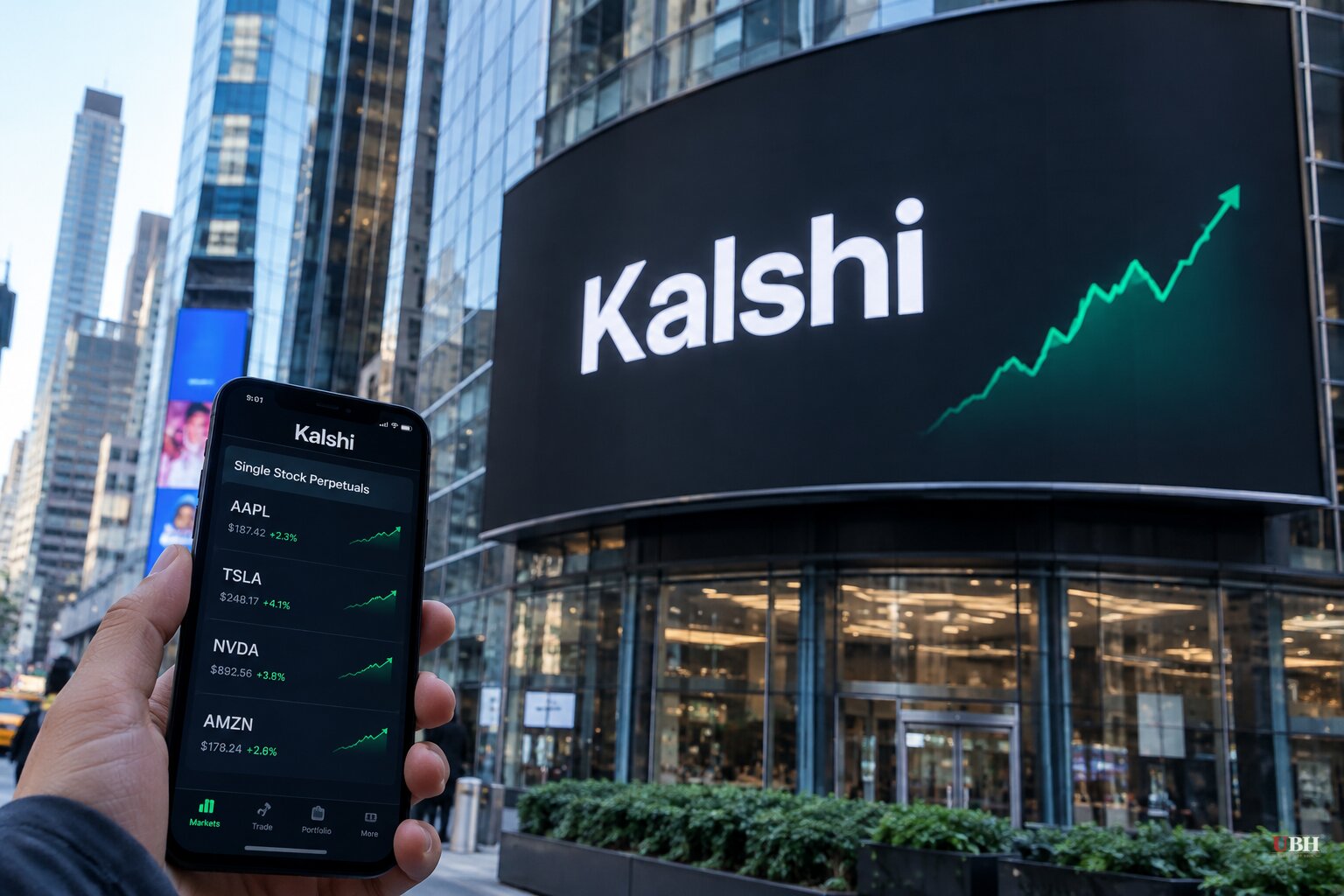
Kalshi's single-stock perpetuals launched Nov. 5 and have reached $5 billion in notional trading volume, Bloomberg reported. The contracts cover 50 large-cap stocks, have no expiration date, and carry maximum leverage of about 6.45x.
Notional volume measures the face value of positions, not the cash customers put up. At 6.45x leverage, a fraction of that figure is actual margin.
Bloomberg reported that traders are using the contracts to hedge against uncertainty in the AI sector, with names such as Nvidia and SpaceX drawing interest. The timing is notable. Nvidia shares fell 12.75% last week, a week in which CEO Jensen Huang resigned, and the iShares Semiconductor ETF dropped 3.67% on Friday alone. Yet the S&P 500 still rose 2.51% for the week to 7,561, its best week since August.
The 10-year Treasury yield hit 5.15% on Friday after hotter-than-expected inflation data. Regan Capital's Skyler Weinand said that sets the stage for a Federal Reserve rate hike in December. A volatile, rate-sensitive market is exactly where leveraged bets on single stocks get tested.
Trading the 2028 race
Politics is feeding the same platform. Fox News reported that Kalshi's 2028 markets have drawn nearly half a billion dollars in trading, with the midterm ballots barely counted.
On Kalshi, Georgia Sen. Jon Ossoff has a 26% chance of winning the Democratic nomination, the best in the field. A Reuters/Ipsos poll found a third of Democrats have never heard of him. California Gov. Gavin Newsom has fallen from 37% to about 12%.
On the Republican side, Vice President JD Vance sits at 33% for the nomination but only 12% to win the presidency. Nate Silver calls that gap the "VP curse," the pattern of vice presidents with unpopular bosses winning nominations and losing in November.
Those numbers are market prices, not forecasts anyone has audited. Kalshi also launched midterm contracts on Nov. 3 tied to a composite index rather than individual race calls. Democrats then swept Congress, and the Dow jumped 1,569 points, or 3%, on Nov. 4, its best post-midterm day since 1982, according to CFRA Research.
What comes next
CME and Cboe's lawsuit against the CFTC is pending. The Democratic majority that takes over Congress has said it wants to examine Kalshi's approvals. Polymarket, meanwhile, is targeting a mid-December launch for its new trading system, Nex, which is now in sandbox testing.
It is unclear whether Trump Jr.'s departure ends the scrutiny or only sharpens it. His $500 million in Polymarket and his Kalshi equity both remain part of the picture.
Sources used for this briefing
6 links from 6 independent newsrooms (syndicated copies of the same report count once)
These are the sources it draws on, linked so you can verify.


