
Unbiased headlines. Facts, not spin.
Unbiased Headlines is an independently owned news organization. We bring you the facts, not opinions, written fresh from 110+ named sources. Sources linked so you can verify it yourself.
 finance
Notable (5/10)
Kalshi and Polymarket Crypto Contracts Hit Record $2.7 Billion in a Week, Led by 15-Minute Bitcoin Bets
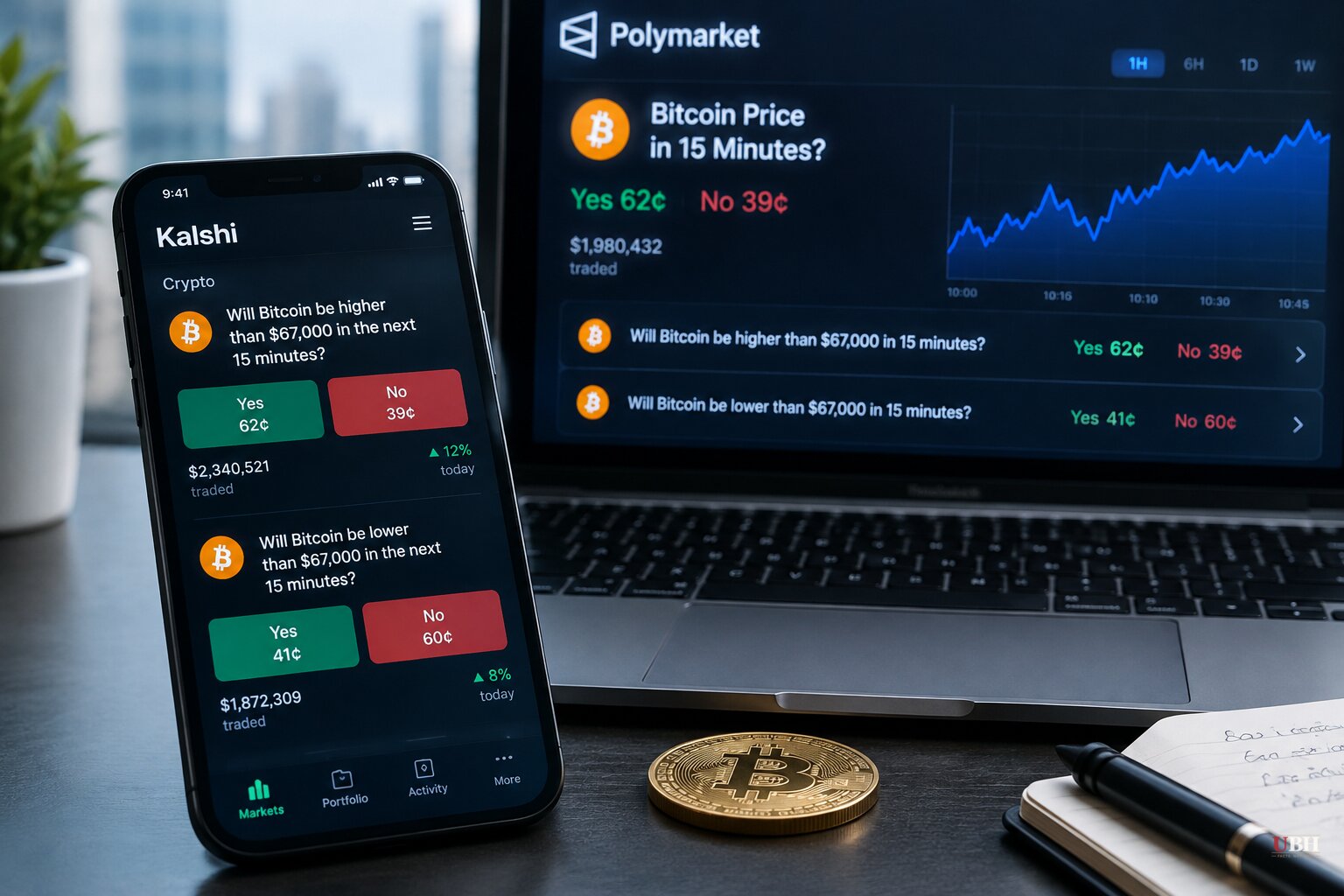
Crypto-related contracts on Kalshi and Polymarket traded a record $2.7 billion in notional volume in a single week in mid-October, according to data compiled by a Dune Analytics user and reported by Bloomberg. That makes crypto the second most traded category on both platforms, behind only sports.
Bitcoin did most of the work. Kalshi's Bitcoin contracts alone generated more than $2 billion that week, led by a 15-minute up/down product. Polymarket's US arm, in its first full week of operation, reported roughly $92 million to $101 million in 15-minute Bitcoin volume.
What the numbers measure
Notional volume counts the full face value of contracts traded. It is not the amount customers put at risk.
Kalshi's overall activity in October has been enormous on that measure. The week of Oct. 5 to 11 hit $19.03 billion in contract volume across all categories, up 3.57% from the prior week. Weekend trading made up 41.44% of that total, according to DefiRate's aggregation. Daily totals regularly ran between $3.9 billion and $4.4 billion.
The two companies count differently. Kalshi reports contracts at $1 face value. Polymarket US reports a venue-native trade volume figure of $2.82 billion for the same week, and Polymarket's offshore platform reported $498.81 million in cash-dollar volume. Dune data compiled by Bloomberg put the combined weekly total at a record $22.2 billion.
Sports still dominate. According to TickerTracker data, Kalshi traded $3.9 billion on Oct. 11, a single-day record for the company. The 123bet analysis of that data found more than 70% of that day's volume came from parlays and combination bets.
The skeptics inside the industry
Breon Corcoran, CEO of IG Group, told analysts Thursday that Kalshi and Polymarket are "talking up their notional traded volume with great gusto." He spoke at a seminar on Underdog, the US prediction markets operator IG is buying.
Corcoran gave an example: in a 100-leg parlay, a $1 stake can carry a notional value in the thousands or tens of thousands of dollars. He said the key metric is net gaming revenue, and that handle, the money customers actually stake, is closer to what listed companies report.
IG's own deal is built on revenue. IG agreed in July to pay $1.1 billion upfront for Underdog, plus an earn-out of up to $200 million tied to 2026 revenue. Underdog co-founder Jeremy Levine said third-quarter net revenue was $105 million, up 118% from a year earlier. He added that the comparison was helped by World Cup matches and a weak margin period the year before.
Robinhood earned $156 million from event contracts in the second quarter, more than ten times the year-earlier figure. Kalshi, still private, raised $1 billion at a $22 billion valuation in May.
Gambling or exchange?
Citizens analyst Jordan Bender told Bloomberg the parlay-heavy mix is "the same playbook we saw five years ago with online betting apps. It looks no different."
Kalshi rejects that. "Sports trading on regulated prediction markets offer a fairer choice to consumers, with no 'house' that restricts winners and hooks people the more they lose," said Elisabeth Diana, the company's head of communications.
The distinction has substance. Kalshi does not book bets against customers or limit sharp accounts. But a counterparty still takes the other side. According to the 123bet analysis, FanDuel supplies much of the liquidity on combos as a market maker. That analysis cites a Bloomberg finding that retail longshot money lost 15% by settlement on Kalshi before fees of up to 7%.
Then there is the tax gap. Kalshi is regulated federally as an exchange, so it does not pay state gambling taxes like New York's 51% levy on sportsbooks. "In Texas or California, where gambling is not allowed, prediction markets have a leg up," Seton Hall law professor Ilya Beylin told Bloomberg.
That is why DraftKings and FanDuel have launched prediction products of their own. DraftKings filed its first event contract templates for its DKeX exchange in May. Underdog launched an exchange in July.
Crypto trading moves to short-term contracts
The crypto record arrives as spot trading volumes across crypto decline, according to Crypto Briefing. Coinbase and other platforms are moving into prediction markets in search of the engagement that buying and selling coins no longer delivers at the same pace.
A 15-minute contract is not an investment in Bitcoin. It is a bet on direction over a quarter hour. That is legal and it is the customer's choice, but it is a different product from owning the asset.
Elections are next
Midterm markets have passed $1.4 billion in trading volume, according to CNN's analysis. Kalshi said it has seen nearly $1.1 billion, and Polymarket said it has seen more than $340 million, including its offshore site. CNN has a partnership with Kalshi.
Dustin Gouker, who writes a newsletter on prediction markets, called the figure "sizable" but "still much less than sports and crypto markets." He expects trading to ramp up significantly on Election Day as polls close.
Oversight is tightening at the edges. Federal regulators have pledged to crack down on insider trading tied to the midterms. Kalshi has already suspended six 2026 candidates for improperly betting on their own races. The Trump administration is finalizing rules that protect election markets.
What remains open is whether notional records turn into durable revenue. Underdog's third-quarter numbers and the IG deal will be an early gauge, and Corcoran said IG is currently the only public company talking about prediction markets revenue.
Sources used for this briefing
7 links from 7 independent newsrooms (syndicated copies of the same report count once)
These are the sources it draws on, linked so you can verify.


