
Unbiased headlines. Facts, not spin.
Unbiased Headlines is an independently owned news organization. We bring you the facts, not opinions, written fresh from 110+ named sources. Sources linked so you can verify it yourself.
 finance
Major Story (7/10)
Event date: October 23, 2026 ·
CoreWeave Stock Is Down 30% in October as Bond Yields Pass 15% and Short Interest Hits 23.7% of Float
Opening
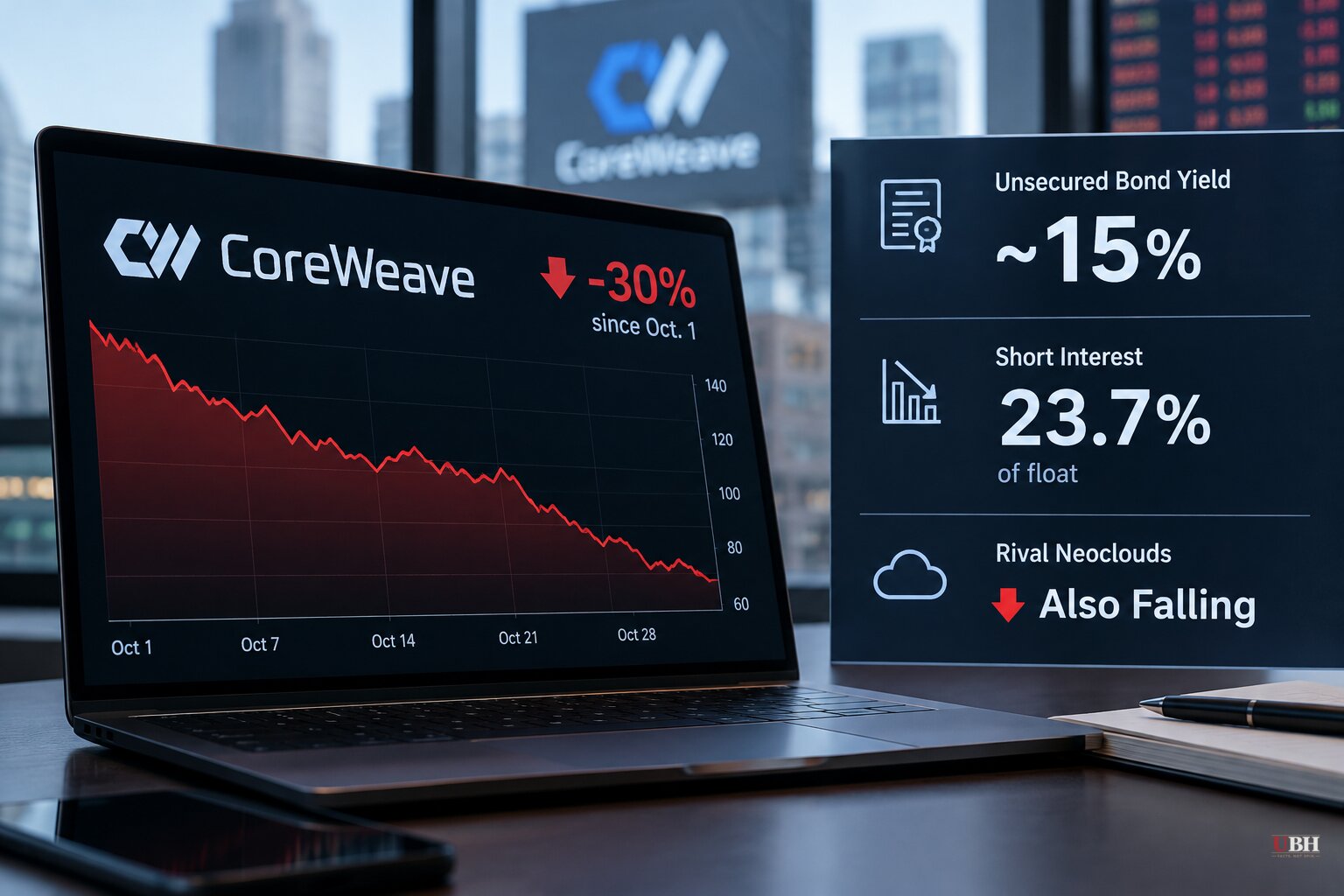
CoreWeave has become the market's test case for whether the AI build-out can be financed at current interest rates. The stock closed Wednesday, Oct. 21, down about 30.2% from its Oct. 1 close. Its unsecured debt yields roughly 15%, and short interest has reached 23.7% of the free float.
The company's market value has fallen to about $34 billion. That compares with a peak near $90 billion, reached about three months after its March 2025 IPO.
The credit market moved first
The five-year credit default swap spread was recently quoted at about 1,067 basis points, or 10.67%. That is up 164% over the past year and another 30% in October alone.
Last week the stock fell more than 15% in a single week. Yields on the company's 2030 bonds jumped about 500 basis points to nearly 16%.
Andrew Keches, a Barclays credit analyst, told clients in a Tuesday note that sentiment is "decidedly negative." He pointed to "the speed at which AI vibes are shifting on a day-to-day basis."
What CoreWeave owes
CoreWeave carries about $20.7 billion in debt due through 2030 and another $14.9 billion after that, roughly $35.6 billion in total. Its June 30 balance sheet shows $35.551 billion in borrowings, plus $16.3 billion in recognized operating lease liabilities. It also has about $35.5 billion in lease commitments that have not yet commenced.
Fox Business has put the company's debt load at $50 billion. The difference from the balance-sheet figure likely reflects what is counted, and the company has not publicly reconciled the two numbers.
Customer concentration adds to the risk. More than two-thirds of CoreWeave's revenue last year came from Microsoft. Nvidia is its largest institutional shareholder, with about 9%, according to FactSet. Microsoft and Meta, both investment-grade companies, are on its customer list.
Investors are asking what capital-raising options remain when unsecured debt yields 15%. CoreWeave has announced no refinancing or restructuring plan.
The pain is spreading through the sector
Other highly leveraged cloud providers are being hit too. Nebius shares are down 27% this month and IREN is down 32%. Australian data center operator NextDC fell 40% on Wednesday after cutting its annual profit forecast.
Firmus, another Australian data center company, canceled its IPO plan earlier this month, citing market volatility. Nscale, the Nvidia-backed U.K. provider, filed for a New York Stock Exchange listing last month. It has not said whether it will go ahead.
The financing pipeline is narrowing. Issuance of AI-related bonds fell from $113 billion in June to $23 billion in September. Gartner forecasts that by 2030, more than 80% of new cloud providers will cease operating independently.
Oracle and Meta show the same strain at larger scale
Oracle shares fell about 6.5% over the same period. Its total borrowings stood at $125.3 billion as of Aug. 31, with roughly $288 billion in lease commitments yet to begin.
Meta reported third-quarter revenue up 26% to $64.6 billion. Capital spending of $34.91 billion exceeded operating cash flow of $32.79 billion, leaving free cash flow negative by $2.12 billion. Meta still held $82.45 billion in cash and marketable securities at the end of September.
The TradingKey analysis of the two companies cautions against reading too much into the selloff. It says evidence of a systemic industry debt crisis remains limited. It describes CoreWeave's exposure as direct financing pressure, and Oracle's as cash-flow pressure from heavy investment.
Not every market agrees
The prediction market Polymarket put the implied probability of a CoreWeave bankruptcy by the end of 2028 at 14% on Wednesday, down 8 points. Zhitong Financial News attributed the move to a strong third-quarter report from SpaceX. The bond and default-swap markets did not follow.
Fox Business reported that chip stocks snapped an eight-day losing streak, their longest in 18 years, with a rebound that lifted the Nasdaq more than 1%. Rising oil prices and higher borrowing costs were keeping that comeback in check, according to Fox Business, which also tied the worries about AI financing to CoreWeave.
What to watch
CoreWeave faces a refinancing decision with its debt priced at distress-level yields. The next signals are whether it announces a financing plan and whether Nscale proceeds with its NYSE listing.
Sources used for this briefing
7 links from 7 independent newsrooms (syndicated copies of the same report count once)
These are the sources it draws on, linked so you can verify.


