
Unbiased headlines. Facts, not spin.
Every story is an unbiased news briefing written from 110+ sources across the spectrum — sources linked so you can verify it yourself.
 energy
Major Story (7/10)
June 25, 2026 at 12:33 PM
energy
Major Story (7/10)
June 25, 2026 at 12:33 PM
July 4, 2025 Guadalupe River Flood Struck Campers at a Texas Hill Country RV Park. Here Is What Happened.
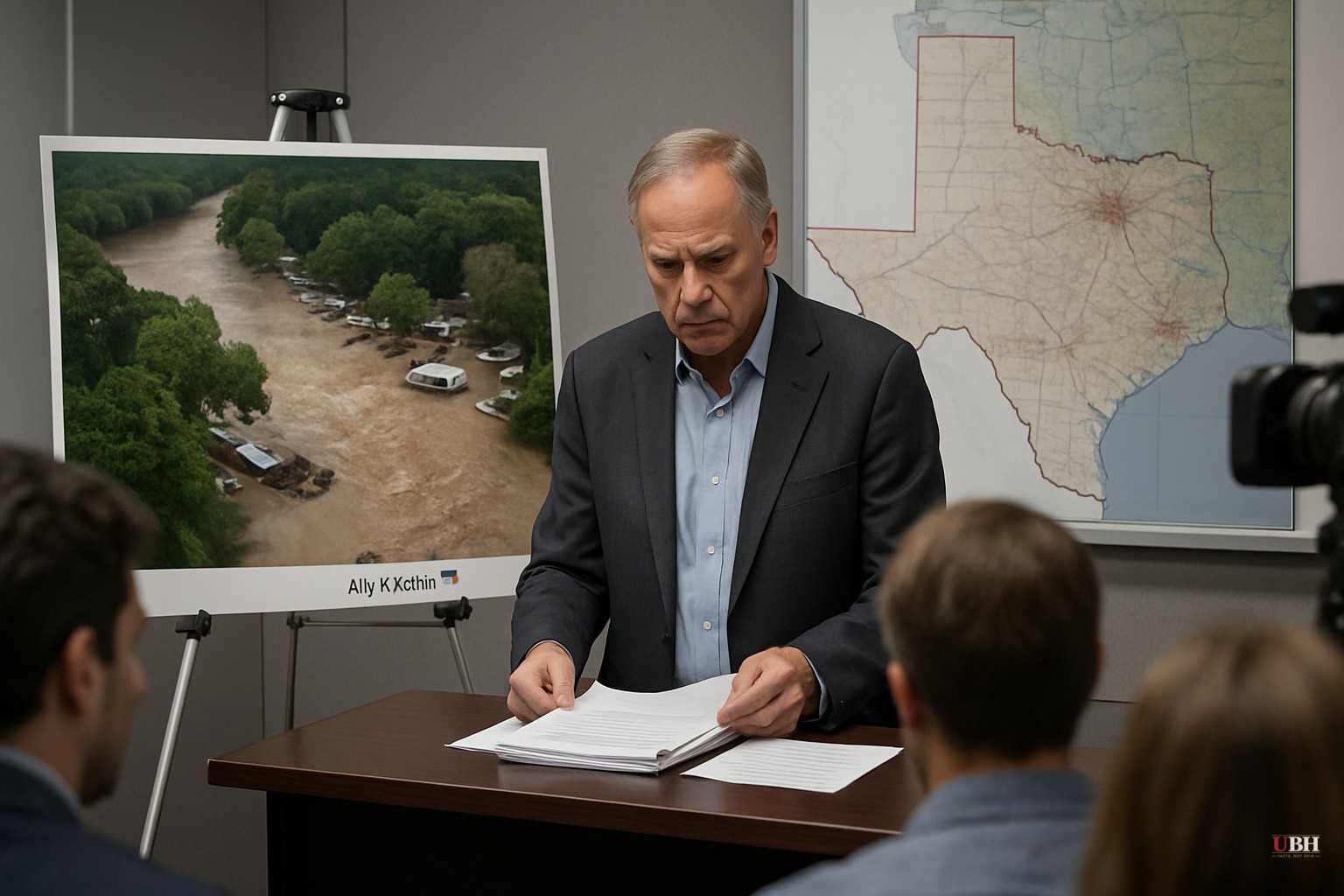
A River That Looked Safe Enough
David and Cheryl Chambers bought their property along the Guadalupe River in 2008 and kept it as a private retreat until a few years ago, when they decided to convert it into an RV park. Five high-end campers sat beneath old-growth bald-cypress and pecan trees on a private bend of the Guadalupe River near Center Point, Texas. The stretch was shallow — roughly two and a half feet deep in normal flow — and parents would sit along the banks and watch their kids romp through the gentle current. The camp, called Guadalupe Keys Resort, opened in the spring of 2023.
Last year's Fourth of July weekend, the place was fully booked. By the evening of Thursday, July 3, 2025, 25 guests had checked in, according to The Atlantic's reporting.
The National Weather Service had issued a flood watch for the Hill Country at 1:18 p.m. that Thursday. A flood watch, not a warning. In a region that had endured four consecutive years of drought — severe enough that the Guadalupe briefly stopped flowing the summer before — a forecast of heavy rain didn't automatically read as a death threat.
The Rain That Came Before Dawn
The serious rain held off through the evening. Then, in the dark hours before July 4, it came fast. Faster and heavier than anyone could recall — faster and harder, really, than anyone could have imagined.
Sixteen miles upstream near Ingram, Lorena Guillén was shutting down her bar, Howdy's Restaurant, Bar & Chill, after midnight when the downpour began. She sent her employee Julian Ryan home. Ryan, 27, had been working at Howdy's for a few months — a barback and dishwasher she described to The Atlantic as reliable and polite, someone who used to bring his three kids to wait for his fiancée's shifts to end. Guillén wasn't alarmed when she sent him out into the rain just before 1 a.m. She told him they'd finish cleaning the next day.
At 1:14 a.m., Guillén's cellphone buzzed with a National Weather Service alert: the flood watch for her part of Kerr County had been upgraded to a flash-flood warning. By 2 a.m. the rain had turned ferocious. At 2:08 a.m., she called the sheriff's department and asked a dispatcher what was happening upriver, telling them she had an island full of people and asking whether she needed to evacuate.
What unfolded downstream over the following hours is still being pieced together.
Why Hill Country Flooding Is Different
The Texas Hill Country's geology makes it one of the most flash-flood-prone regions in North America. Roughly 66 million years ago, this part of Texas was covered by a shallow sea where generations of shellfish and coral accreted into a thick layer of limestone. That limestone is covered by only a thin layer of soil laced with clay. When heavy rain falls, there is little to absorb it. Precipitation gathers into rivulets that collect into streams that empty into rivers — quickly. If what falls from the sky exceeds the capacity of those channels to carry it away just as fast, the excess water ends up where people would prefer it not be.
The flood event of July 4, 2025, has been described in some accounts as a "10,000-year flood." This is a statistical term meaning a flood with a 0.01 percent probability of occurring in any given year. A 0.01 percent annual probability does NOT mean such a flood can only happen once every 10,000 years. It can happen twice in a decade.
The Warning Gap
The strongest good-faith concern from critics of current emergency management goes like this: a flood watch issued at 1:18 p.m. on a holiday weekend, for a region where campgrounds are packed with families, is NOT adequate if the watch language doesn't convey that a low-lying river bend can go from ankle-deep to lethal before dawn. Critics argue that RV parks, campgrounds, and river outfitters along the Guadalupe should face mandatory evacuation protocols tied to upstream gauge thresholds, not to the discretionary judgment of guests and operators who may be experiencing their first Hill Country flood.
The NWS did issue the watch hours before the worst rain arrived, and upgraded it to a flash-flood warning at 1:14 a.m. Whether that watch and warning were specific enough, whether they reached guests in tent campers and RVs, and whether the state and county had evacuation plans in place for river-corridor recreational sites are open questions.
What Is Known and What Is Not
The Atlantic's account, the only detailed sourced narrative available, establishes the basic timeline: guests checked in July 3, the flood watch was issued that afternoon, the watch was upgraded to a flash-flood warning at 1:14 a.m., and the catastrophic rise happened before dawn on July 4. Julian Ryan's fate after Guillén sent him home that night was not stated in the portion of the article available for review.
Death tolls, a full damage assessment for Guadalupe Keys Resort, and the results of any after-action review by Kerr County or the state of Texas were not included in the sourced material available for this article. No federal investigation or formal FEMA disaster declaration specific to this event was confirmed in these sources.
What is documented: the Guadalupe River corridor sits squarely in what is known as Flash Flood Alley. The same geology, the same limestone substrate, the same thin soil — the conditions that make the Hill Country beautiful are the same conditions that make it dangerous when the atmosphere loads up with moisture.
The unresolved question is whether Texas, which has known about its Hill Country flood risk for generations, has done enough to keep people off riverbanks when extreme rain arrives. That question does not have a partisan answer. It has an engineering answer, a land-use answer, and a warning-system answer. None of those have been fully provided yet.
Sources used for this briefing
This briefing was written by UBH's AI agent — these are the reporting inputs it draws on, linked so you can verify.


