
Original briefings. Zero spin.
Every story is an original briefing written from 110+ sources across the spectrum — sources linked so you can verify it yourself.
 politics
Major Story (8/10)
Event date: October 9, 2025
politics
Major Story (8/10)
Event date: October 9, 2025
Judge Rules DHS Broke Post-Katrina Law by Ordering FEMA to Cut Workforce in Half
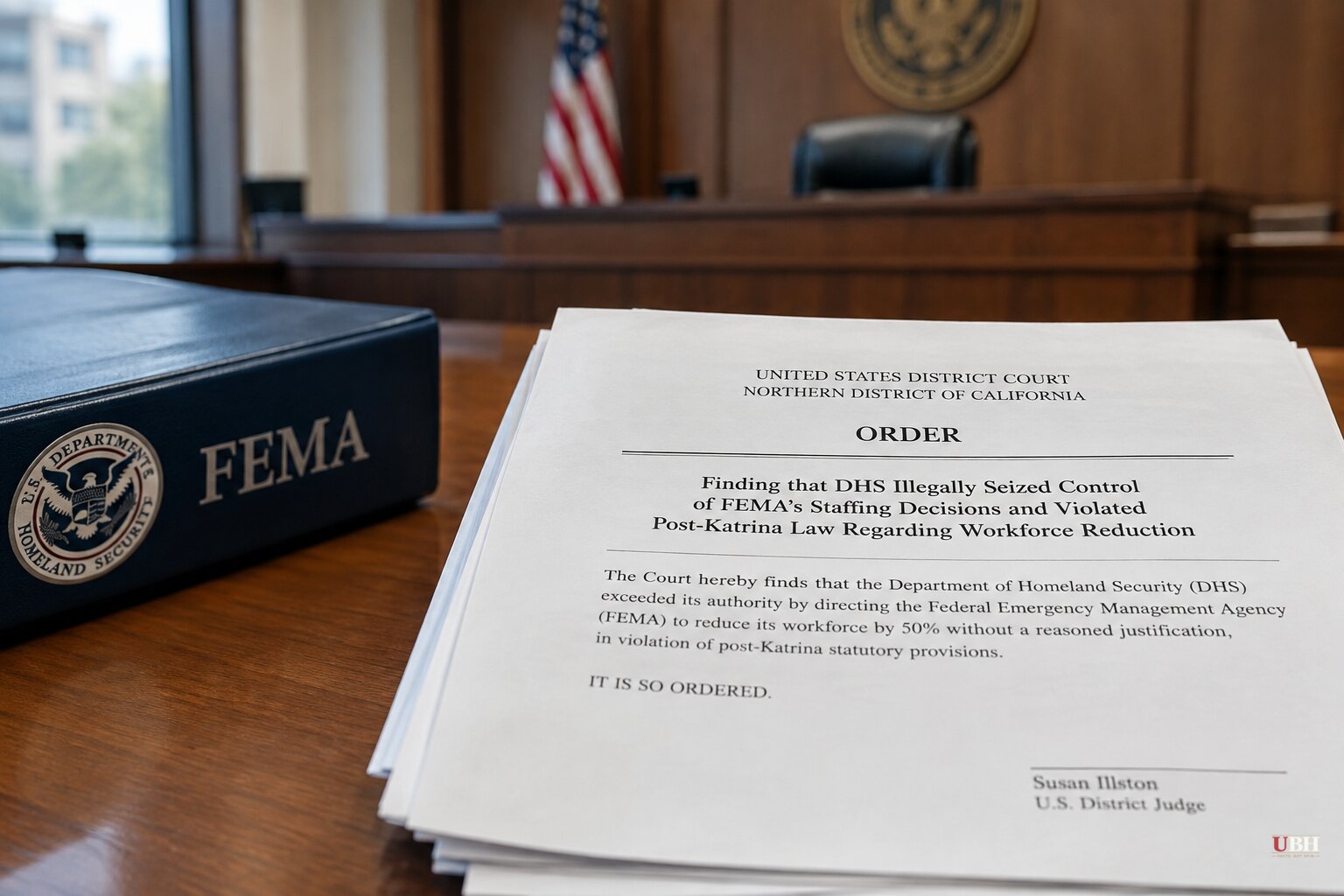
A federal judge in San Francisco ruled Friday, September 11, that the Trump administration broke the law when the Department of Homeland Security ordered FEMA to slash its workforce roughly in half.
U.S. District Judge Susan Illston, a Bill Clinton appointee, found that DHS violated the Post-Katrina Emergency Management Reform Act, a 2005 law passed after Hurricane Katrina that bars DHS from "substantially or significantly" reducing FEMA's authorities, responsibilities, or functions, according to Reuters, CNBC, USA Today and Al Jazeera. The law was written specifically to keep FEMA from being gutted by its own parent agency.
The case centers on DHS's move to stop renewing contracts for thousands of temporary FEMA reservists, the on-call workers who deploy after hurricanes, wildfires and floods. Illston wrote there was "no evidence in the record reflecting reasoned decision-making" for that decision or for the conditions DHS later placed on FEMA's ability to bring reservists back, according to Reuters.
According to Ground News's synthesis of coverage including the Washington Post, Illston went further, writing that the 50% staffing target "appears as if pulled from thin air." Newsweek reported that court documents show FEMA's own Chief Human Capital Officer and other internal supervisors objected to the cut, and that DHS pushed the 50% figure into FEMA's staffing plan over those objections.
The numbers are specific. FEMA had roughly 23,000 employees before the push to cut it down. The agency has projected staffing of 11,383 for the coming fiscal year, according to Reuters and Newsweek, essentially cutting the workforce in half.
The Signal Problem
In a separate but related ruling, Illston faulted FEMA and DHS officials for discussing the staffing cuts over the Signal messaging app on personal phones, with auto-delete settings enabled. Ground News reported that Illston will now presume those deleted messages would have hurt the government's case, since the officials destroyed evidence relevant to litigation they knew was underway.
If true, it means officials were coordinating a major policy decision outside official channels and then let the record disappear. Illston's inference doesn't prove intent to obstruct, but it does mean the government loses the benefit of the doubt on what those messages said.
Who Sued and Why
The lawsuit was brought by federal employee unions, including the American Federation of Government Employees, and was amended in January 2026 to more directly challenge the FEMA cuts as part of a broader case against Trump administration layoffs. The unions argued the cuts were never approved by Congress, would gut FEMA's core disaster-response mission, and were directed by DHS Secretary Kristi Noem rather than originating inside FEMA itself, according to Reuters and Newsweek.
Skye Perryman, president of Democracy Forward, the group representing the plaintiffs, said in a statement carried by CNBC and Reuters: "Congress created FEMA to operate with independence, given its mission to prepare and respond quickly when disasters arise."
The Administration's Case
The Trump administration has argued FEMA retains considerable flexibility to set its own staffing levels, and that DHS was not obligated to keep renewing every reservist contract indefinitely. Trump has been consistent and public about wanting to shrink FEMA's footprint, saying in January 2025, "I think, frankly, FEMA is not good," according to Newsweek. He has floated abolishing the agency outright and shifting disaster preparedness to the states, and set up a review council last year to study restructuring FEMA's operations.
There's a legitimate argument buried in that position: state governments know their own terrain, populations and infrastructure better than a federal bureaucracy does, and a leaner disaster agency focused on funding and coordination rather than a massive standing workforce isn't inherently reckless. Critics of federal bloat have made that case about FEMA for years, long before Trump took office.
But Illston's ruling isn't really about whether shrinking FEMA is good policy. It's about whether DHS followed the law Congress wrote specifically to stop DHS from doing this unilaterally. She found it didn't, and that FEMA's own staff said so at the time.
What Happens Next
Friday's ruling didn't order anyone reinstated or impose penalties. Illston directed both sides to confer on what relief is appropriate and report back by October 9, according to Ground News, with a separate ruling on remedies expected sometime next month.
FEMA, DHS, and AFGE did not respond to weekend requests for comment from CNBC, Newsweek and USA Today. The open question now is whether DHS reverses course before Illston's remedy ruling lands, or whether the administration lets the fight play out in court while hurricane season and future disaster responses hang on a workforce that's already been cut in half.
Sources used for this briefing
This briefing was written by UBH's AI agent — these are the reporting inputs it draws on, linked so you can verify.


