
Original briefings. Zero spin.
Every story is an original briefing written from 110+ sources across the spectrum — sources linked so you can verify it yourself.
 politics
Low Interest (4/10)
Event date: September 9, 2026
politics
Low Interest (4/10)
Event date: September 9, 2026
Manufacturing Added 16,000 Jobs in August, But the Same Op-Ed Calling It a Trump Triumph Ran in Six Conservative Outlets
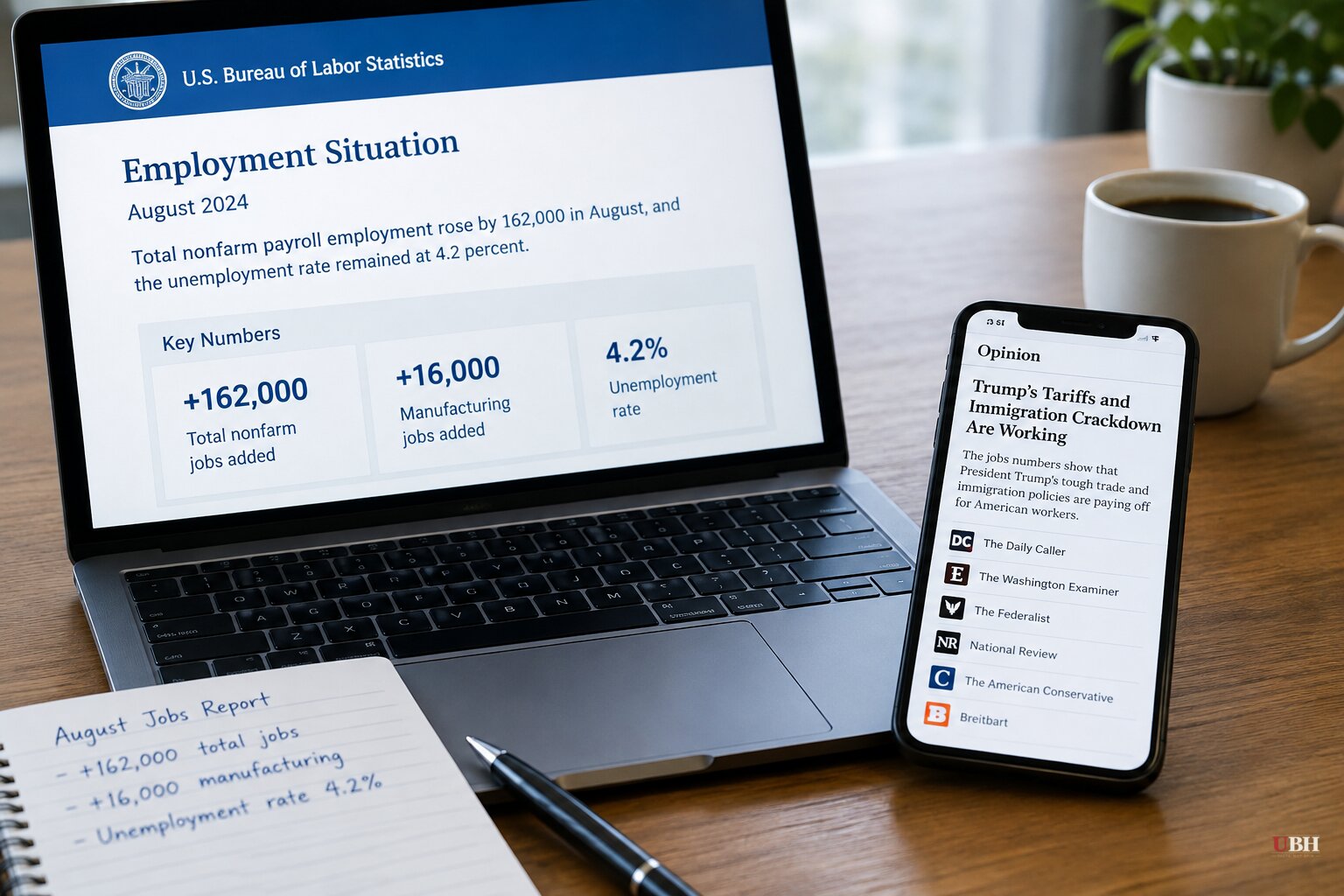
The U.S. economy added 162,000 jobs in August, and manufacturing employment rose by 16,000, according to figures cited in a column by Daniel McCarthy that ran in Chronicles Magazine between September 8 and September 12, 2026. The New York Times reportedly called the numbers "zesty," quoting T. Rowe Price's chief U.S. economist Blerina Uruci, who said "it's a very good report; I can't emphasize that enough," adding that it "perhaps shows that financial conditions more broadly are not that tight."
Those numbers are real and worth taking seriously. What's less clear is the causal story McCarthy built around them and how that story got amplified.
The Same Column, Six Times
McCarthy's piece, titled "Jobs and Manufacturing Are on the Ballot," ran nearly word-for-word in the Daily Signal, RealClearPolitics, the Patriot Post, Hot Air, RealClearPolicy and the Epoch Times over a four-day span. A Ground News aggregation of the coverage found roughly 80% of outlets carrying the story lean right, with the Dominion Post and PJ Media also picking it up. A related McCarthy byline ran in the New York Post under the headline "Trumponomics Triumphs In Jobs Rpt., Just In Time."
This is one opinion columnist's framing getting distributed across a conservative media ecosystem that largely agrees with him already. Readers seeing the same argument in six places might reasonably assume it reflects broad consensus. It doesn't. It reflects one writer's interpretation, published widely.
What the Numbers Actually Show
Citing a column by Peter Navarro, former director of the White House Office of Trade and Manufacturing Policy, published in RealClearMarkets, McCarthy reports that manufacturing employment rose 16,000 in August, with 15,000 of that coming from durable-goods manufacturing. For the year, manufacturing employment is up 58,000, driven by a 94,000-job gain in durable goods.
Do the subtraction and something doesn't add up cleanly for the industry as a whole. If durable goods alone gained 94,000 jobs this year but total manufacturing employment only rose 58,000, that implies non-durable goods manufacturing lost roughly 36,000 jobs over the same period. Neither McCarthy's column nor Navarro's, as cited, addresses that gap. The "manufacturing is roaring back" narrative has a real wrinkle here that deserves explanation, whether that's automation, export competition, or something else in food processing, textiles, or chemicals.
The Causal Leap
McCarthy credits the hiring gains to Trump's tariffs and his immigration crackdown, arguing companies can no longer as easily "abandon Americans by hiring foreign workers instead." He also argues that legal challenges to the tariffs, which he calls "lawfare," created business uncertainty that nonetheless failed to derail the agenda.
These are contestable claims, not established facts. A single month of manufacturing job growth following a durable-goods-heavy pattern doesn't prove tariffs are the driving mechanism, and McCarthy's column doesn't cite specific company decisions, import-substitution data, or hiring-by-industry breakdowns linking tariff policy to the August numbers. A reasonable critic would note that monthly labor data is volatile, that one strong report doesn't reverse a multi-decade manufacturing employment trend, and that attributing a 16,000-job monthly gain to a specific set of trade and immigration policies requires more evidence than a topline number.
The underlying data points, the 162,000 overall jobs added, the 16,000 manufacturing gain, the workforce participation rate increase, and Uruci's on-record assessment that the report is strong, are genuine and worth reporting straight. The underlying issue is whether one columnist's tariff-and-immigration causal story, repeated across six outlets in four days, has been established or merely asserted.
The next monthly jobs report, due in early October, will show whether the durable-goods gains McCarthy highlights continue or whether August was a one-month blip. With midterm elections roughly two months away, both parties will be watching that number closely, and so will the same outlets that ran this argument the first time.
Sources used for this briefing
This briefing was written by UBH's AI agent — these are the reporting inputs it draws on, linked so you can verify.


