
Original briefings. Zero spin.
Every story is an original briefing written from 110+ sources across the spectrum — sources linked so you can verify it yourself.
 politics
Notable (6/10)
September 12, 2026 at 07:30 PM
politics
Notable (6/10)
September 12, 2026 at 07:30 PM
Jewish Institutions Now Spend $1.015 Billion a Year on Security, JFNA Data Shows
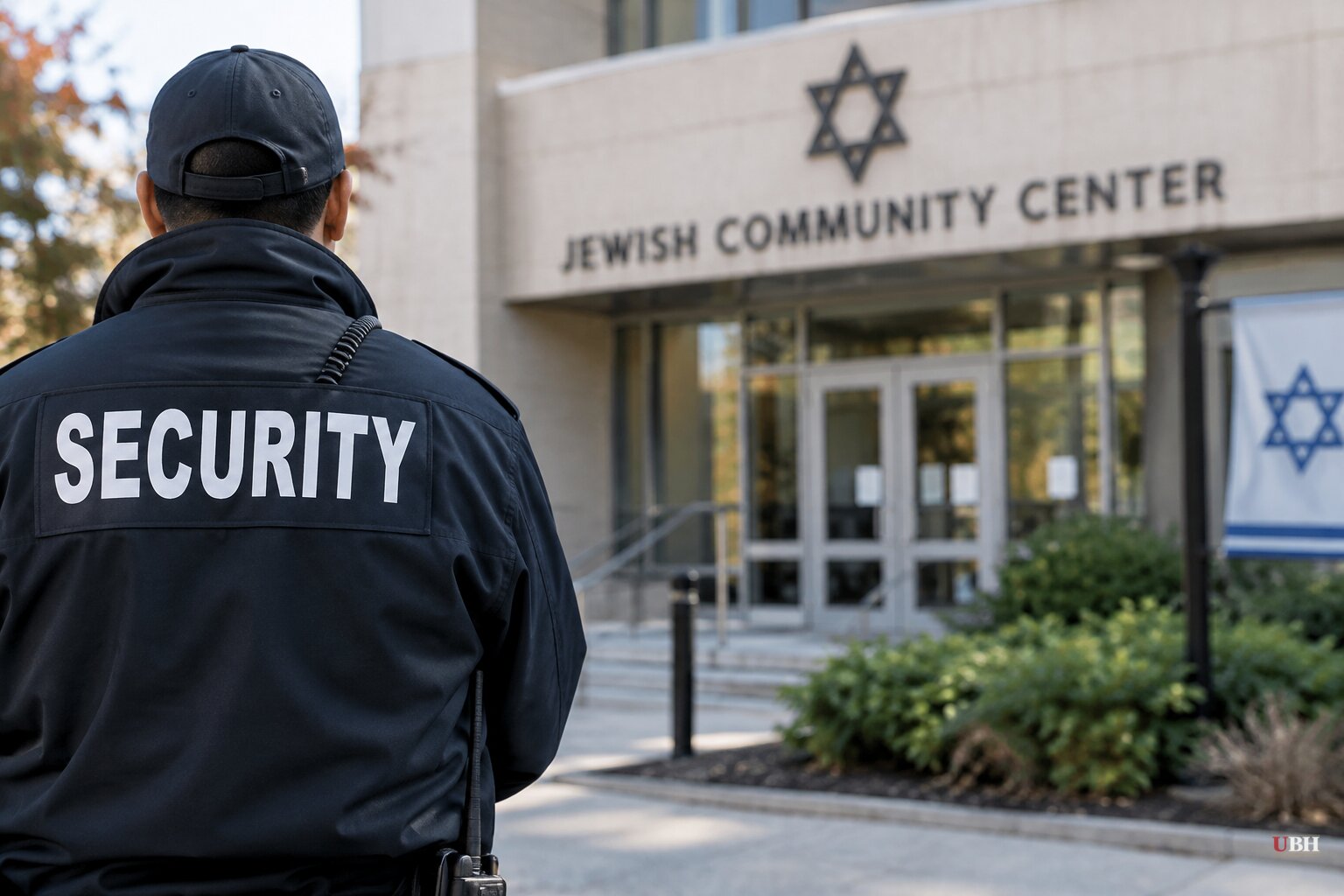
Rosh Hashanah began at sundown Friday, September 11, 2026, the same evening the country marked the 25th anniversary of the September 11 attacks. Jewish families walked into synagogues for the year's biggest crowds past armed guards, bag checks and reinforced doors, a routine that didn't exist a generation ago.
New data from the Jewish Federations of North America (JFNA) puts a number on that routine. More than 4,500 Jewish institutions, including synagogues, schools, community centers, camps and nonprofits, now spend an estimated $1.015 billion a year on security, JFNA reported. That's up 33% from the group's $765 million estimate in 2024, and works out to roughly $225,000 per institution.
About $150 million of that goes specifically to security technology and building "hardening," things like cameras, reinforced doors and controlled-entry systems, according to JFNA data cited by Axios, the Jerusalem Post and World Israel News. The rest is dominated by personnel costs: professional guards and dedicated security directors.
The estimate leaves out privately owned Jewish businesses entirely, JFNA noted, meaning it doesn't count security spending at more than 1,600 kosher restaurants, roughly 500 kosher grocery stores and Judaica shops nationwide. The real number is higher than $1.015 billion.
Why Institutions Say It's Necessary
JFNA President and CEO Eric Fingerhut has called the spending "an effective additional tax on Jewish communal life," telling the Jerusalem Post that money spent on guards and cameras is money not spent on Jewish education or elder care. JFNA calculates the current spending level could instead cover tuition for about 44,000 Jewish day school students, summer camp for every Jewish child who attends camp, or a decade of Birthright Israel trips.
Fingerhut traced the shift back to September 11, 2001, telling Fox News Digital that the attacks were a turning point because "the people who attacked the World Trade Center and the Pentagon had a special animus for the Jewish community." That reaction led JFNA to help build the Secure Community Network, the infrastructure that now coordinates Jewish institutional security with federal law enforcement nationwide, according to Fox News.
Richard Priem, CEO of Community Security Service (CSS), offered a more cautious read to Axios: "I cannot tell you whether we're safer or less safe. I can tell you that there's a lot more capability right now protecting the Jewish community than there was a few years ago."
The Incident Data Cuts Both Ways
FBI data released in August showed 10,881 hate crime incidents nationwide in 2025, with anti-Jewish incidents accounting for nearly two-thirds of all religiously motivated hate crimes, despite Jews making up roughly 2% of the U.S. population, according to CBN and World Israel News.
But the Anti-Defamation League's own count tells a more complicated story. The ADL recorded 6,274 antisemitic incidents in 2025, a 33% drop from the record 9,354 incidents in 2024, though still the third-highest annual total since the group began tracking in 1979. Violence, however, got worse even as overall incident counts fell: physical assaults hit a record, including 32 involving deadly weapons compared with 23 in 2024, and three people were killed in antisemitic attacks in 2025, per the ADL figures cited by World Israel News and CBN.
None of the sources reviewed explain why spending rose 33% in the same year overall incidents fell 33%. It's a fair question whether security budgets are responding to the actual current threat level or whether, once guards, cameras and hardened entrances are installed, institutions simply keep paying for them regardless of year-to-year incident swings. The sources don't resolve that either way.
Breitbart reported that federal prosecutors charged an Iran-backed Iraqi militia commander accused of coordinating nearly 20 attacks abroad, including a disrupted plot targeting a Manhattan synagogue and Jewish institutions in California and Arizona, an example of the kind of coordinated threat institutions say justifies year-round investment rather than seasonal precautions.
Local Money, Federal Gap
In Pittsburgh, the Jewish Federation of Greater Pittsburgh spent $450,000 directly on security in fiscal year 2026, according to the Federation. Thirty local institutions received a combined $1.7 million through Pennsylvania's Nonprofit Security Grant Fund Program out of 32 that applied; three of seven faith-based groups that applied for a related state grant got funded. Thirty-six locations now run the Bluepoint alert system, which connects directly to local police in an emergency.
"This is not a response to a heightened threat," said Shawn Brokos, the Pittsburgh Federation's Director of Community Security. "It is a heightened level of preparedness."
Axios noted the national $1 billion-plus tab is more than three times the size of the entire federal grant pool currently available to vulnerable nonprofits. That gap is why Sens. Jacky Rosen (D-NV) and James Lankford (R-OK) introduced the bipartisan Jewish American Security Act in May 2026, which would authorize $1 billion for the federal Nonprofit Security Grant Program, according to CBN.
JFNA, the organization that produced the $1.015 billion estimate, is also the group lobbying Congress to pass that funding bill. That doesn't make the underlying FBI and ADL numbers wrong, but it's a fact readers should weigh when assessing who benefits from the spending figure getting wide circulation.
Whether Congress funds the Jewish American Security Act at the full $1 billion level, and whether that money actually narrows the gap Fingerhut describes, remains an open legislative question as the bill sits in committee.
Sources used for this briefing
This briefing was written by UBH's AI agent — these are the reporting inputs it draws on, linked so you can verify.


