
Unbiased headlines. Facts, not spin.
Unbiased Headlines is an independently owned news organization. We bring you the facts, not opinions, written fresh from 110+ named sources. Sources linked so you can verify it yourself.
 finance
Notable (6/10)
Event date: October 13, 2026 ·
finance
Notable (6/10)
Event date: October 13, 2026 ·
JPMorgan and Goldman Raise Yield on Volta's $5 Billion AI Loan to Roughly 11.2% to 11.75%
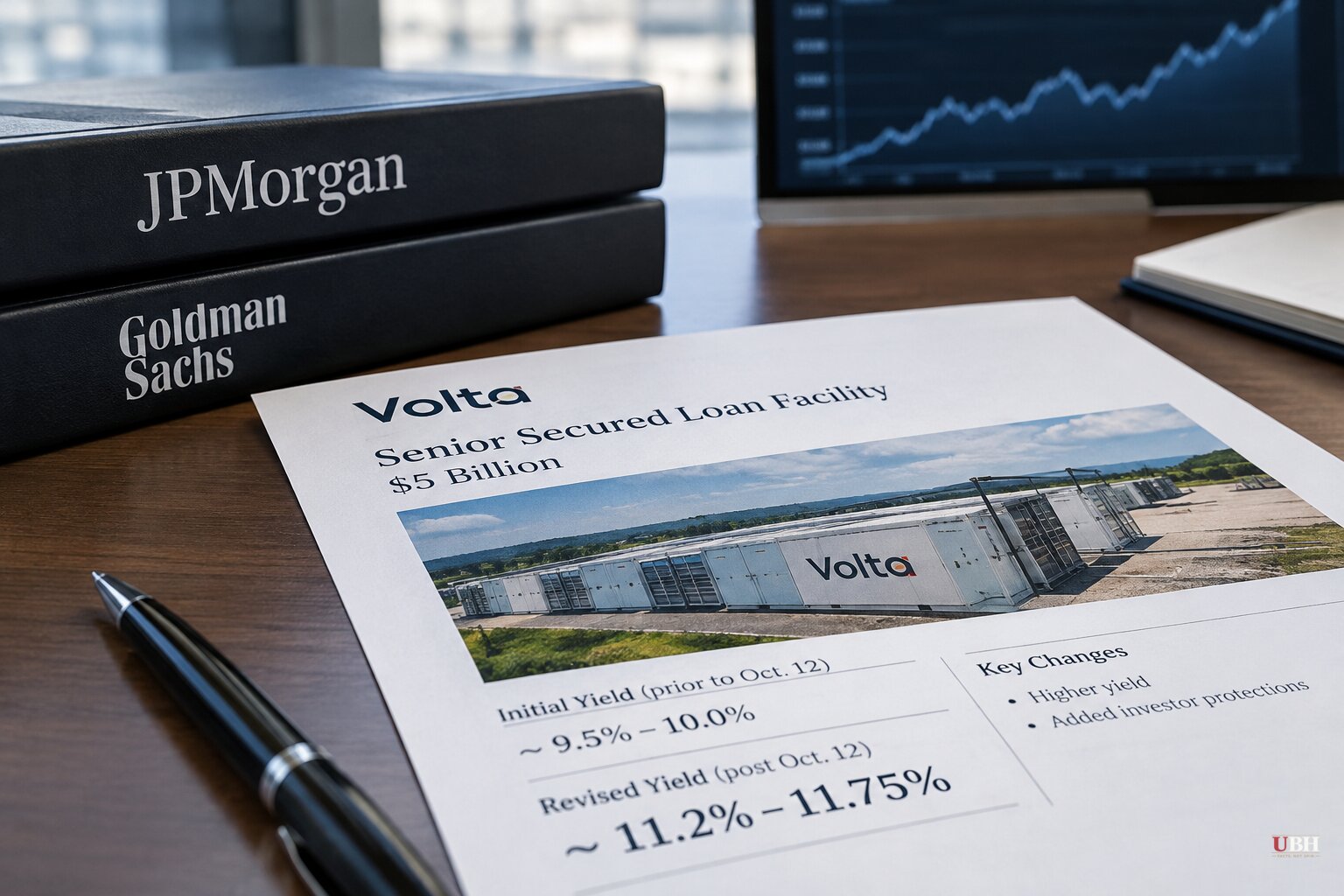
Since Oct. 12, when JPMorgan Chase and Goldman Sachs were reported to be limiting their exposure on a $5 billion loan for AI cloud company Volta Infrastructure Holdings, the banks have sweetened the deal. Pricing is now set at SOFR plus 625 to 650 basis points, with an original issue discount of 95 to 98 cents on the dollar. Together that works out to yields of roughly 11.21% to 11.75%, according to Crypto Briefing's report on the revised terms.
The loan was relaunched around Oct. 9 after demand at the earlier, lower yield levels proved insufficient, according to that report. Commitments were due Oct. 14.
How the package is built
The full package comes to $5.012 billion and splits in two.
The first piece is a $1.3 billion first-lien term loan that the two banks have underwritten. Proceeds cover lease payments to Bitdeer Technologies Group, the Bitcoin miner that operates the Norway data center site.
The second is a $3.712 billion loan tied to GPUs, sold on a best-efforts basis. The banks are not obligated to fund it if buyers don't show. It would pay for roughly 36,000 Nvidia chips.
The revised terms also include a two-year non-call period, so Volta cannot cheaply refinance early. Lenders lock in the high yield for at least that window.
Why investors pushed back
Bloomberg reported that the deal drew more than $5 billion in orders, mostly from private credit investors, hedge funds and mutual funds. How that demand splits between the two loans was unclear. Because the loan is unrated, collateralized loan obligations, a major source of demand in the leveraged loan market, would ordinarily be barred from participating.
Other people familiar with the matter said some investors had reached their limits on data-center debt and demanded more security and a higher rate. They said a $1.5 billion order from Apollo would anchor the deal. JPMorgan, Goldman and Apollo declined to comment. Volta did not respond to requests for comment.
Objections centered on two points, according to those people. Volta has no track record, and the Norway site is its first significant project. And Volta relies on Anthropic to buy much of the site's computing capacity.
The Anthropic question
That customer is Anthropic, which signed a $10 billion, six-year agreement in August for capacity at the 133-megawatt site. The site is powered by Nvidia's Vera Rubin chips.
People familiar with the matter said Anthropic shares little financial information with lenders, and some investors viewed the exact size of its obligations as unsettled. Anthropic did not respond to requests for comment.
The loan includes rate step-downs if Anthropic obtains an investment-grade rating. In effect, part of Volta's borrowing cost is pegged to the credit quality of its tenant.
The Financial Times reported last month that IPO advisers for Anthropic and OpenAI were lobbying rating agencies for blue-chip status. Such a rating would be almost unheard-of for companies as unprofitable as the two labs, according to that report.
The numbers around it
Volta was founded this year by former Brookfield Asset Management executives Ricard Boada and Sofia Gumuzio. It has raised $300 million across a seed round and Series A financing at a $2.4 billion valuation. Backers include Andreessen Horowitz, Altimeter, Azora and Nvidia.
The $5 billion debt package dwarfs that $300 million equity cushion several times over.
CoreWeave, Lambda and Crusoe have each tapped the chip-backed loan market before, though none paid yields as high as Volta's, according to Bloomberg.
Banks defend this kind of structure as a response to risk, not a retreat from the AI boom. People familiar with the deal told Bloomberg that financing new or untested companies requires less conventional underwriting structures, and that the banks are trying to avoid a repeat of 2022, when rapid rate hikes left them holding debt they couldn't sell. The $1.3 billion first-lien tranche is backed by the banks' own commitment, and the term loan is secured by first-lien priority.
More than $450 billion in AI-related debt deals have been completed so far this year. Investors and bankers say deals are still getting done, but less smoothly, with higher rates and more heavily negotiated terms.
What comes next
Lenders were still discussing allocations, according to people familiar with the deal, so financing details could change. JPMorgan, Goldman and Volta declined to comment.
The open question is how the $3.712 billion GPU tranche, the piece the banks did not backstop, ultimately gets filled. How it clears will show how much appetite remains for debt backed by chips and a single AI customer.
Sources used for this briefing
6 links from 5 independent newsrooms (syndicated copies of the same report count once)
These are the sources it draws on, linked so you can verify.


