
Unbiased headlines. Facts, not spin.
Unbiased Headlines is an independently owned news organization. We bring you the facts, not opinions, written fresh from 110+ named sources. Sources linked so you can verify it yourself.
 finance
Major Story (8/10)
finance
Major Story (8/10)
Nasdaq Falls About 2% and Is On Pace for Its Worst Week Since June as AI Stocks Slide Again
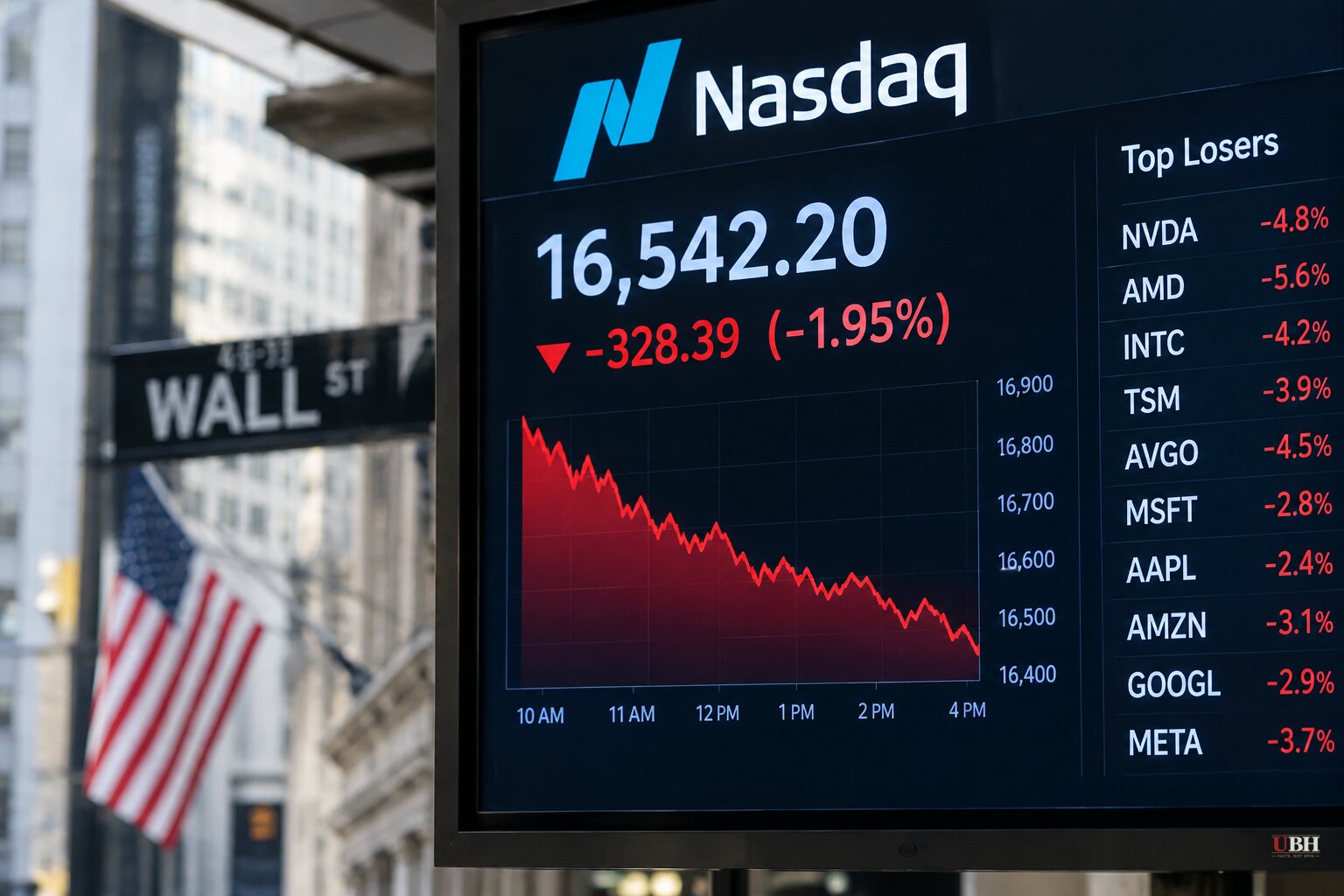
Since Wednesday's Oct. 14 rout in AI-linked stocks ended a 53-session stretch without a 1% drop in the S&P 500, the selling has not let up. By mid-afternoon Friday, Oct. 16, the Nasdaq Composite was down about 2%, on pace for its worst week since June.
The S&P 500 was off roughly 1% to 1.2% on the day and about 2% on the week. The Nasdaq has lost more than 4% since Monday. The Dow Jones Industrial Average was down about 0.5%, or 268 points at one point, but is still up less than 1% for the week. That makes it the only major index headed for a weekly gain.
Where the damage is
Communication services fell 2.7% and information technology fell 2.4%, the two worst of the 11 S&P 500 sectors. Consumer discretionary slid 1.5%. Energy was the exception, with Chevron helping hold the Dow's losses in check.
The VanEck Semiconductor ETF (SMH) is down about 8% for the week, led lower today by Micron, Advanced Micro Devices and Sandisk. That is on track for its biggest weekly decline since July.
Thursday's session was no relief for chips. The closely watched semiconductor index fell 0.88%, its seventh straight daily drop, even as the Dow gained 556 points, or 1.08%, and the S&P 500 rose 0.33%. The chip index is down roughly 20% from its June peak. It is still up 61% for the year, according to figures from the PHLX Semiconductor Index.
South Korea's KOSPI, heavily exposed to memory chips, plunged almost 8% on Thursday and has dropped 18% over five sessions. LPL Financial's Adam Turnquist said the country's "concentrated exposure to memory leaves it more vulnerable to competitive threats, positioning unwinds, and shifts in the memory cycle."
The debt question
The sharpest stress is in the AI borrowers. CoreWeave shares were down about 10% Friday, taking the week's loss past 23%. The company's total debt has risen above $51 billion.
The yield to maturity on CoreWeave's 9.625% bond due 2032 jumped to 14.8% this week, and its 9.75% bond due 2031 hit 14.9%. Credit-default swaps are pricing in better than a 50% chance of default within five years. Oracle also fell sharply Wednesday on concerns about borrowing costs tied to the AI buildout.
CoreWeave's CEO pushed back, saying the market is acting "irrationally" and that the company has enough order backlog to service its obligations.
Michael Rosen, chief investment officer at Angeles, said debt issuance is something to watch if it reaches "levels of excessiveness." But he said, "we're not remotely close to that right now."
Gabelli Funds portfolio manager Hendi Susanto argued the fundamentals are intact. "It is the expectations that are fragile," he said, adding that suppliers are expanding capacity because they see orders coming.
There are other warning signs on the demand side. Taiwan Semiconductor CEO C.C. Wei told analysts Thursday that rising component prices and macroeconomic uncertainty were challenging demand in some segments. TSMC shares closed 2% lower despite strong earnings. Saxo strategist Neil Wilson cited valuations, Chinese competition, inflation and rates, along with signs of slower revenue growth at Anthropic and OpenAI. Multiple outlets reported that Anthropic told investors ahead of its planned IPO that sales grew 45% to $17 billion last quarter.
Oil and inflation add pressure
The tech selloff is landing on top of an energy shock. West Texas Intermediate rose about 2% to above $100 a barrel and Brent gained 3% to above $109. The U.S. and Iran have not reached an agreement to end the war.
Wholesale inflation this week posted its biggest monthly gain since 2022. Core producer prices, which strip out food and energy, rose 0.7%, above estimates. Consumer inflation remains well above the Fed's 2% target.
The 10-year Treasury yield was about 5.09% Friday, down from 5.10% Thursday. It topped 5.30% earlier this month, the highest level since 2002.
What comes next
Fed Chairman Kevin Warsh spoke at an IMF event in Bangkok overnight. He did not say whether the Fed would raise rates before year-end. Traders read that as a sign of a hold. The CME Group's FedWatch tool shows an 85% chance the Fed leaves its overnight rate unchanged at its Oct. 27-28 meeting.
Earnings from Tesla, Meta Platforms and Procter & Gamble are still ahead. Analysts expect quarterly earnings growth of more than 30%, led by AI-related megacaps. That raises the question of whether those results can show AI spending holding up through 2027.
Sources used for this briefing
7 links from 7 independent newsrooms (syndicated copies of the same report count once)
These are the sources it draws on, linked so you can verify.


