
Unbiased headlines. Facts, not spin.
Unbiased Headlines is an independently owned news organization. We bring you the facts, not opinions, written fresh from 110+ named sources. Sources linked so you can verify it yourself.
 finance
Major Story (8/10)
Event date: October 14, 2026 ·
finance
Major Story (8/10)
Event date: October 14, 2026 ·
Default Insurance on CoreWeave and Oracle Debt Hits Record Highs as CoreWeave CDS Tops 1,100 Basis Points
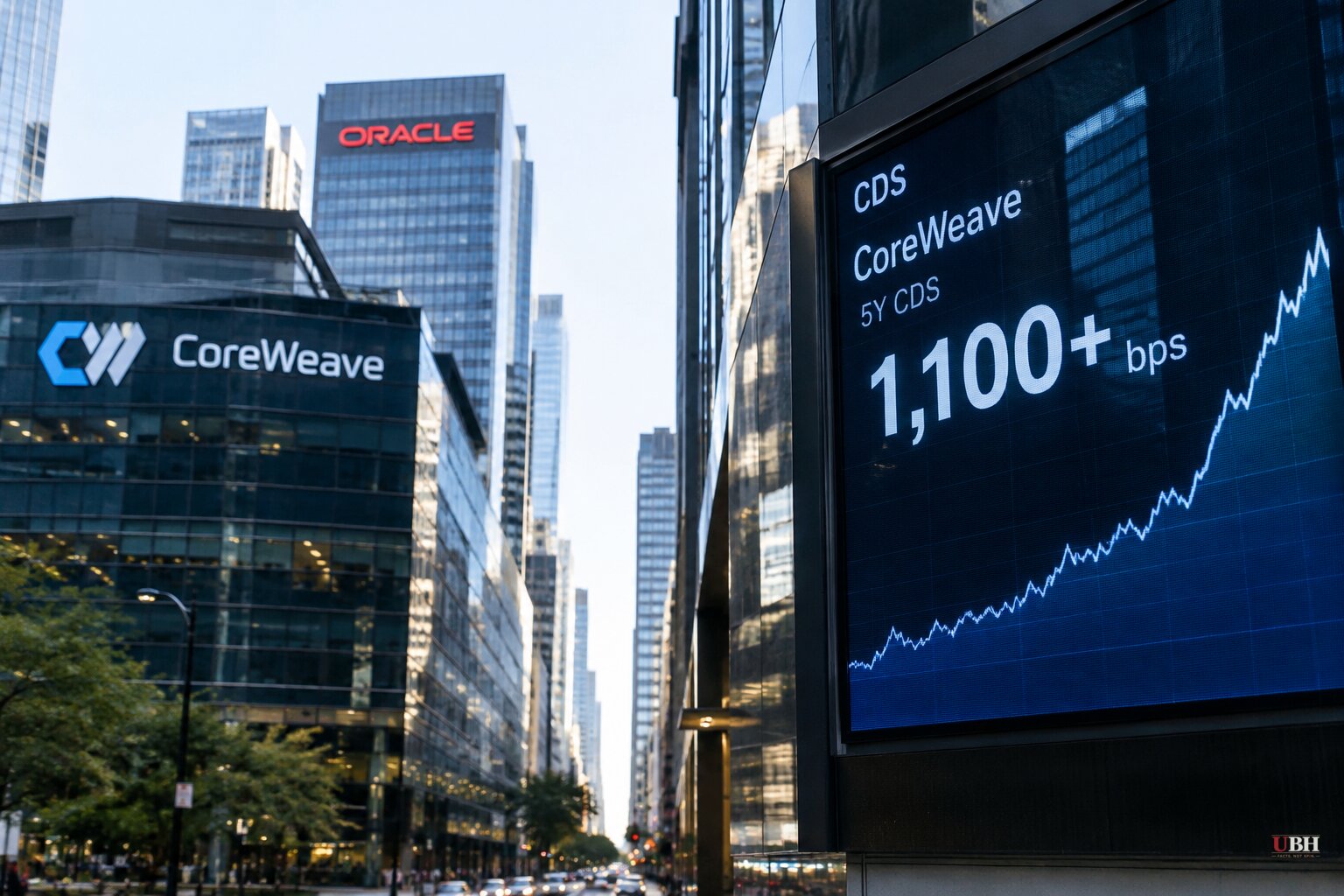
Since CoreWeave's shares and bonds began sliding this week, the stress has spread into the derivatives market: the cost of insuring against tech defaults hit record highs on Thursday, Oct. 15, according to LSEG and S&P Global Market Intelligence data.
CoreWeave and Oracle lead the move
CoreWeave's five-year credit default swap (CDS) spread blew past 1,100 basis points, per S&P Global Market Intelligence. A CDS is an insurance contract on a company's bonds. The wider the spread, the more the market is charging for protection.
At that level, the pricing implies roughly a 64% chance of default over the next five years. A year ago the implied figure was about 30%.
The yield on CoreWeave's 2031 bond rose as high as 16% before retreating to around 14%. The company is loss-making and owes nearly $50 billion, according to LSEG data.
CoreWeave stock fell another 2% on Thursday after a 15% slide Wednesday. That is nearly a fifth of its value in two days. The shares are still down only about 10% for the year. Rival Nebius, which has no publicly tradable CDS, is up about 114% over the same period.
"CoreWeave is quickly becoming the AI trade's canary in the coal mine," said Kathleen Brooks, research director at XTB.
Oracle's CDS neared 300 basis points, up about 31 basis points this week. Its reported debt load is about $160 billion. Earlier this year S&P cut its rating to BBB-, the lowest investment-grade rung, citing uncertainty around its AI spending. One more notch down is junk, a category many institutional buyers cannot hold.
CDS on Nvidia, STMicroelectronics and SpaceX also rose sharply. Spreads for Amazon, Alphabet and Meta traded at record highs too, though they have climbed far more slowly than Oracle's or CoreWeave's.
Inflation and rate-hike bets raise the cost of carrying the debt
The trigger is a hotter-than-expected U.S. inflation report. Consumer prices rose 3.7% last month, the last reading before the midterms. The report strengthened bets that the Federal Reserve will raise interest rates further.
On Wednesday, Oct. 14, the S&P 500 fell 1.11% and the Nasdaq Composite fell 1.88%, each its worst day since July. Oracle dropped 8.8%, Dell 11.3% and Marvell 8.7%.
A benchmark semiconductor index fell 4.3% and is down roughly 12% over the past week. Nvidia is down roughly 7.5% from the record high it hit earlier this month.
Chip stocks were also rattled after China's CXMT announced progress on advanced memory chips. That raised competition worries for U.S. and South Korean manufacturers whose outlooks, analysts say, are "priced to perfection."
Higher yields make the data-center buildout more expensive to finance. That hits the debt-heavy corners of the AI industry hardest. AI infrastructure demands huge upfront capital, with revenue expected later.
The borrowing binge behind the hedging
Oracle, Broadcom and SpaceX have priced nearly $500 billion in new AI-related debt in 2026, according to Crypto Briefing. The same report says Broadcom could need around $600 billion more in funding over the coming years.
SoftBank sold a record $11 billion in junk bonds last month, promising its highest-ever yields. CEO Masayoshi Son has backed OpenAI with $64.6 billion in total. SoftBank has become a bellwether for AI sentiment.
Broadcom CEO Hock Tan compared the investor rush into anything AI-related to casino gambling earlier this week.
What the numbers do and do not show
None of the companies whose CDS have widened has defaulted or signaled that it might, Reuters noted in its explainer. Shares in AI-driving companies are still among the biggest gainers on global equity markets this year.
The CDS market is also small relative to the debt it covers. Single-name CDS total about $9 trillion, according to the International Swaps and Derivatives Association. Global debt securities outstanding exceed $150 trillion, according to Bank for International Settlements data. Daily trading across the CDS market averaged $16 billion in the second quarter, per the Depository Trust & Clearing Corporation. Trades in individual names can be sparse, sometimes in the single digits per day.
The revenue side of the ledger is not empty either. An investor who attended a pre-IPO meeting with Anthropic's leadership in San Francisco on Wednesday said third-quarter revenue rose 45% from the previous quarter to $16.8 billion. Anthropic is targeting a $2 trillion valuation. The revenue surge did little to calm markets, according to Reuters.
Steve Sosnick, chief strategist at Interactive Brokers, said there is "so much good news priced into the chip sector right now" that it is vulnerable without fresh catalysts. "Trees don't grow to the sky," he said.
Timing is the open question. Borrowing costs are rising now, while the revenue meant to repay the AI buildout is still arriving. Oracle's one-step cushion above junk is the nearest test of how far that gap can stretch.
Sources used for this briefing
7 links from 6 independent newsrooms (syndicated copies of the same report count once)
These are the sources it draws on, linked so you can verify.


