
Unbiased headlines. Facts, not spin.
Unbiased Headlines is an independently owned news organization. We bring you the facts, not opinions, written fresh from 110+ named sources. Sources linked so you can verify it yourself.
 finance
Major Story (7/10)
Event date: October 14, 2026 ·
finance
Major Story (7/10)
Event date: October 14, 2026 ·
Big U.S. Bank Stocks Head for Sixth Straight Weekly Loss, Longest Streak Since 2008
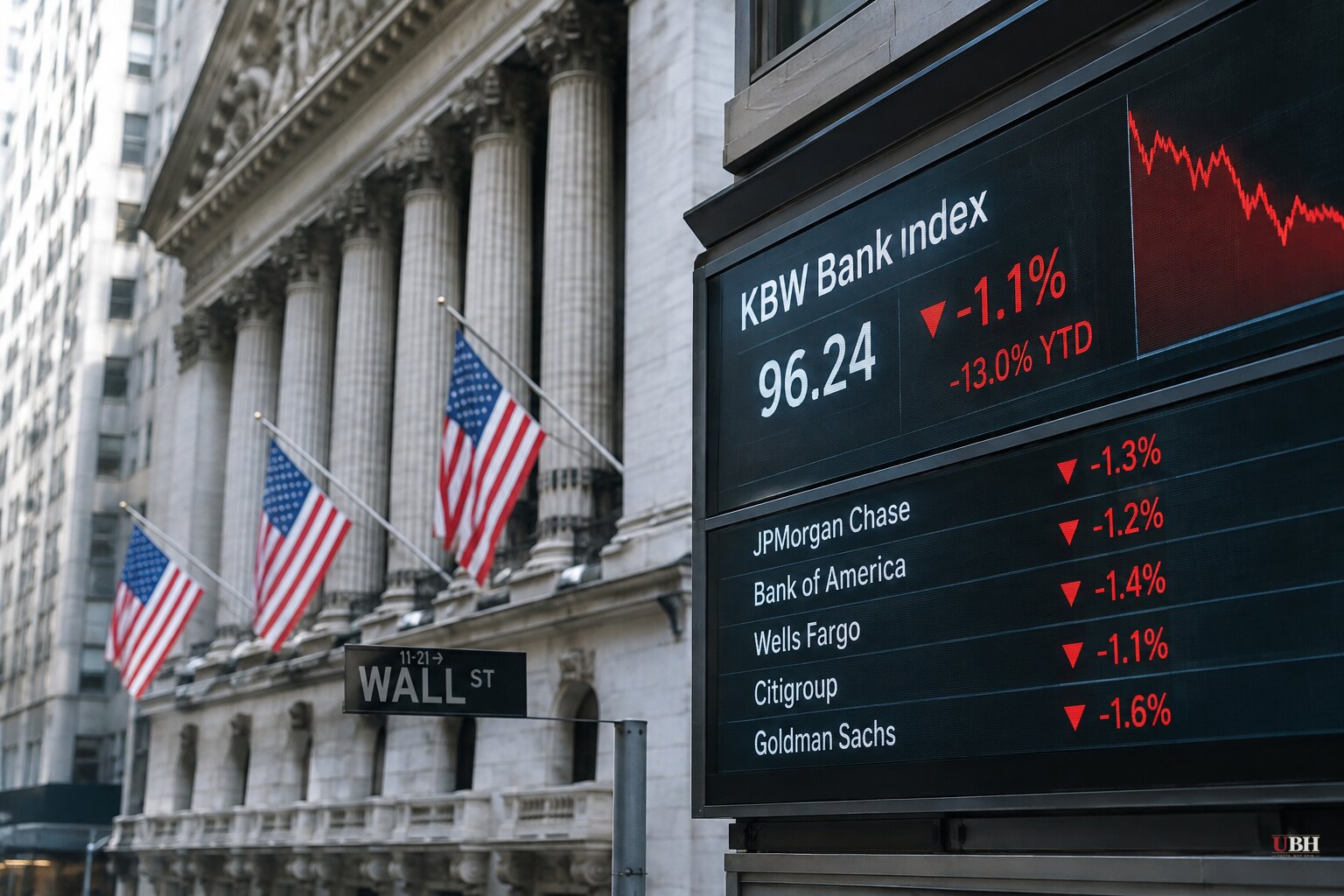
Since the Federal Reserve raised interest rates on Sept. 16, its first hike in three years, big U.S. bank stocks have slid steadily. They are now on pace to close this week, today, Oct. 16, with a sixth consecutive weekly loss. That would be the longest such streak since 2008.
The 24-member KBW Bank Index is down about 1.1% this week. It has lost roughly 13% since its record high in August, which is correction territory. The group has had bigger selloffs before, including a drawdown of almost 17% earlier this year.
Citigroup, State Street, Bank of America and Morgan Stanley are among the index's worst performers this week. JPMorgan Chase is up 1.7% over the same stretch.
A historic stretch of underperformance
Barclays analyst Jason Goldberg wrote in a Wednesday note that the index underperformed the S&P 500 on 18 of the 21 trading sessions after the Sept. 16 hike. He said nothing like that has happened in any rolling 21-session window since the index debuted in May 1992.
The pain has been broad. Over the month to Oct. 12, Bank of America had fallen 13%, Goldman Sachs 12% and Morgan Stanley 11%. Wells Fargo was off 7%, Citigroup 6.5% and JPMorgan 6%.
Earnings did not change the mood
The big banks reported third-quarter results Tuesday and Wednesday. Bloomberg Intelligence analyst Herman Chan said the results "did little to reverse the weakness, with stable operating leverage but mixed trading as fixed-income results disappointed despite strength in equities."
JPMorgan earned $5.57 per share against a market forecast of $5.90. Fixed-income trading revenue was $5.4 billion, about $550 million below the consensus estimate. The bank booked $658 million in securities losses and had $27.3 billion in expenses. Stripping out the securities losses, earnings would have been $5.75 per share.
Goldman Sachs earned $17.01 per share, up from $12.25 a year earlier and well above the $12.86 analysts expected. Net revenue was $18.68 billion. Equities revenue rose 72% from a year ago and investment banking fees rose 21%.
Citigroup posted $23.85 billion in revenue and $5.25 billion in profit, with earnings of $2.85 per share. Revenue was up 8% from a year earlier, its best third quarter in a decade. Citi also raised its full-year net interest income outlook.
Wells Fargo beat on earnings but missed on revenue. Its net interest margin, the spread between what it earns on loans and pays on deposits, stabilized at 2.43%, slightly ahead of expectations.
Why investors are selling anyway
Chan said big-bank stocks face "a confluence of concerns, with a higher-for-longer rate backdrop raising the risk of slower economic growth and higher loan losses." This week's hot inflation reading deepened unease over how hard the Fed will push to contain price pressures, according to Bloomberg.
Treasury yields have spiked above 5%. Evercore ISI strategist Julian Emanuel noted that financials have historically benefited from higher rates because they support net interest margins. Instead, he said, the sector "has fallen precipitously since yields have spiked above 5%."
Manulife John Hancock Investments strategist Matt Miskin described the squeeze: "higher yields can lead to better revenues, but they can also lead to a tipping point where consumers just can't pay these kinds of loans."
Dealmaking is another worry. Emanuel said OpenAI's IPO, once expected this year, has been pushed back to 2027, and Oura's offering has been delayed. He said that has "raised fears of a deteriorating funding environment." Chan added that AI companies face higher funding costs, which casts doubt on how long the capital-markets revenue tied to the AI infrastructure buildout can last.
Then there is technology risk. Chan said agentic AI could eventually threaten the cheap, steady deposits that underpin bank profits. Emanuel pointed to deposit competition from AI offerings that maximize cash yields, and to a consumer AI agent called Muse. Robinhood and Coinbase have also rolled out agentic trading tools for customers.
The case that the selloff is overdone
Not everyone reads the results as a reason to sell. CNBC's Jim Cramer called the universal negative reaction "strange" given a set of quarters with "plenty of positives." He said investors are worried about the future: "persistent inflation, rising interest rates, and newly wobbly capital markets."
Cramer said Citi's turnaround makes the pullback "a buying opportunity." His charitable trust upgraded Wells Fargo to a buy-equivalent rating, citing CEO Charlie Scharf's view that the bank is positioned to do better at higher rates.
Citigroup CEO Jane Fraser said the bank returned more than $4 billion to common shareholders and expects to exceed this year's return target. JPMorgan's management gave better-than-expected net interest income forecasts for the fourth quarter and 2027, according to the earnings call.
The Macro Paper team has flagged the bank index's weakness as a potential "major warning sign for the US stock market" if it keeps falling while the S&P 500 holds up. Whether the sixth weekly loss becomes a seventh will show in next week's trading. It will also show whether the earnings-season outlooks from JPMorgan and Citi can outweigh the rate and AI concerns.
Sources used for this briefing
7 links from 6 independent newsrooms (syndicated copies of the same report count once)
These are the sources it draws on, linked so you can verify.


