
Unbiased headlines. Facts, not spin.
Unbiased Headlines is an independently owned news organization. We bring you the facts, not opinions, written fresh from 110+ named sources. Sources linked so you can verify it yourself.
 finance
Major Story (8/10)
finance
Major Story (8/10)
Treasuries Poised for Best Week Since February as Yields Ease From Multi-Decade Highs
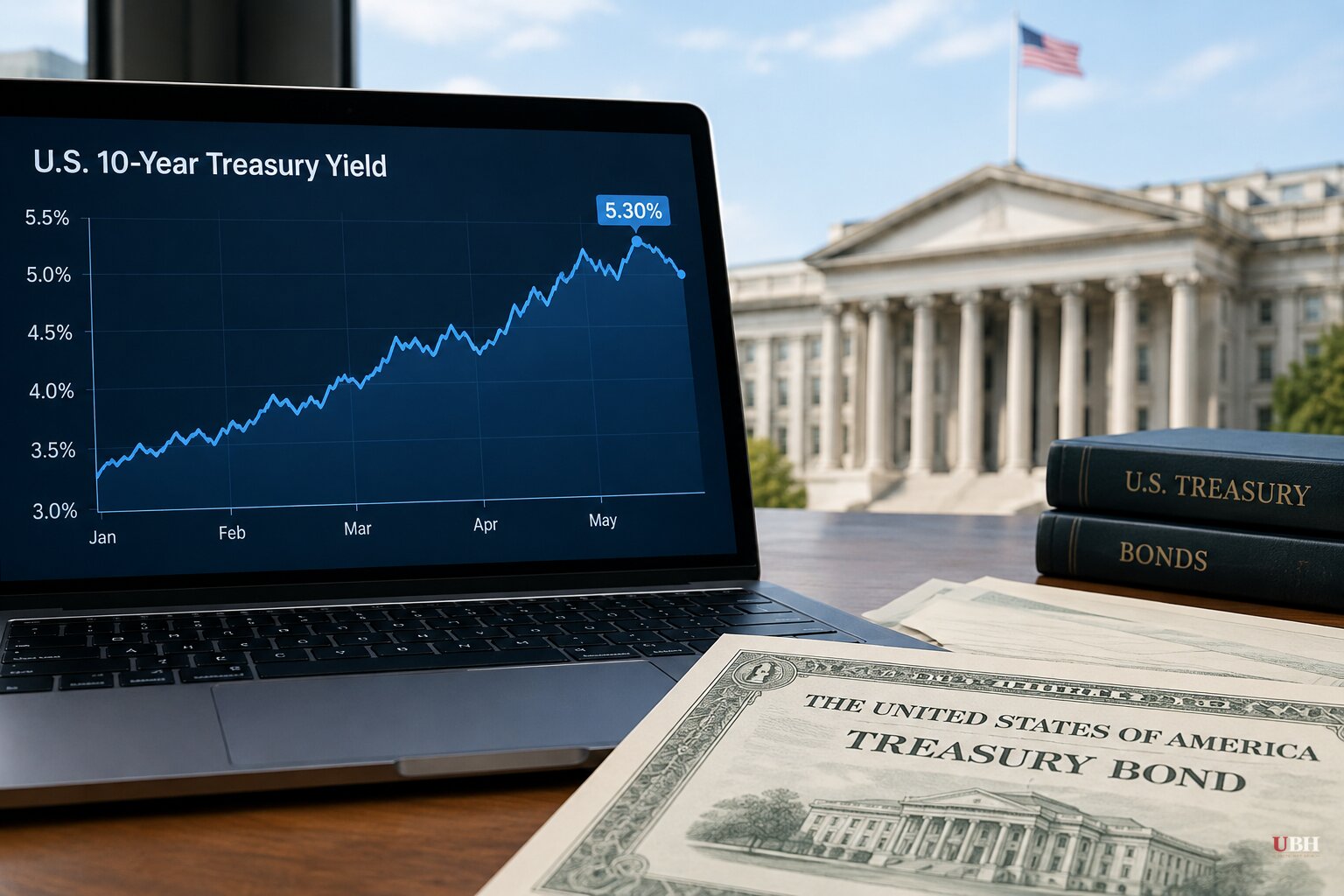
Since late February, the 10-year Treasury yield has climbed roughly 125 basis points, a run that took it above 5% and into territory not seen in decades. This week, that rout paused. Government bonds are on track for their best week since February, according to the Financial Times, as investors sought safety while tech stocks wobbled.
A markets wrap describes the week as a bruising one for technology shares, with U.S. stock futures rising afterward. The bond rally is the flip side of that nervousness.
How high yields got
On Sept. 25 the benchmark 10-year yield touched 5.2%, and the 30-year hovered around 5.5%. The Epoch Times, citing market data, said that was the 10-year's highest level since June 2007. CNN put the recent peak at a 24-year high, the highest since 2002. The sources disagree on the exact benchmark year, but they agree on the direction and the scale.
The auction results are the harder evidence. Treasury sold $728 billion of securities in one recent week across eight auctions, according to Wolf Street. Of that, $607 billion was T-bills and $121 billion was 3-year and 10-year notes plus 30-year bonds.
The 3-year note sold at 4.932%, the highest auction yield since May 2006 and up from 4.474% a month earlier. The 10-year sold at 5.30%, the highest since November 2000. All three long-dated auctions cleared at yields above anything seen in more than 20 years.
The auctions did not fail. Wolf Richter wrote that at those higher yields additional demand emerged and the market "breathed a sigh of relief that it wasn't any worse." The 10-year closed that week at 5.24%.
What is pushing yields
The Epoch Times cited war-driven inflation and fiscal fears. CNN noted lingering uncertainty over the war with Iran. The Federal Reserve has also raised rates, and officials have signaled more may come.
Fed Governor Michael Barr said in a Sept. 23 speech at a Chicago Fed event that policymakers "were out of position, and we made an adjustment in the right direction." He added: "In my base case, further policy adjustments are likely to be needed to ensure inflation comes down to target in a timely fashion." Cleveland Fed President Beth Hammack said on Sept. 24 that the labor market is "closer to my definition of maximum employment."
As of Sept. 25, CME FedWatch data showed a 69% probability of another quarter-point hike at the October meeting, per the Epoch Times.
The supply side is the part that should bother taxpayers. Washington is selling hundreds of billions of dollars of debt every week, and it takes yields above 5% to clear the 10-year. Wolf Richter framed the market's worry as a flood of new supply. Every point of extra interest on federal debt is money that cannot go to anything else.
The case that growth can absorb it
Not everyone treats the bond selloff as a warning. Giuseppe Sette, co-founder and president of Reflexivity, told the Epoch Times that activity measures like new-order PMIs show the U.S. is in "an extremely ebullient growth phase." The Atlanta Fed's GDPNow model projected third-quarter growth of 5%. Last month's durable goods orders were unchanged, better than the 0.4% decline economists expected.
Stocks have mostly agreed with the optimists. The S&P 500 closed at a record 7,819 on a recent Tuesday, its first record since mid-August and its first close above 7,800. The Nasdaq Composite hit back-to-back records. The Dow was still about 5% below its early-August high.
A narrow rally
The gains rest on a thin base. Per CNN, tech is the only sector up over the past month. Real estate, financials and materials each fell more than 4.5% as borrowing costs rose. Nvidia, with a market value near $6 trillion, accounts for more than 8% of the S&P 500.
"The breadth of the rally has narrowed," said Ulrike Hoffmann-Burchardi, a global head of equities quoted by CNN.
That concentration is why this week's tech wobble mattered. When AI stocks stumble, the index has little else holding it up, and money moves into Treasuries. Yields fall, but that relief comes from nerves, not from any change in the supply of debt.
What comes next
The Fed's October meeting is the next hard test. A second consecutive hike would add short-term pressure on the 3-year yield, which has already climbed about 150 basis points since February. Third-quarter earnings season is also getting under way, which will show whether the AI trade can carry the market while the other sectors absorb the cost of money at 5%.
Sources used for this briefing
6 links from 6 independent newsrooms (syndicated copies of the same report count once)
These are the sources it draws on, linked so you can verify.


